Progressive prizes grow from contributions on connected slots, with game triggers and wager conditions shaping how the pool can be won.
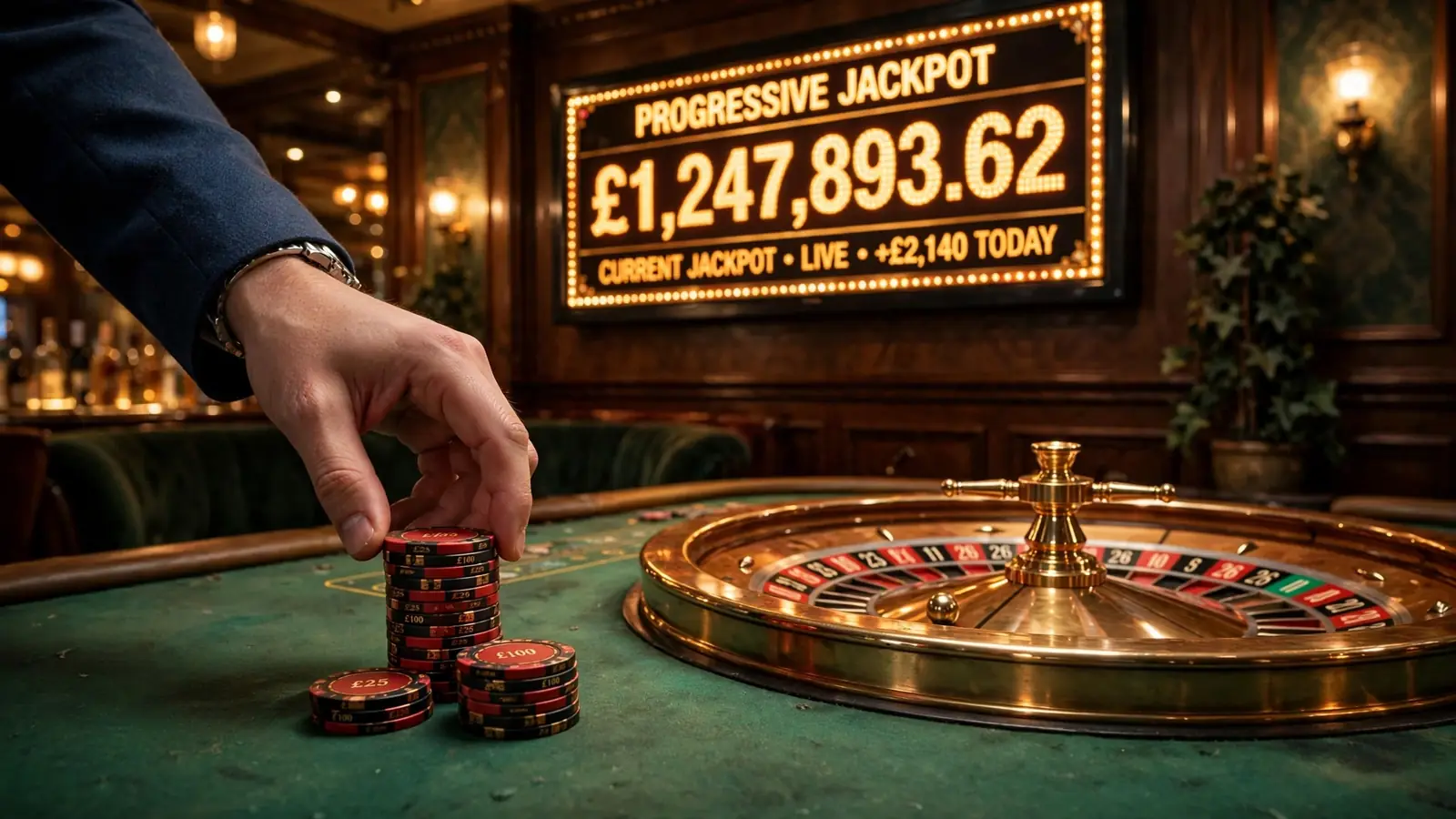
A progressive jackpot is built from play rather than fixed at a single advertised amount. With progressive jackpot casino slots, a small share of each wager is directed into a prize pool. The pool gathers contributions from wagers on connected machines, so its displayed value reflects money accumulating across that connected play. The mechanism is simple in outline, though the number on screen can make it feel almost like a character in the game: present, growing, and waiting.
The contribution is typically between 1% and 3% of each wager. That share is assigned to the jackpot pool; it is not the whole stake, nor does every spin add the same cash amount when wagers differ. A larger wager can produce a larger contribution in monetary terms, while a smaller wager contributes less. The percentage range describes the share, not a promise about how quickly a jackpot will rise. Its pace depends on the wagers being made across the connected slots.
This is the distinction between an ordinary prize and a progressive one. An ordinary prize is set within the game’s payout structure. A progressive prize has an accumulating element: contributions enter a shared pool as play takes place. The value therefore changes with activity, rather than remaining at one fixed figure. Players see the visible result, but behind it is a stream of small allocations from many wagers.
Progressive jackpot slots can make a session especially exciting, but it helps to consider practical details alongside the prize potential. This list offers a quick reference for players exploring their options in 2026.
Zombillion
Zombillion lists a payout speed of 1–3 business days, a practical detail to consider when choosing a site for progressive jackpot slots.
Amunbet
Amunbet lists a payout speed of 1–3 business days. This gives players a stated timeframe to consider alongside their interest in progressive jackpot slots.
Britsino
Britsino lists a payout speed of 1–3 business days, offering a clear practical detail for players considering progressive jackpot slots.
Chanze
Chanze lists a payout speed of 1–3 business days. Players interested in progressive jackpot slots can factor this stated timeframe into their choice.
SpinFormula
SpinFormula lists a payout speed of 1–3 business days, a useful detail to note when exploring progressive jackpot slots.
Dieselwin
Dieselwin lists a payout speed of 1–3 business days. This stated timeframe is one practical point for players to consider.
NightLuck
NightLuck lists a payout speed of 1–3 business days, giving players a clear detail to weigh when considering progressive jackpot slots.
Jetsetspins
Jetsetspins lists a payout speed of 1–3 business days. Players can consider this timeframe as part of their search for progressive jackpot slots.
x3bet
x3bet lists a payout speed of 1–3 business days, a practical point to keep in mind when exploring progressive jackpot slots.
WinBeast
WinBeast lists a payout speed of 1–3 business days. This gives players one stated detail to consider when choosing a site.
The word “shared” matters. A pool does not grow from one person’s session alone. Contributions from wagers placed on connected slot machines collect in the same fund. A single spin may add only a small amount, but the system gathers those amounts across connected play. The scale of the displayed jackpot is thus a record of pooled contributions, not evidence that any individual wager has a special relationship with the whole prize.
That collective structure also changes how the game is understood. The stake is still made by one player at a time, but part of it participates in a broader accumulation. The jackpot belongs to the game’s shared mechanism, not to a private pot created by one account. In progressive jackpot casino slots, an individual can contribute to a pool without controlling its size, its pace of growth or the activity taking place elsewhere on the connected system.
A contribution of 1% to 3% may sound modest, and per wager it is. Repeated across connected play, however, those allocations are what make a progressive figure possible. The pool’s growth is cumulative: each qualifying wager adds its allotted share, and the total reflects many such additions. This is why the jackpot can appear much larger than the contribution associated with any one spin. It is an aggregation, not a sudden windfall conjured by the machine’s display.
The percentage should not be confused with a forecast. It does not say how long a particular jackpot will take to reach a given value, or how much any one player will contribute over a session. Those outcomes depend on wager size and the volume of connected play. Nor does the contribution rate by itself describe the chance of winning. Funding and winning are separate parts of the arrangement: one explains how the pool grows; the other depends on the game’s own rules.
For someone looking at a progressive jackpot online casino, the visible total can suggest a single machine steadily filling its own reservoir. In fact, the important idea is the connection between slots and the common pool. Contributions made through connected machines accumulate together. The screen offers a neat number; the underlying activity is dispersed across wagers and players. The display simplifies the accounting. The money does not arrive as one dramatic deposit.
This model helps explain why progressive prizes are presented as moving totals rather than fixed awards. As contributions enter, the pool grows. The number shown is therefore tied to ongoing play, not simply printed into the game once and left unchanged. That movement can give the jackpot a public presence: its value is visible, while the individual contributions that form it are too small and numerous to notice one by one.
There is an unromantic arithmetic beneath the spectacle. A small fraction is set aside repeatedly, and connected play turns those fractions into a pooled prize. The drama belongs to the display; the growth belongs to accumulation. No single wager needs to carry the whole promise. It is the combined stream that gives the progressive jackpot its scale.
A search for progressive jackpot slots online can produce the impression that there is one stable catalogue waiting to be browsed. In practice, the games available depend on the operator. A specialist review reports that availability can also change when providers update their catalogues. A title found on one site may therefore be absent from another, or no longer appear where it was previously listed.
That makes availability a moving detail, not a permanent quality of a game. The name of a slot may remain familiar while the places offering it change. Providers maintain and revise their game catalogues; operators, in turn, decide which titles to carry. The result is a patchwork rather than a single, complete selection of online progressive jackpot slots.
The operator’s own games catalogue is the most direct place to establish what it currently offers. A general description of a site, an old review or a search result may describe a selection that has since changed. This is not necessarily a contradiction: the information may have been accurate when published, while the catalogue has moved on. Progressive slots are products in circulation, not fixtures in a permanent display case.
A game’s availability is shaped by two separate catalogues: the provider’s supply and the operator’s selection. A provider update can alter what is available for operators to carry; an operator’s catalogue determines what is presented on that particular site. These changes help explain why lists of online slots with progressive jackpots do not always match from one source to another.
It also explains why a list described as the best progressive jackpot slots online cannot be treated as a universal answer. The title may be attractive to one player and irrelevant to another, but before preference comes a simpler condition: whether the game is available through the operator being considered. A list compiled without that distinction can blur a game’s reputation with its current accessibility.
There is a quiet editorial problem here. Lists travel further than the catalogues they describe. A page can keep naming a slot after its availability has changed, giving the appearance of a live recommendation when it is only a record of an earlier selection. The catalogue itself is the more immediate evidence; older descriptions are useful only with their date and context in view.
A game title appearing in a catalogue confirms that it is listed there; it does not, by itself, answer every question about how it can be played. In particular, the words “free” and “progressive” should not be treated as interchangeable signals. A listing of a progressive game does not establish that it is available in a free-play mode. The distinction matters because a title’s presence and the conditions attached to a particular way of playing it are different pieces of information.
The same caution applies when comparing sites. A larger-looking catalogue does not establish that every listed title will remain available, nor that the same selection will be present elsewhere. The relevant point is narrower: availability varies by operator, and provider catalogue changes can alter it. Beyond that, the catalogue at the time of checking is more dependable than a claim that a particular game is universally available.
For anyone comparing online progressive jackpot slots UK operators list, the sensible comparison is therefore not a frozen ranking but a current catalogue. Titles come and go with the collections operators carry and the updates providers make. The game may persist in conversation after it has disappeared from a particular menu. That is the ordinary afterlife of a product: remembered longer than stocked.
A progressive prize can sit behind very different kinds of game event. In one slot, the jackpot may be triggered at random; in another, a particular combination may be required; elsewhere, the route runs through a bonus round. The shared label describes a prize that can grow, not a single set of rules for winning it.
That distinction matters because the screen can make unlike mechanisms look much the same. A jackpot meter is visible, but it does not tell the whole story of what must happen for the prize to be awarded. The trigger belongs to the game’s design. It may be a sudden event, a result formed by symbols, or a feature reached during play. The details are not interchangeable.
With a random trigger, the jackpot is awarded when the game’s chance-based mechanism selects that outcome. There need not be a visible combination that signals the prize is close. A sequence of ordinary spins, or a run without a jackpot, does not reveal that the next result is due. Randomness offers no readable countdown.
This can be difficult to reconcile with the way people interpret patterns. Repeated symbols invite a story; a near miss seems to point somewhere; a long wait can feel like it ought to be repaid. Yet a random trigger does not become more likely merely because it has not appeared recently. The screen may present the prize as a dramatic possibility, while the underlying condition remains a chance event rather than a puzzle to solve.
There is a quiet tension here. The player sees a game with rhythms and images, while the trigger may have no visible rhythm at all.
Other designs tie the progressive prize to a specified combination. In that case, the game makes the condition more legible: the required symbols or result are part of the route to the jackpot. That does not make the outcome controllable. It means only that the qualifying event has a defined form.
A combination-based trigger can encourage close attention to the reels, because the prize appears connected to what lands on them. But the existence of a stated combination should not be mistaken for a promise that it can be assembled through persistence or strategy. The design identifies what counts as a win; it does not make that win inevitable.
The exact condition varies by game. A general description of progressive slots cannot supply a universal symbol pattern, and one game’s rules should not be carried over to another. The paytable or game information is where the particular trigger is explained.
A third design makes entry into a bonus round part of the route to the progressive prize. Here the jackpot is not necessarily awarded by an ordinary spin alone: a feature must be reached, and the prize is associated with that feature. The bonus round is therefore part of the trigger, not merely a decorative pause in the base game.
Awarded when the game's chance-based mechanism selects the outcome, regardless of visible symbols or patterns.
Tied to a defined set of symbols or results that must land on the reels to trigger the prize.
Requires the player to first reach a specific feature or bonus round where the jackpot is then associated.
That distinction can be easy to miss. Bonus features often have their own visual language and smaller outcomes, but their presence does not mean every bonus round includes a progressive prize. Nor does reaching one, by itself, establish that the jackpot has been won. The game’s stated rules determine whether the feature is an entry point, a qualifying condition, or simply another part of play.
Across progressive jackpot slot games, then, the useful question is not simply whether a jackpot is displayed. It is what event the rules say awards it. Random selection, a specified combination and entry into a bonus round are different mechanisms, with different signs visible to the player and different limits on what can be inferred during play.
The largest progressive jackpot slots may attract attention because of the headline prize, but size alone says nothing about the trigger. A striking meter cannot explain whether a prize is random, combination-based or tied to a feature. The mechanism is in the rules. The spectacle is elsewhere.
A progressive slot machine can look like a solitary cabinet or a game on a screen, but a network jackpot belongs to a wider arrangement. When the same progressive slot game is carried by several operators, its network pool is shared across those operators. The machines are the visible points of play; the prize pool is the common feature linking them.
That distinction matters. A jackpot displayed within one game does not necessarily belong only to the operator hosting that particular session. In a networked arrangement, play on the same game across participating operators contributes to a pool that is not confined to one casino’s customers. The shared prize follows the game network rather than the walls of a single venue.
The machine itself is therefore less like a sealed box with a private prize and more like an entry point into a common system. A player may encounter the game at one operator, while another player encounters the same title elsewhere. If both operators carry that progressive game, the network jackpot is shared between them. Different screens; one pool.
This is not a claim that every progressive slot machine is connected to every other one. The connection described here is specific: operators carrying the same progressive slot game share its network jackpot pool. A different game has its own arrangement, and the word “progressive” alone does not make separate titles part of one network. Similar themes or matching symbols do not establish a shared prize.
The distinction can be easy to miss because the machine presents a complete little world: reels, symbols, a jackpot display. The display makes the prize feel local. The underlying pool may not be. The game’s network relationship crosses operator boundaries, while the player sees only the version offered in the current account or venue.
It also helps to separate the network from the operator. An operator makes a game available to its customers; the network pool connects operators that carry that same title. The shared jackpot is not simply a collection of unrelated prizes that happen to be shown on similar machines. Its defining feature is that participating operators are linked through the same progressive game.
For progressive slot machines in the UK, the important point is the scope of the game’s connection, not the appearance of the cabinet or the screen. A machine may be physical, or the game may be played online, but the central idea remains that a network prize can be shared across operators carrying the same game. The pool is broader than any one operator’s offering, yet narrower than all progressive slots as a category.
When multiple operators carry the same progressive slot game, they share a single network pool. This means play across different participating casinos contributes to the same common prize fund.
That makes “shared” a precise word rather than a marketing flourish. It describes a jackpot pool associated with a particular game across the operators that carry it. It does not mean every player, every machine or every progressive title is linked to one universal prize. The network has boundaries, even if those boundaries are not obvious from the reels.
The machine is the doorway. The network is the room.
Progressive jackpot slots sit within a British gambling market shaped not only by the games themselves but by the rules governing who may offer them. For remote gambling aimed at people in Great Britain, the UK Gambling Commission’s reach does not stop at the coastline or at the border of a server room. The operator’s equipment may be elsewhere; the relevant question is whether the service is being offered to consumers here.
That distinction matters in an industry whose machinery is often invisible. A slot appears on a screen, while the systems behind it may be distributed across locations and businesses. Regulation follows the market being served, rather than relying on the physical address of a computer. Geography, in this arrangement, is less a map of hardware than a question of responsibility.
The phrase “progressive jackpot slots UK” can make the subject sound like a single national catalogue. It is not. A progressive jackpot slot is a particular kind of game, while the UK market is the framework in which remote gambling is offered and regulated. Those are related ideas, but they are not interchangeable: a game’s presence on a screen does not explain how the wider market is organised.
Nor does the word “UK” always map neatly onto the regulator’s stated remit. The Commission’s rule for remote gambling concerns consumers in Great Britain. That is the useful boundary here. Treating every part of the United Kingdom as though the same legal description applied would blur a distinction that legislation itself preserves.
There is a social idea beneath this arrangement. Online gambling can cross borders with little visible effort, but public responsibility cannot be left to the location chosen for a server. The regulatory approach places the obligation on businesses offering remote gambling to people in Great Britain, even when the technical apparatus is housed elsewhere. The screen may flatten distance; oversight restores it as a practical question.
This context does not identify the best progressive jackpot slots in the UK, or establish which titles are most popular or largest. Those descriptions depend on game-specific information, not on the fact that the market is regulated. A list of names would answer a different question and would need evidence about the games themselves.
For players, the broad point is that progressive jackpot slots are encountered within a market where the offer of remote gambling to Great Britain has a defined regulatory boundary. The same boundary applies whether the game is viewed on a phone or another device: the physical route to the screen does not relocate the consumer. The machinery may travel. Responsibility stays put.
Free spins can look like a way to try progressive jackpot slots without putting personal funds at stake. The important distinction is between spinning a game and qualifying for its progressive prize. A promotion may cover a slot without including its jackpot feature, or may exclude progressive games altogether. A free spin is not, by itself, evidence that any jackpot won will be payable.
A specialist review of promotional terms reports that most free-spin offers are restricted to non-progressive games. It also reports that winnings from progressive slots played with free spins are commonly subject to a cap of £50–£100. These are reported promotional terms, not a universal rule: the offer’s own conditions determine which games count, whether progressive prizes are excluded and what happens to winnings above a stated limit.
That distinction matters because promotional language tends to make the spin prominent and the conditions subordinate. A slot may appear in a free-spin promotion while its progressive component is unavailable under that offer. In other cases, a prize may be credited only within a capped amount. The headline promise and the payable result are not necessarily the same thing.
No-deposit bonuses bring a different set of restrictions. A specialist review of bonus terms reports wagering requirements of 40x–60x and maximum withdrawal caps of £50–£100 for winnings from such offers. A wagering requirement means the bonus, or the bonus and associated winnings as defined by the terms, must be staked a specified number of times before withdrawal. The exact calculation and eligible games depend on the offer’s rules; the multiple alone does not tell the whole story.
For progressive jackpot slots, the key question is whether the promotion permits play that can qualify for the jackpot at all. A bonus can fund spins on a game while excluding jackpot contributions or jackpot winnings. Terms may also set a cash-out ceiling, so even a successful promotional session need not produce a withdrawable amount equal to the displayed prize. Promotional access and real-money eligibility are separate matters.
Free play can still offer a way to become familiar with a game’s layout and pace, where a suitable demo is available. It should not be confused with a free route to a real-money progressive jackpot. Promotions are designed around defined limits; the progressive prize may sit outside them.
The conditions deserve the quiet attention usually reserved for the large print. A bonus is an offer, not a change to the game’s underlying prize rules.
A progressive jackpot slot may look like a small, self-contained machine: reels, symbols, a prize counter climbing in the corner. Its legal setting is less solitary. In Great Britain, commercial gambling is overseen by one regulator, the UK Gambling Commission, whose remit includes online casinos. A site offering casino games is therefore part of a regulated commercial activity, not merely a publisher of software.
The distinction between an operating licence and a personal licence matters. An operating licence is issued to a business. It concerns the organisation conducting gambling, such as an online casino offering slots to customers. A personal licence, by contrast, is issued to an individual working in gambling operations. The two licences attach to different things: the business and the person. One is not a substitute for the other.
That division reflects a familiar feature of regulation: institutions act through people, but responsibility cannot be reduced to an employee’s credentials. A company may hold authority to conduct gambling while individuals in relevant roles may hold personal licences. The Commission’s licensing system addresses both levels, rather than treating a site’s staff and the commercial operation as one indistinguishable entity.
For a casino site carrying progressive jackpot slots, licensing is part of the framework surrounding the offer. The game itself may be supplied by a separate provider, but the Commission regulates gambling activity, including online casino gambling. A video slot with a progressive prize is not outside that framework simply because its software and its operator are different businesses. The relevant question is the regulated activity being offered, not the visual boundary of the game.
This can also clarify what a demo version does—and does not—tell a visitor. A game shown for free may demonstrate its interface, but the display alone does not establish who is conducting real-money gambling or what licence applies to that business. Licensing belongs to the operator’s commercial activity; it is not a badge conferred on a screen because a particular slot appears within it.
The Commission is the sole regulator for commercial gambling in Great Britain. That statement is geographically specific: it describes Great Britain, not every jurisdiction gathered under the broader label “United Kingdom”. Its role includes online casinos, and its licensing framework distinguishes the businesses offering gambling from the individuals operating within the sector.
For anyone comparing UK sites with progressive jackpot slots, that distinction is more useful than treating “licensed” as a vague quality label. The operating licence concerns the business behind the gambling offer; a personal licence concerns an individual. Different responsibilities, different holders. A small legal distinction, with a large practical footprint.
A progressive jackpot changes the arithmetic beneath the familiar promise of a slot’s return. Return to player, or RTP, describes the share of wagered money a game is designed to return over extended play. It is a theoretical measure, not a schedule of payments: it does not say what one person will receive in a session, or when a large prize might appear.
For progressive jackpot slots, the base game’s RTP often sits in the 88%–92% range. The portion not assigned to that ordinary return is directed towards the jackpot pool. In effect, some of the game’s payout potential is held back from routine wins and gathered into a prize that can become conspicuous enough to define the whole game.
That exchange can make a progressive slot look less generous when judged only by its base-game RTP. The headline jackpot draws attention; the smaller, repeated outcomes are less theatrical. Yet the two figures describe different things. RTP concerns theoretical returns across play, while the jackpot is a particular prize within the game’s overall payout structure. A large advertised amount does not, by itself, make the underlying return higher.
Nor does RTP reveal the progressive jackpot slot odds. A return percentage cannot show how frequently a jackpot is won, or how much of the theoretical return comes from any single prize. Those questions belong to the game’s design and prize distribution, not to the RTP figure alone. Confusing them turns one useful measure into a promise it was never meant to make.
The range also means that progressive slots should not be treated as though they share a single mathematical profile. A game near one end of the stated band may allocate a different share to its base play than one near the other. The distinction matters even when both display a growing jackpot: the visible prize can be similar in concept while the ordinary return differs.
This is why a list of top-rated progressive jackpot slots cannot be built from a jackpot figure alone. “Top-rated” might refer to the size of the prize, the base-game RTP, or some other feature, and those are not interchangeable measures. A headline number is good theatre. Arithmetic is less obliging.
RTP is best read as a description of the game’s long-run design, not as a forecast for an individual result. In progressive slots, it also signals the trade-off: a lower base-game return can sit alongside a share reserved for the accumulating prize. The jackpot may dominate the display; the base-game percentage explains part of its cost.
A random jackpot feature can have a condition that is easy to overlook: the stake must reach a stated minimum for the highest prize tier to be available. A specialist review reports this requirement for certain randomly triggered progressive games; it should not be treated as a rule applying to every progressive jackpot slot.
The distinction is between taking part in the base game and qualifying for a particular jackpot tier. A spin may still be possible below the qualifying stake, while the top tier remains out of reach. The precise condition belongs to the individual game’s rules. A title’s promotional description or the size of its displayed progressive prize does not, by itself, establish which stake qualifies.
That matters because a larger wager is not simply a more expensive way to pursue the same chance. Where the rule applies, it changes eligibility for the highest tier. The game information should make clear whether a minimum stake is required, and what that stake is, before play begins. If the condition is not clear in the rules available on the casino site, the jackpot display cannot fill in the gap.
In Britain, online slot stakes are subject to a legal maximum per game cycle: £5 for customers aged 25 and over, and £2 for those aged 18 to 24. A game’s qualifying threshold therefore cannot be considered in isolation from the rules governing the player and the slot. A threshold above the applicable maximum would not be a practical route to qualification.
The point is narrow, but consequential. A progressive jackpot can be visible while its top tier is not available at every stake. The rules decide.
A large win on a slot with a progressive jackpot may not arrive as a single, immediate payment. A specialist review reports that substantial withdrawals can involve additional verification and, in some cases, payment in structured instalments over several years. The arrangement matters: the headline prize and the money reaching an account may be separated by checks and a payment schedule.
That is a different process from an ordinary withdrawal. The review does not establish a universal timetable or a standard instalment plan, so neither should be assumed for every progressive jackpot win. The operator’s terms are the place to look for the applicable procedure before a withdrawal is requested.
Payment methods can also affect the wait. The same kind of specialist review gives indicative processing times of one to three working days for debit card withdrawals, hours for e-wallets, and three to five working days or longer for bank transfers. These are reported estimates, not a promise that a particular payment will clear within that period. Additional checks or the chosen method may alter the experience.
For players in the UK, the practical distinction is between a prize being confirmed and funds becoming available. A video slot with a progressive jackpot may produce a life-changing figure on screen; the withdrawal process is more procedural, and potentially slower. There is little drama in verification, except that it stands between a recorded win and spendable money.
Slots without progressive jackpots do not carry this particular possibility of a very large, structured payout, but ordinary withdrawal terms still apply. For a progressive prize, the payment conditions deserve attention alongside the game itself.
No. Game availability varies by operator and can change when providers update their catalogues, so check the casino’s current games list.
Not necessarily: their base-game RTP often falls to 88%–92%, with the difference going towards the jackpot pool. Whether that trade-off suits you depends on how you value the jackpot chance against the base-game return.
Sometimes, but certain games require a minimum bet to qualify for the highest jackpot tier. Check the slot’s rules to see which tiers your stake qualifies for.
Check how the jackpot is triggered, whether a minimum bet is needed for the highest tier, and the game’s base RTP. Jackpot slots may use random triggers or require a specific combination or bonus-round entry.
E-wallet withdrawals can take hours, debit card withdrawals typically take 1–3 working days, and bank transfers often take 3–5 working days or longer. Large jackpot payments may require extra verification and can be made in instalments over several years.
E-wallet withdrawals can take hours, compared with typically 1–3 working days for debit cards and often 3–5 working days or longer for bank transfers. Check the payment methods and withdrawal terms of a UK-licensed operator before choosing.