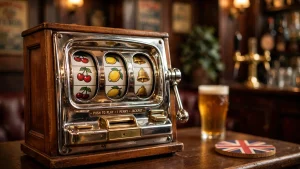
Progressive slots direct a share of wagers into a changing prize pool, with award rules and game terms shaping how the jackpot is won.

A progressive jackpot is built from contributions attached to play. Each wager on a connected slot machine adds a small share to a prize pool, so the total can rise as more wagers are made. The prize is not simply a fixed amount printed beside the game: its defining feature is that the pool changes as contributions arrive.
For progressive jackpot slots, the contribution is typically between 1% and 3% of each wager. The precise share depends on the game, but the broad mechanism is straightforward: a portion of the money staked is directed into the jackpot pool. One wager adds a little; many wagers add more. The figure displayed as the jackpot therefore represents an accumulated total, not a promise that a particular player’s stake has created the whole prize.
That distinction matters. A large jackpot can be the visible result of contributions from many separate rounds of play. The player at a machine sees the current pool, while the pool itself may reflect activity well beyond that single screen. A progressive prize is collective in origin, even when its eventual award is experienced by one person.
When choosing progressive slots online in the UK, payout speed is one practical detail to consider. Use this list as a quick reference to the payout information available for each operator.
Zombillion
Zombillion lists a payout speed of 1–3 business days.
Amunbet
Amunbet lists a payout speed of 1–3 business days.
Britsino
Britsino lists a payout speed of 1–3 business days.
Chanze
Chanze lists a payout speed of 1–3 business days.
SpinFormula
SpinFormula lists a payout speed of 1–3 business days.
Dieselwin
Dieselwin lists a payout speed of 1–3 business days.
NightLuck
NightLuck lists a payout speed of 1–3 business days.
Jetsetspins
Jetsetspins lists a payout speed of 1–3 business days.
x3bet
x3bet lists a payout speed of 1–3 business days.
WinBeast
WinBeast lists a payout speed of 1–3 business days.
Some pools are confined to connected machines running the same game. Others are network jackpots shared across operators that carry that same progressive slot. In that arrangement, players using the game at different operators contribute to a common pool. The operators are separate businesses; the jackpot is shared through the game’s network. A familiar game title can therefore link play across more than one site without making those sites one casino.
The network is not a general fund for every progressive game. Its reach follows the particular game and the machines connected to its pool. A progressive jackpot at one title does not automatically include wagers on another title, even if both appear in the same catalogue or have similarly prominent jackpot displays. The important connection is between the game and its linked machines, not merely the fact that the games are both progressive.
This is why the phrase “online slots with progressive jackpots” can describe quite different arrangements. In one case, contributions may accumulate from play tied to a narrower set of connected machines. In another, the same game may be carried by multiple operators and feed a shared network pool. The visible principle is alike—wagers add to a growing total—but the scale of the contributing network can differ.
The pool’s movement is easier to understand as a stream than as a single deposit. Every qualifying wager sends a portion towards the prize. Those portions gather over time, and the displayed total changes as the pool receives contributions. The contribution from any one wager is modest beside a large jackpot; the cumulative effect is the point. A progressive pool depends on repeated play, not on a solitary, dramatic payment from the operator at the moment the prize is shown.
That does not mean the display reveals the full history of the pool. It shows a total, while the underlying accumulation may involve many connected machines and, in a network arrangement, more than one operator. The number on screen compresses that activity into a single figure. It is a useful sign of the pool’s current size, but not a map of every contribution that brought it there.
The network model also changes the scale of the story. A local pool can grow through wagers made on its connected machines; a shared network pool can gather contributions from players encountering the same game at separate operators. The same basic mechanism remains in place. The connection widens the circle of contributing play, rather than changing the fact that the jackpot is funded through wager-linked contributions.
There is a quiet social arithmetic here. The prize appears singular, but its growth is distributed: many small shares enter the pool, and the total becomes large through accumulation. The screen gives the jackpot a neat, individual face. Its funding is less individual. Many wagers, one pool.
A progressive jackpot can be awarded in more than one way. In some games, the jackpot is triggered randomly while a player is taking part. In others, a particular symbol combination must appear, or the player must reach a bonus round where the jackpot can be won. The word “progressive” describes the growing prize, not a single set of rules for claiming it.
With a random-trigger game, the jackpot does not depend on landing a named combination in the ordinary way. The trigger may occur during play without a visible sequence of symbols announcing that it is due. A run of spins without a win does not, by itself, show that the next spin is closer to triggering one. Random is not a queue.
Other games make the route more visible. A particular combination may award the jackpot directly, or a qualifying result may open a bonus feature in which the jackpot is available. Reaching that feature is not necessarily the same as winning the top prize: the bonus round may still have its own outcome. The game’s rules need to distinguish between entering a feature and receiving the jackpot.
Some random-trigger progressive jackpot games set a minimum bet for eligibility for the highest jackpot tier. A specialist review has described this condition for a particular game; it should not be treated as a rule shared by all progressive slots. Where it applies, a lower stake may still allow play but not qualify for that top tier. The relevant game rules should state which stake, trigger and prize tier are connected.
That detail changes the meaning of “playing for the jackpot”. A spin can be part of a progressive game without meeting the conditions for every prize tier. The distinction belongs to the game’s own rules, not to the general label attached to it. There is no universal bet level that can be assumed across progressive slots.
For the same reason, there is no single method for how to win on progressive slots. A combination-based game calls for the specified result; a random-trigger game does not offer a symbol pattern that can be pursued as a reliable route to the jackpot. Bonus rounds add another possible route, but their entry and award conditions depend on the individual game. Past spins do not create a dependable signal about when a random trigger will occur.
The practical question is what the game counts as a jackpot-winning event. Its rules can clarify whether the award is random, tied to a combination, or available through a bonus feature, and whether a qualifying stake applies. Those conditions are more useful than assuming that all online progressive slots work alike. Similar-looking jackpot displays can sit above different award mechanisms.
“Must-hit-by” language also needs careful reading. The phrase alone does not establish how a particular game triggers its jackpot or what conditions apply to a player’s stake. The operative details are those set out for that game, including any distinction between jackpot tiers and any bonus-round requirements. A label is not a trigger rule.
Progressive slots therefore share an appealing idea—a prize that can be won—but not one universal route to it. Some awards arrive through chance during play; others depend on a defined result or feature. Knowing which mechanism is in place explains how a jackpot may be awarded. It does not make the event predictable.
A progressive slot’s RTP is a measure of the share of stakes the game is designed to return over extended play, not a forecast of what will happen in a particular session. Its percentage belongs to the mathematics of the game across repeated play. It does not tell any individual player when a jackpot will appear, or whether it will appear at all during a given stretch.
For progressive slots, the base-game RTP often sits in the 88%–92% range. That figure reflects a particular allocation: some of the potential payout is directed towards the jackpot pool rather than returned through ordinary play. The percentage therefore needs to be read as part of the game’s payout structure, not as a separate promise that the jackpot will make up the difference for any one player.
This distinction can be easy to blur. A lower base-game RTP does not, by itself, reveal the odds of winning the progressive jackpot. Nor does the size of a displayed prize disclose how likely it is to be awarded. RTP and jackpot probability describe different things: one concerns theoretical returns across play; the other concerns the chance of a specific event. The first cannot simply be converted into the second.
There is no universal set of progressive-slot odds that can be applied across games. The jackpot rules and underlying mathematics belong to each individual title, so a broad statement about the odds of winning progressive slots would imply a consistency that the category does not establish. A displayed pool may grow conspicuously; its visibility is not a statistical explanation.
RTP is also not a personal return rate. A player’s results can diverge sharply from the theoretical figure, because the calculation describes an aggregate rather than a guaranteed pattern for each account or session. The percentage cannot identify a “top” progressive slot, either. A higher RTP alone would not settle questions about jackpot chances, game conditions or what a player might experience.
That is the boundary of the number. It helps explain how a progressive game’s payout is apportioned, but it is not a winning formula, a timetable or a ranking. Claims that a particular title offers better jackpot odds need information about that title’s own probability model, not an inference drawn from its RTP. Arithmetic is useful. It is not clairvoyance.
Free spins can make a progressive slot appear to offer a way into a jackpot without staking personal funds. The distinction between a free-play demonstration and bonus spins attached to an account matters, though. A demonstration lets someone try a game without playing for withdrawable cash; bonus spins may produce winnings, but those winnings are governed by the promotion’s terms. “Free” describes the starting stake, not necessarily the conditions attached to any money won.
There is a further complication: most free-spin offers are restricted to non-progressive games. A specialist review reports that free spins on progressive slots are generally subject to a winnings cap in the £50–£100 range, but that is a reported offer pattern, not a universal rule. The same review notes that free spins are more commonly limited to non-progressive titles. Whether a particular promotion can be used on a progressive slot therefore depends on its eligible-games list, rather than on the game’s jackpot label alone.
That list is worth reading before spinning. An offer may name eligible games, exclude particular titles, or state that bonus spins apply only to selected games. If the progressive slot is not included, its jackpot feature cannot be reached through those spins. A page showing a progressive game in a free-play mode also does not, by itself, establish that winnings can be withdrawn: the mode may be for entertainment rather than a cash bonus.
A bonus can set conditions on how winnings are converted into withdrawable funds. For no-deposit bonuses, a specialist review reports wagering requirements of 40x–60x and maximum withdrawal caps of £50–£100. These figures describe the terms reported in that review; they should not be read as a standing rule for every UK offer. The promotion itself determines what counts towards the requirement, which games qualify and whether a cap applies.
The arithmetic can be less intuitive than the headline. A wagering requirement applies to the bonus amount or winnings as specified in the terms, not necessarily to the amount someone hopes to withdraw. A cap, meanwhile, can limit the sum payable even after the wagering condition has been met. The exact wording matters: offers can differ in their definitions, eligible games and expiry conditions. Dry print, consequential sums.
Free spins on a progressive slot deserve particular scrutiny because two sets of conditions may meet: the promotion’s bonus rules and the game’s own eligibility requirements. The promotional terms say whether the spins may be used on that title and what happens to any resulting winnings. The game’s rules determine how its features operate. A free-spin offer should not be assumed to qualify for a progressive jackpot merely because the slot itself has one.
The same care applies to free progressive slots played online without a download. A browser-based demonstration can remove the need to install software, but it does not turn practice play into real-money play or make a promotional offer eligible. The important distinction is not how the game is opened; it is whether the session is a demo, bonus play or cash play, and what conditions govern its results.
For anyone comparing free offers, the useful details are therefore practical rather than promotional: which game titles are included, whether progressive slots are excluded, how winnings are treated, and what wagering requirement or withdrawal cap applies. If the terms do not clearly say that a progressive title is eligible, the offer should not be treated as a route to its jackpot. And if the game is only available in a demo, its displayed balance is not a cash balance.
Free spins can provide a taste of a game, but they do not erase the boundary between practice and a payable win. On progressive slots, the label alone says little about bonus eligibility. The small print does.
Progressive slots sit inside a gambling system whose rules concern operators as much as games. In Great Britain, the UK Gambling Commission is the sole regulator for commercial gambling, including remote gambling offered to consumers. The location of a casino’s key equipment does not remove that obligation: an operator selling remote gambling to people in Great Britain must hold the relevant Commission licence.
The Commission issues operating licences to businesses and personal licences to individuals working in the regulated sector. That distinction reflects the machinery of oversight: a company needs permission to offer gambling, while certain people involved in its operation are licensed in their own right. A site’s presentation or its choice of games cannot substitute for an operating licence.
The boundary is geographic as well as technical. The Gambling Act 2005 governs gambling in England, Wales and Scotland; Northern Ireland has a separate legal framework. So “Britain” is the more exact term when describing the Commission’s role, even though online casino searches and everyday conversation often use “UK” as shorthand.
For a customer, the safeguards are part of the licensed service, not decorative additions. Operators must check a customer’s age before allowing a deposit and prompt new customers to set a financial limit before their first deposit. Account-level controls must remain accessible. Licensed operators must also provide tools such as deposit and loss limits, session reminders, self-exclusion and routes to support.
The rules reach into the pace and funding of play, too. Online slots cannot offer autoplay, and at least 2.5 seconds must pass before another game cycle can begin. Credit cards cannot be used to fund gambling, including through a money service business; a wallet funded by credit card cannot be used for that purpose either. These restrictions make the regulated slot less like an endlessly accelerating machine and more like a product designed to retain friction. Deliberate friction.
Online progressive slots in Britain are therefore not defined only by the changing prize attached to a game. They are offered within a system that assigns responsibility to operators, sets limits on how play is conducted and provides mechanisms for customers to pause or exclude themselves. The Commission’s public register allows the status of an operator’s licence to be checked. In a market built around digital access, the licence is the part that should not be invisible.
A catalogue is not a permanent census of progressive jackpot slots. The games available to UK players differ between operators, and a provider’s catalogue can change as it adds or removes titles. A specialist review describes this variation, but it cannot make a list fixed: availability is tied to the particular operator and the state of its catalogue when it is checked.
That makes browsing a matter of narrowing down what is actually offered, rather than relying on a name remembered from somewhere else. An operator’s own game catalogue is the place to check. Where it has a search function, a title can be entered directly; where it offers categories or provider filters, those can help reduce a large library. The labels and tools may differ from one catalogue to another, so no single route can be assumed across every site.
There is a small, useful distinction between finding a game and finding a kind of game. A title search answers the first question. For the second, a catalogue may provide a category or a provider name that makes progressive jackpot slots easier to identify. If it does not, browsing can be less tidy: the game may sit among other slots without a conspicuous label. A result on one operator’s site does not establish that the same title is available elsewhere.
This is why a list described as the best progressive slots to play in the UK can age quickly. Even without ranking claims, a selection may reflect only one catalogue at one moment. A game that appears in an operator’s library today may not be present after providers update their offerings; another title may be added. “Best” also implies a shared measure of quality, while a catalogue only confirms what can be found there. Those are different claims.
Popularity is no firmer a guide unless it is backed by published information about what players actually choose. A title’s appearance in a catalogue does not, by itself, show that it is among the most popular progressive slots in the country. Nor does a familiar name prove that the current version, or the same game, is offered by every operator. Catalogue presence is a practical fact, not a public vote.
For anyone looking to play progressive slots online for free, the catalogue alone may not settle whether a particular title is available in a free-play mode. That depends on what the operator makes accessible, and the presence of a game in a list should not be read as confirmation of every way to play it. The same caution applies to broad advice about how to play: locating a title is only the first step, not a verdict on its terms or suitability.
A sensible comparison is therefore modest. Check the operator’s current catalogue, search by title or use any relevant filters, then confirm that the result is the intended game. Repeat that check when the catalogue may have changed. It is less glamorous than a definitive league table, but it reflects the way these libraries are maintained: by separate operators and changing provider portfolios.
A moving shelf.
A title can be named without being crowned. Gladiator: Road to Rome is a useful reminder of the difference: naming a game is not the same as establishing that it belongs among the best progressive slots in the UK, still less explaining why it would suit a particular player. A ranking needs something to compare. A memorable-sounding name is not a measurement.
The word “best” carries several possible meanings. It might refer to a jackpot’s scale, the chance of triggering it, the experience of the base game, or simply whether a title is available where someone plays. Those are not interchangeable judgements. A game could be attractive by one measure and unremarkable by another; a list that merges them into a single order would conceal the choice of criteria rather than resolve it.
That leaves the title as a name, not a verdict. There is no honest route from a product label to claims about its jackpot, symbols, bonus play, return or mobile performance without dependable information about those features. A confident description would be more decorative than useful.
The same restraint matters when considering progressive slot games as a group. A list of the best online titles would imply that each had been assessed on common terms. Without comparable information, the order would be arbitrary: an attractive heading disguising a judgement with no visible basis. A short list is not automatically a more reliable one. Sometimes it is merely a smaller display of uncertainty.
Availability adds another complication. A specialist review reports that the games offered can differ between operators and may change when providers update their catalogues. That makes any selection tied to a particular catalogue provisional. The same title may not be present everywhere, and a list assembled at one point cannot be treated as a permanent map of the market. Catalogues move. Rankings age with them.
This also explains why labels such as “mystery progressive” or “mobile progressive” cannot, by themselves, do the work of a recommendation. They suggest a kind of game or a way of accessing it, but do not establish quality. Nor does the phrase “free progressive slots” settle what a particular offer permits; the terms of bonus play belong to the offer and its conditions, not to a title’s name. Categories help organise a shelf. They do not tell the whole story of what is on it.
There is a small social history in the appetite for a “best” list. Lists make abundance feel manageable: many titles become a handful, and a handful becomes a decision. But a ranking can also convert the absence of comparable evidence into the appearance of certainty. The neat numbered order is persuasive precisely because it hides how much judgement went into making it.
A more careful account would distinguish what is known about a game from what is merely implied by its label, and would treat availability as something that can change. Gladiator: Road to Rome can be named in that spirit, without being presented as the leading choice or assigned features that cannot be substantiated. The result is less theatrical than a league table. It is also less likely to mislead.
No crown awarded.
Playing progressive slots for real money and receiving a large progressive jackpot are separate parts of the transaction. A cash balance may be available for withdrawal through the payment methods an operator supports; a substantial jackpot can involve a different process, with checks and a payout schedule that does not resemble an ordinary cash-out.
A specialist review reports that debit-card withdrawals can take 1–3 working days, e-wallet payments can arrive within hours, and bank transfers may take 3–5 working days or longer. These are reported timeframes, not a promise attached to every account. The route chosen matters, as can the operator’s processing arrangements. The clock, in other words, is not set by the slot alone.
A large win can bring a further pause. The same kind of specialist review notes that substantial progressive jackpots may require additional verification and may be paid in structured instalments spread over several years. That does not mean every large prize follows this arrangement: the terms for a particular game and operator determine what happens. A headline jackpot and the amount available immediately are not necessarily the same thing.
Verification is part of the practical distinction. A routine withdrawal and a prize of exceptional size may not call for identical checks, and a winner may need to provide further information before payment proceeds. The review’s account makes clear that a jackpot can therefore involve both identity checks and a longer payment schedule. Paperwork is less theatrical than a win. It is still part of it.
Substantial progressive jackpots may require additional identity verification and can be paid out in structured instalments over several years, rather than as a single immediate sum.
For anyone comparing real-money progressive slots in the UK, the relevant details are the withdrawal methods, any stated processing times, and the rules for handling a large prize. The game’s description alone cannot settle those matters. The payment terms do.
New progressive slots may attract attention for their changing prize pools, but novelty does not tell a player how a win will be paid. Nor does a progressive slots strategy alter an operator’s withdrawal process. The useful distinction is between playing with cash in the account and receiving a major prize: the first is a matter of making a withdrawal request; the second may involve additional checks and instalments.
A progressive slot’s prize can be expressed as one striking total. Collecting it may be a more measured affair.
“Penny progressive” sounds like a precise description of a slot, but the label alone does not set out the game’s stake or jackpot rules. “Penny” may suggest small-denomination play; “progressive” describes a jackpot pool that grows through contributions from wagers made on connected slot machines. The two words point in different directions: one towards the scale of a stake, the other towards how a prize accumulates.
That distinction matters. A game carrying the label is not thereby shown to have a fixed penny stake, nor does the phrase explain how much of a wager goes into its jackpot pool. The pool is shared across connected machines, so its growth reflects play across that network rather than a single machine acting alone. The label gives a broad category, not a complete set of terms.
In practice, “penny” should not be read as a promise that every spin costs the same small amount. Nor does it establish that all such slots share one jackpot size, contribution rate or method of awarding the prize. Those details belong to the individual game’s rules. A name can be suggestive without being a specification.
The phrase “progressive slots meaning” can therefore be answered in two parts: the jackpot increases as contributions from wagers on connected machines enter a shared pool; “penny” does not, by itself, settle the game’s precise stake conditions. That is a modest distinction, but useful in a market where familiar labels can make unlike products sound interchangeable.
The penny is not the whole story.
The difference between progressive and non-progressive slots is not simply whether a prize can become conspicuously large. It lies in how the game’s theoretical payout is divided. In a progressive slot, part of the return is channelled away from the base game and into the jackpot pool. The displayed prize has a cost, even before anyone wins it.
That allocation helps explain why the base-game RTP for progressive slots often sits in the 88%–92% range. The portion not returned through ordinary play is directed towards the progressive jackpot. RTP describes the game’s expected return across play; it does not tell a player when a jackpot will be won, or whether a particular session will come anywhere near that theoretical figure.
A non-progressive slot does not make this same allocation to a growing jackpot pool. Its payout structure is therefore not split in that particular way. That does not, by itself, establish that a non-progressive game has a higher RTP: the figure depends on the individual game, and a comparison requires the published RTPs for the specific titles involved.
The distinction is easy to miss because both types present themselves as reels, symbols and spins. Yet the progressive version carries an additional destination for part of the game’s return. The non-progressive version does not build that shared prize through the same mechanism. One pays towards a pool; the other has no such pool to fund.
This is a matter of allocation, not a promise of value. A lower base-game RTP in a progressive slot reflects the jackpot contribution in the game’s design, but it is not a measure of the chance that the jackpot will fall. Nor does the presence of a large displayed prize make the ordinary play more generous. Different destinations for the money.
No. Game availability varies by operator and changes as catalogues are updated. A network jackpot is shared across operators only when they offer the same progressive slot.
Check how the jackpot is triggered and whether a particular stake is needed to qualify for the top prize. Also consider that progressive slots often have a base-game RTP of 88%–92%, with part of each wager going to the jackpot pool.
Debit card withdrawals typically take 1–3 working days, e-wallets can take hours, and bank transfers often take 3–5 working days or longer. Large jackpot payouts may involve extra verification and structured instalments over several years.
Sometimes, but certain games require a minimum stake to qualify for the highest jackpot tier. Check the game’s rules for the qualifying bet and prize tier.