A physical wheel and studio dealer create a streamed table, while bets are placed through a separate on-screen interface.
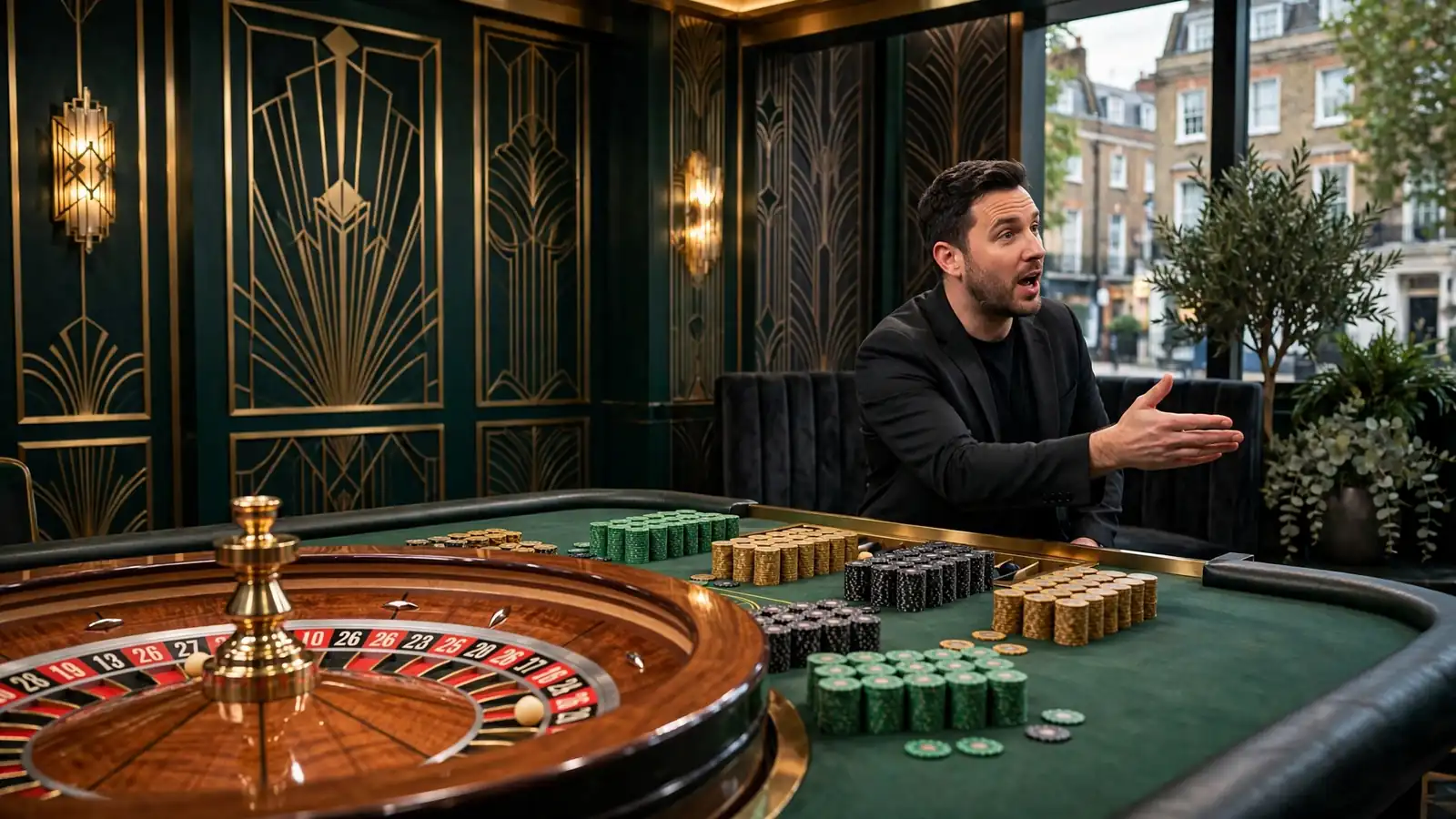
A live dealer roulette table is not simply a roulette graphic made to look more lifelike. Its central event takes place in a studio: a human dealer spins a physical wheel, and the game is streamed as it happens. The player’s part takes place elsewhere, through an on-screen interface used to place bets. One room contains the wheel; another contains the controls. The stream joins them.
That division is the defining feature of live dealer roulette. In a computerised version, a Random Number Generator determines the result. The animation may show a wheel and ball, but the image is not a live record of a physical spin. At a live table, the wheel is real and the dealer is present in the studio, even though the player encounters both through a screen. The distinction is not about how convincing the graphics appear. It is about what is producing the game.
The format has an older social shape than most online play. A casino table has always arranged people around a shared centre: the wheel, the cards, the felt, the dealer’s hands. Online, that arrangement is partly rebuilt. The screen becomes a window onto the table, while the betting interface supplies a separate means of participation. There is a human being in the transmitted scene, but the player is not physically seated opposite them. The room is present as an image, not as a place one can enter.
For live roulette, it is worth checking the details that matter to your session, including whether English-speaking dealers are available. The available information for these entries is limited to payout speed.
Zombillion
Zombillion is listed with a payout speed of 1–3 business days. No details are available here about its live roulette tables or dealer language.
Amunbet
Amunbet is listed with a payout speed of 1–3 business days. The available information does not specify live roulette or English-speaking dealers.
Britsino
Britsino is listed with a payout speed of 1–3 business days. No live roulette or dealer-language details are provided.
Chanze
Chanze is listed with a payout speed of 1–3 business days. The information provided does not describe its roulette offering or dealer languages.
SpinFormula
SpinFormula is listed with a payout speed of 1–3 business days. No details are available about live roulette or whether dealers speak English.
Dieselwin
Dieselwin is listed with a payout speed of 1–3 business days. The available facts do not cover live roulette tables or dealer language.
NightLuck
NightLuck is listed with a payout speed of 1–3 business days. No information is provided about its live roulette or English-speaking dealers.
Jetsetspins
Jetsetspins is listed with a payout speed of 1–3 business days. The provided information does not specify roulette games or dealer languages.
x3bet
x3bet is listed with a payout speed of 1–3 business days. No live roulette or English-speaking dealer details are available here.
WinBeast
WinBeast is listed with a payout speed of 1–3 business days. The available information does not describe its live roulette tables or dealer languages.
That is a modest technological achievement, but a revealing one. Digital services often promise to remove the awkwardness of physical settings: no journey, no queue, no need to be seen. Live casino retains one element that software alone cannot reproduce in quite the same way: a person carrying out the visible action. The dealer’s role is not decorative, since the wheel is physically spun in the studio. Yet the interaction remains mediated. A player does not reach across the table; the interface receives a bet, and the stream shows the live game.
For anyone considering roulette online in the UK, the difference between a live table and a computerised game is therefore a question of source and setting. Both are online. Both are viewed on a screen. But one transmits a physical game with a human dealer, while the other uses a random-number system to generate its outcome. The visual language can overlap; the underlying process does not.
The interface is the quieter half of the arrangement. It lets a player submit bets while the studio supplies the live picture. That division can make the experience feel both intimate and remote: the dealer is close enough to see, yet the player’s actions are represented by buttons and digital selections. A table that once required a seat, a body and a place in a room is converted into a stream plus a control panel. Modernity, in this case, has not abolished the table. It has put it behind glass.
The word “live” can carry more emotional weight than its technical meaning warrants. It signals that the game is being transmitted in real time from a studio, with a human dealer and a physical wheel. It does not, by itself, establish every quality a player might associate with being in a casino. Nor does it mean that the player and dealer share a room in any ordinary sense. The connection is audiovisual and transactional: the game is streamed, and bets are entered through the interface.
That distinction matters when the appeal is not only roulette but also the person dealing it. A live stream makes the dealer visible, but visibility is not proof of a particular language being spoken. A page or table description needs to state whether a dealer speaks English; the existence of a human dealer alone does not settle the question. “Live” describes the format, not the dealer’s language. Small distinction. Important one.
The phrase “English-speaking dealers” may be part of what someone seeks from live roulette, especially when the table’s human presence is the point. But it should be treated as a separate feature to confirm, rather than inferred from the stream. The same caution applies to assumptions about conversation or personal attention: the defining facts are the real-time studio broadcast and the on-screen betting interface. Anything beyond those depends on what the particular table offers.
In this format, online casino roulette is neither a purely automated simulation nor a return to the old casino floor. It is a hybrid: a physical wheel and dealer made available at a distance, with digital controls replacing the player’s place at the table. The camera provides the room’s visible surface; the interface provides the means to take part. The result is recognisably social, but carefully contained—human action on one side of the screen, remote participation on the other.
Roulette reduces a casino game to a small, legible wager: a ball comes to rest on a number, and a player wins by having selected that number. The action is simple to state, even if the room around it is not. A wheel turns; a choice has already been made; the result settles the matter. For all the ceremony, the central exchange is between a prediction and an outcome.
That clarity helps explain roulette’s place in casinos. The player does not need to hold a hand of cards or make a sequence of decisions as the round develops. The wager expresses one thought: this is the number. When the ball lands elsewhere, the thought has not been rewarded. When it lands on the chosen number, it has.
There is a quiet formality in that arrangement. Roulette gives chance a visible destination. It does not merely announce that a result has been generated; the ball can be watched as it moves and finally stops. In a physical casino, the wheel and table turn an abstract uncertainty into a public event. Attention gathers around the same object, though each person may have made a different choice.
The bet is therefore both practical and expressive. A selected number is not a forecast supported by certainty; it is a position taken before the result is known. The game does not ask why that number was chosen. It records the choice and then supplies an answer. A superstition, a remembered date, a pattern noticed on the table or no particular reason at all can sit behind the same selection. The rules have no way to distinguish them.
In a UK roulette casino, the broad idea remains unchanged whether the game is presented at a physical table or as roulette in a casino online. The setting can alter how the action is seen, but not its central condition: the ball lands on a number, and a player wins by selecting that number. The distinction matters because the atmosphere can make the surrounding experience feel like the game itself. It is not. At the centre is still a choice made before a result.
This is also why the word “bet” carries more weight than it first appears to. It marks the point at which observation becomes commitment. Before a selection, the wheel is simply turning towards an unknown result. After one, the player has attached a hope to a particular number. The physical movement may be brief; the waiting can feel longer, because the mind has already supplied a story about what the outcome might mean.
Casinos have always understood the usefulness of such visible rituals. A roulette table gives spectators a shared focus and gives players a clear role: choose, wait, discover. No elaborate explanation is needed for the basic objective, and no special vocabulary is required to understand whether the chosen number has appeared. That makes roulette unusually easy to follow from the edge of the table, even for someone who has not placed a bet.
Yet simplicity should not be mistaken for control. Selecting a number is an act of choice, but it does not direct where the ball lands. The player supplies the prediction; the game supplies the result. The elegance is in the separation. One is personal, the other indifferent.
At a roulette table, then, the wheel is more than scenery and the bet more than a mark on a layout. Together they make uncertainty visible: a number is named, the ball settles, and the result either matches the choice or does not. A very old kind of suspense.
A live roulette table asks for something digital roulette does not: time. The computerised version can move from one result to the next with little pause; a live table follows the slower rhythm of a game conducted in real time. There is room for the dealer’s actions, for bets to be entered and for the round to proceed. The interval is part of the format, not a technical fault.
That difference changes the feel of a session. Digital roulette can be played in quick succession, while live play has a more measured pace. A table may be open, but each round still belongs to a shared sequence rather than to an individual button press. For some, that gives the game a more social tempo. For others, the waiting is simply waiting. The distinction matters when a casino site offers both formats under the same broad label: live dealer roulette is not just a visual alternative, but a different use of time.
The connection has to keep up. A stable internet connection is a practical condition of live play because the game arrives as a real-time stream. If the picture freezes or the connection drops, the table’s sequence becomes harder to follow, and the interface may not respond as expected. The experience depends on both the stream and the betting controls remaining available together. A reliable connection cannot make the game faster; it can make its ordinary pace less vulnerable to interruption.
This is one reason the format is not equally suited to every moment. A weak signal, a crowded network or a device being moved between connections can interfere with the continuity that live play requires. Digital roulette does not depend on a live video feed in the same way. The distinction is mundane, but useful: live play is not only a game choice; it is also a small demand on the room, the device and the network around it.
The other practical difference is the price of entry. Live tables can have higher minimum bets than digital versions, narrowing the choice for people who want to keep each stake small. The table minimum is set by the individual game, so it is worth checking before joining rather than assuming that every roulette table on a site begins at the same level. A casino’s range may include different formats and limits, but the word “roulette” alone does not settle what a particular table will accept.
A specialist review has reported starting stakes close to 20p at many live roulette and baccarat tables. That is a reported snapshot, not a standing promise about every casino site or every table: limits vary, and the available figure can change. The same review noted that blackjack tables often begin at higher levels. The useful point is not to treat 20p as a universal threshold, but to recognise why minimums matter when comparing live tables. A low entry point on one table does not establish the terms of another.
The combination of measured pace, connection demands and table minimums gives live play its particular threshold. Finding a roulette casino site is only the beginning of the practical decision; the table itself sets the conditions under which a session can happen. It is less a question of spectacle than of fit: whether the pace suits the occasion, the connection is steady and the minimum sits within the intended budget.
No rush.
The distinction between European and American Roulette is visible before the ball moves. On a European wheel, the green pocket is marked 0. The American wheel has two green pockets, 0 and 00. That extra pocket is not decoration: it changes the odds attached to the game, even though the two versions share the familiar numbered wheel and table.
For a player comparing live roulette tables, the layout is a more useful starting point than a casino’s promotional language. A table’s name may sound like a small detail beside its lighting, dealer or interface. Yet the number of pockets is built into every spin. The American layout has one additional outcome, and the chance of winning is 1 in 38, compared with 1 in 37 on the European wheel.
The difference is modest in appearance and permanent in effect. With European Roulette, the green zero sits alongside the numbered pockets. American Roulette retains that zero and adds 00. Each pocket is a possible resting place for the ball; the additional one makes a successful selection less likely. The wheel does not need to look dramatically different for its arithmetic to change.
That is why the label matters when browsing a live roulette casino. A polished studio cannot turn an American wheel into a European one, and a dealer’s manner has no bearing on which pockets the wheel contains. The table layout is the relevant detail. Where the choice is between versions, European Roulette offers the more favourable winning odds of the two described here.
This is not a ranking of casinos. “Best” depends on what is being compared, but the wheel itself supplies a concrete point of comparison: one green pocket or two. A table that makes its roulette version clear allows that distinction to be understood before play begins. If the layout is unclear, the name alone may not settle it; the 00 pocket is the visible clue to the American arrangement.
There is a small historical irony in the extra green space. It looks like one more mark on the felt, but it changes the conditions for everyone at the table. The green pockets are not numbers players select in quite the same way as the numbered spaces, yet they belong to the wheel’s possible outcomes. In American Roulette, 00 joins 0 as a separate pocket. The added possibility is enough to shift the stated odds from 1 in 37 to 1 in 38.
The comparison should stay narrow. European Roulette has a single zero; American Roulette has zero and double zero. The corresponding chances of winning are 1 in 37 and 1 in 38. Those figures describe the difference between these wheel layouts, not a promise about any individual spin. A ball has no memory of what came before.
Features a single green pocket (0), offering winning odds of 1 in 37.
Features two green pockets (0 and 00), resulting in winning odds of 1 in 38.
For someone weighing live roulette options, the table’s presentation can be vivid, but the wheel remains the more consequential piece of information. A dealer may announce the game and the screen may show the racetrack layout, yet neither replaces checking whether the table is European or American. One pocket changes the odds. That is enough.
A roulette bet is not simply a choice between a number and a colour. Different selections cover different portions of the betting layout and receive different payouts when successful. The house edge measures the casino’s mathematical advantage within those terms. It is not a fee visibly removed from each stake; it is built into the relationship between the chances of a bet succeeding and the amount paid when it does.
A straight-up bet selects one number. Its house edge is 2.9%. Other roulette bets carry a 2.7% house edge. The difference is small, but it reflects an important distinction: a bet that appears more selective is not necessarily treated more generously by the game’s payout structure. The layout offers variety; it does not offer a route around the edge.
That distinction can be easy to miss because the table presents bets as a menu of choices. Some selections cover a narrower part of the layout, while others are broader. The potential payout changes with the selection, but the house edge describes the underlying advantage in a different way. A larger-looking return on a successful narrow bet does not, by itself, make that bet more favourable overall.
In a UK casino roulette game, these figures are useful as a way to compare bet types, not as a forecast of what will happen in a particular session. A single result may have little resemblance to the mathematical pattern behind the edge. The percentage describes the terms of the game across repeated play, not a deduction that can be watched occurring spin by spin. The casino’s advantage is quiet bookkeeping.
French Roulette adds a rule that changes the treatment of one specific outcome. When an even-money bet is in play and the ball lands on zero, the player loses only half the stake rather than the whole amount. Even-money bets are selections with a win-or-lose character such as a broad choice between two sides of the layout. The rule softens the zero result for those bets; it does not apply to every selection.
This is the practical importance of the French rule. Zero remains a losing result for an even-money bet, but the loss is reduced. That is different from removing the house edge: the rule modifies what happens on one outcome, while the game still retains an advantage for the house. The distinction belongs in the table’s terms, not in a promise about how any particular run will end.
For anyone comparing casino roulette games, the useful questions are therefore specific: what kind of selection is being made, what does it pay, and does a rule such as the French half-loss provision apply? The bet label alone is not enough. Two choices can look quite different on the layout while their house edges remain close.
When an even-money bet is in play and the ball lands on zero, the player loses only half the stake rather than the whole amount.
Roulette rewards attention to these small printed arrangements more than to dramatic theories about the “right” choice. A straight-up selection and a broader bet are different ways of engaging with the same game, each with its own payout shape. The house edge supplies a common measure beneath that surface variety. It is not a prediction, and it is not a reason to treat one spin as evidence about the next.
A real-money live roulette session has a different tempo from digital roulette. The live game proceeds through a physical table and dealer, so there is less room for the rapid succession of rounds possible in a computerised version. That slower rhythm is part of the format, not a promise of a more favourable result. The wheel still turns without regard for how long a player has been waiting.
The price of joining can differ too. Live tables have higher minimum bets than digital games, which may make a real-money table less accessible to someone accustomed to small online stakes. The minimum is a condition of that particular table, not a measure of skill or a reason to stretch a budget. A sensible boundary is set before play begins and kept intact; the pace of a live stream does not make money less real. Dry arithmetic.
There is also a public framework around real-money access in the UK. Live dealer casinos may legally offer gambling to UK players when they hold a licence from the UK Gambling Commission. The licence is not decorative wording: it places the operator within the country’s regulatory system. A live table’s studio may be elsewhere, but location alone does not replace the requirement for a UKGC licence when an operator serves the British market.
This arrangement reflects a broader distinction in British gambling regulation. The state permits commercial gambling, but makes permission conditional on oversight. For the player, that means the legality of a live casino is tied to the operator’s licence, not simply to the fact that a stream works or that a site accepts a deposit. Real-money access belongs inside that regulated framework.
The table itself remains an entertainment product, not a way to earn income. A slower game can feel more social or deliberate, but neither impression changes the financial terms of a bet. Before joining, the stake limits and table conditions matter because they determine whether the game fits within the amount already set aside. If they do not, another table—or no real-money session—is the more coherent choice.
The appeal of live dealer roulette lies partly in its human, physical setting. Its costs and legal status are less atmospheric: minimums shape access, and licensing determines whether the operator may serve the UK market. Both deserve attention before the first bet. This article is for entertainment purposes only, not gambling advice.
A free roulette game can make the shape of the experience familiar without putting money at stake. It offers a way to see how a roulette interface is arranged and how selections are entered, but any result in a no-cost session is part of that play experience, not a cash return. Free play does not provide real payouts or winnings.
That distinction matters because the word “roulette” can describe rather different settings. Live dealer roulette shows a human dealer spinning a physical wheel in real time, while computerized roulette uses a Random Number Generator. A free version may be a computer-based game rather than a live table; the label alone does not establish that a dealer, studio or physical wheel is involved. The presentation should make clear what kind of game is being offered.
Practice has a modest purpose. It can help make an unfamiliar screen less unfamiliar: where the controls sit, how a selection is made, and what the game displays as play proceeds. It cannot turn a free session into a forecast of later results. Nor does a run of outcomes in practice establish what will happen in a session involving money. A rehearsal is not a promise.
The same separation applies to a free casino roulette game described as a UK option. The location in its description does not change what free play is: no real stake is being risked, and no real payout is being earned. If a game switches between free and real-money modes, those are materially different conditions, not merely two labels on the same outcome. The applicable rules and the interface should be understood before real-money play begins.
Roulette also has rules and an underlying house edge, but practice is not a means of removing either. A simulated session can show how a game behaves on screen; it cannot make the terms of a real-money game more favourable. Nor should a free result be treated as evidence that a particular approach will produce a return later.
Free play, then, is best understood as an introduction to presentation and controls, not as a source of income or a substitute for real-money conditions. It may be entertaining in its own right. It is not a payout route, and this article is for entertainment purposes only, not gambling advice.
A roulette bonus can look like an invitation to sit at a live table, yet the headline rarely tells the whole story. The operative details are in the terms: which games qualify, how much each game contributes towards wagering requirements, and whether the bonus can be used on live tables at all. A welcome offer is not necessarily a roulette offer.
Live games may count for only a small share of the wagering requirement. Some terms assign them a 10% weighting, so only a fraction of qualifying live-game play counts towards the requirement. The rest does not vanish from the table; it simply does not advance the bonus conditions at the same rate. A prominent bonus amount can therefore suggest more usable play than the small print allows.
The structure of UK welcome offers also matters. A specialist review of UK casino offers describes most welcome deals as free spins for slot games, which cannot be used at live tables. That distinction is easy to miss when a casino promotes several games beside one general offer. The offer may be available to a new customer without being applicable to live roulette.
A no-deposit bonus raises a separate question: not just whether an offer can be claimed without an initial payment, but which games its terms include and what conditions attach to any resulting balance. The label alone does not establish that live roulette qualifies. Nor does the word “roulette” in a promotion necessarily mean that every roulette format is eligible.
Before opting in, the relevant terms are the eligible games, live-game weighting, wagering requirements and maximum bet limits. These conditions determine whether a bonus has practical value at a live table; the headline is only its advertisement. Bonuses are not a substitute for a clear budget, and their conditions can make an offer less useful than its presentation suggests.
There is a small irony in the arrangement: the game most visible in the promotion may be the one least able to move the bonus along. Terms decide. This content is for entertainment purposes only and is not gambling advice.
The phrase “best way to win” suggests that a method might turn roulette into a dependable source of income. The numbers offer no such promise. A staking system can change how much is placed on each spin, but it cannot remove the house edge built into the game.
The stated edge is 2.9% on a straight-up bet and 2.7% on other bets. These figures describe the game’s mathematical advantage over repeated play; they do not forecast the result of a particular spin, or say when a run of wins or losses will end. A player may win in the short term. That possibility is not evidence of a pattern that can be relied upon.
This is where systems that raise or lower stakes acquire their appeal. A sequence can look orderly: after a loss, increase the next stake; after a win, return to a smaller one. But the sequence does not alter the probabilities attached to the bets. It can instead make losses accumulate more quickly, while no system guarantees that a winning result arrives before a budget is exhausted. Arithmetic is patient. A bankroll is not.
Claims about a method that wins every time, whether at a physical table, online or on electronic roulette, mistake a desired outcome for a controllable one. Past results and statistical trackers do not make future spins predictable. A table records what has happened; it does not take instructions from the record.
The useful role of probability is narrower and less theatrical: it helps set expectations. Roulette can produce a win, but no betting pattern can make that outcome certain or erase the house’s mathematical advantage. Treating a session as entertainment rather than a way to make money keeps that distinction visible. A budget set in advance should remain a limit, not a figure to chase after losses or extend after a win.
The wheel has no memory. The stake, however, is real. This is general entertainment information, not gambling advice.
The name Lightning Roulette points to a particular roulette variant, but a name is not a rulebook. It does not, by itself, establish how a round works, what features are included, which odds apply or whether the game is available at a particular UK casino. Those details need to come from the game’s own rules and the operator’s information, rather than from assumptions attached to the word “Lightning”.
That distinction matters because the established description of standard roulette is narrower: a ball is spun around a physical wheel, and the result is the number where it lands. In live dealer roulette, the wheel and dealer are streamed while bets are placed through an on-screen interface. These general facts do not confirm that every game carrying a variant name follows the same presentation or adds any particular feature.
Nor does the word “slots” settle the question. A search phrase or label is not enough to determine whether a specific offering is a slot game, a live table game or something else. The game rules are the proper place to establish what is being played; the operator’s terms and licensing information establish the conditions under which it is offered.
In the UK, real-money online casino gambling is legal at sites holding the relevant UK Gambling Commission licence. That regulatory boundary is separate from the mechanics of any named roulette variant. A licence does not, on its own, verify claims about a game’s special features or outcomes.
The name can be recognised. The details still need checking. This article is for entertainment purposes only, not gambling advice.
Live roulette variants include European, American and French Roulette. European Roulette has one green zero, American Roulette has 0 and 00, and French Roulette can halve the loss on an even-money bet when the ball lands on zero.
No. In roulette, straight-up bets have a 2.9% house edge, while other bets have a 2.7% edge; French Roulette also halves the loss on an even-money bet when the ball lands on zero.
American Roulette has two green pockets, 0 and 00, while European Roulette has only 0. The odds of winning are 1 in 38 on the American wheel and 1 in 37 on the European wheel.
Place your bet using the on-screen interface, then watch the dealer spin a physical wheel in real time. You win if the ball lands on a number you selected.
You win a roulette bet when the ball lands on the number you selected. Roulette retains a house edge, so no staking system guarantees a win.
Choose a casino that holds a UK Gambling Commission licence. Check the table details to confirm the dealer speaks English, and consider the minimum bet and whether your internet connection is stable enough for the live stream.
The number of zero pockets has a major effect: American Roulette has both 0 and 00, while European Roulette has only 0, giving players better odds on the European wheel. In French Roulette, an even-money bet loses only half when the ball lands on zero.