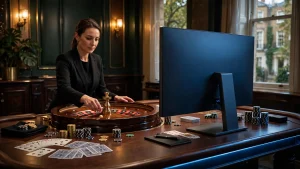
See how a studio stream, dealer-led rounds and the betting interface shape Dream Catcher play and comparisons with roulette.
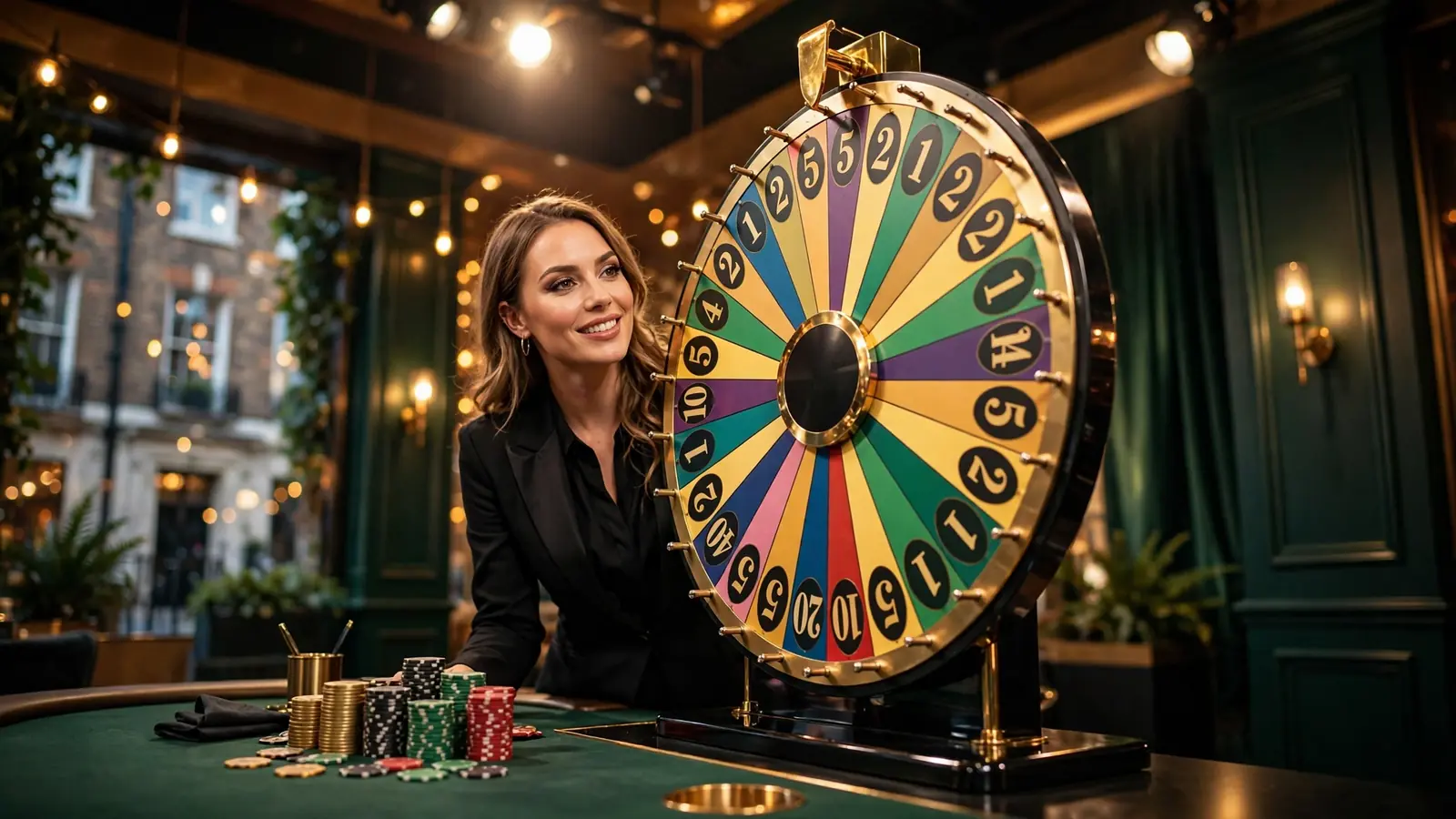
The phrase “live Dream Catcher” points to a particular expectation: a casino game presented as an event happening now, rather than as a sequence generated entirely by software. In live casino play, the action is streamed in real time from a studio, where a human dealer conducts the game. Players make their bets through an on-screen interface. The screen is therefore doing two jobs at once: carrying the studio’s activity to remote viewers and sending their decisions back into the game.
That arrangement is simple to describe, but it changes the character of online play. A digital version can move from one result to the next without waiting for a person to deal or operate equipment. A live table follows a human pace. There is a dealer, a sequence of actions and a point at which betting closes so play can continue. The player is not controlling a private simulation; the interface connects a remote participant to a shared, timed event.
The studio matters because it supplies the visible action. The stream shows gameplay as it happens, while the betting interface provides the means to take part. Neither element replaces the other. A video without a working interface would be a broadcast to watch, not a casino game to join; an interface detached from the live action would be closer to a digital game. The live format depends on their coordination.
That coordination also places a practical condition on the experience: the internet connection has to remain stable. A live stream and an on-screen betting interface rely on information moving between the studio and the player’s device. If the connection falters, the sense of following one continuous event can falter with it. The requirement is less glamorous than the studio image, but more consequential. A polished broadcast cannot compensate for a broken link.
Live play also takes longer than its digital counterpart. Human-led action has a rhythm set by the game and the dealer, rather than by software moving instantly to another result. The difference is not merely visual. It affects how long a round feels and how quickly a player can move from one decision to another. Online casino play is often described as though every format compresses time; the live table declines to cooperate.
The same distinction appears in the price of entry. Live games have higher minimum bets than digital versions. That can make the format less suitable for someone whose priority is to keep each stake low, even if the studio presentation is appealing. A screen may make a table feel close at hand, but it does not remove the table’s minimum. The physical setting is remote; the financial threshold is not imaginary.
This is why the words “Dream Catcher online casino” cannot, by themselves, explain what the experience will involve. They suggest a game sought in an online setting, but the live format is defined by how play is delivered: a real-time studio stream, a human dealer and bets entered through an interface. The title of a game does not establish the rules, table limits or presentation offered by any particular operator. Those details belong to the specific game and site, not to the general meaning of live casino.
For the same reason, “play Dream Catcher online” can describe more than one kind of expectation. Some online casino games are digital versions, while live dealer games transmit a human-led session from a studio. The distinction is not a decorative choice of graphics. In the live format, the visible activity is being conducted in real time, and the player’s participation is organised around that activity. It is a small piece of remote theatre with a financial interface attached.
There is a social history in that arrangement, even when no conversation is involved. Casinos have long turned games into public performances: a person acts, others watch, and rules make the uncertain outcome legible. Streaming moves that structure onto a screen. The studio becomes the shared room, while the interface gives distant players a way to enter the event. Technology extends the room’s reach, but leaves its human pace intact.
That pace sets the format apart from faster digital play, just as the higher minimum bets distinguish its practical threshold. Neither feature makes live casino play inherently better or worse. They describe a different bargain: more visible human action in exchange for waiting on it, and a more substantial minimum stake than a digital version may require. The attraction may lie in seeing a dealer conduct the game rather than watching software produce a result. The trade-off remains.
A search for live Dream Catcher in the UK is ultimately a search for a particular game experience within this broader format. The essential live element is not the name on a screen but the relationship between studio, dealer, stream and betting interface. Once that relationship is clear, the label “live” becomes less mysterious. It also becomes less of a promise: the word describes the method of play, not a guarantee about a specific operator’s offer or a game’s individual terms.
A human pace, carried by a signal.
The name Dream Catcher can suggest a particular live casino experience, but a game’s name does not settle its legal status. In the United Kingdom, the relevant question is whether the operator providing real-money play to customers in the market holds the required licence from the UK Gambling Commission. Live dealer casinos are legal when they operate under that licence. The condition applies to the operator, not simply to the title displayed on a screen.
That distinction matters because a familiar game name can travel farther than the legal permissions attached to any one website. A reference to Dream Catcher, or a page presenting a live casino game under that name, is not itself evidence that a particular operator is licensed to offer it to UK customers. Nor does the general legality of live dealer casinos confirm that a specific Dream Catcher casino or table is available. Those are separate claims, and they should not be folded into one.
The Gambling Act 2005 governs gambling in England, Wales and Scotland. It treats a casino as an arrangement that gives people the opportunity to take part in one or more casino games. For remote gambling, the practical consequence is that an operator selling real-money gambling to customers in Great Britain must hold the relevant Gambling Commission licence, whether the business is based in Britain or elsewhere. Physical distance does not create an exemption from the rules governing the market being served.
This is a characteristic feature of the British framework: the regulatory question follows the offer to the customer, rather than stopping at the operator’s registered address. An overseas business that serves Great Britain is not outside the licensing requirement merely because its studios, offices or ownership are elsewhere. Offshore casinos that do not hold a UK Gambling Commission licence sit outside that regulatory system. A foreign licence is not a substitute for the British one when an operator offers gambling to customers in Great Britain.
The distinction is more than paperwork. Licensing is the legal threshold that separates an authorised operator in this market from one operating beyond the UKGC system. It also prevents a misleading shortcut in which a game’s live presentation is mistaken for proof of regulatory approval. A human dealer, a studio feed and a recognisable game name may describe what is being offered; none, by itself, establishes that the operator holds permission to offer it here.
The rules also have a territorial detail often flattened by the casual phrase “UK gambling law”. The Gambling Act 2005 applies in England, Wales and Scotland, but not Northern Ireland. The legal framework should therefore not be described as though the same Act governs every part of the United Kingdom. For the British market, remote operators serving consumers in Great Britain must hold the relevant Gambling Commission licence. The broader point remains that legal access to online gambling is tied to regulation in the market, not simply to the fact that a site can be reached.
Age is another part of that boundary. Online gambling is legal for people aged 18 and over when it takes place with an operator holding a UK Gambling Commission licence. Operators must verify a customer’s age before permitting a deposit into a gambling account. The age requirement and the licence requirement work together: legal participation is not created by a game being visible or technically accessible.
For Dream Catcher, then, the careful wording is conditional. A live dealer casino offering real-money play to British customers needs the appropriate UKGC licence. Whether a particular operator currently holds that licence, and whether it offers a particular game under that authority, are questions about that operator’s actual service. The general rule cannot answer them in advance.
This restraint can feel less satisfying than a confident label. But a game title is not a regulator, and a polished studio is not a licence. The legal framework is deliberately less interested in the atmosphere of a game than in who provides it and under what authority. That is the hinge on which the British status of live casino play turns: not the name Dream Catcher alone, but the licensed operator behind any real-money offer.
Choosing a live Dream Catcher casino in the UK means checking the practical details as well as the game itself. This list highlights the payout information available for each operator.
Zombillion
Zombillion lists a payout speed of 1–3 business days, a useful detail to consider when choosing where to play.
Amunbet
Amunbet lists a payout speed of 1–3 business days. This gives players a stated timeframe to bear in mind for withdrawals.
Britsino
Britsino states a payout speed of 1–3 business days, providing a clear reference point for withdrawal timing.
Chanze
Chanze lists payouts as taking 1–3 business days, a practical detail for players considering their options.
SpinFormula
SpinFormula gives a payout speed of 1–3 business days. This stated timeframe can help set expectations around withdrawals.
Dieselwin
Dieselwin lists a payout speed of 1–3 business days, offering a specific detail to consider when assessing the casino.
NightLuck
NightLuck states a payout speed of 1–3 business days, giving players a reference for withdrawal timing.
Jetsetspins
Jetsetspins lists payouts as taking 1–3 business days. That stated timeframe is its available practical detail for this page.
x3bet
x3bet gives a payout speed of 1–3 business days, a useful point to keep in mind when considering withdrawals.
WinBeast
WinBeast lists a payout speed of 1–3 business days, providing a stated timeframe for withdrawals.
“Best” is a verdict that needs a measure. For a search focused on Dream Catcher, the useful question is not which casino has the grandest label, but what would make a particular offer or table suitable for the kind of play being considered. A ranking without stated criteria turns preference into apparent fact. A careful comparison makes its standards visible.
The first distinction is between the game and the conditions attached to it. A casino may present a live table as the centrepiece of its offer, while the surrounding promotion is designed for something else. That matters because a welcome bonus is not automatically a discount on every game. Its value depends on eligibility, the rules for using it and the amount of progress that eligible play contributes towards any wagering requirement.
A specialist review reports that most UK welcome offers are free spins on slots and cannot be used at live tables. That observation should be treated as a description of the offers covered by that review, not as a permanent rule for every casino. Offers change, and individual terms determine what applies. The practical comparison is therefore between the wording of a specific promotion and the games it permits, rather than between headline bonus sizes in isolation.
There is a second complication: being allowed to play a live game does not necessarily mean that a wager counts fully towards a bonus requirement. Live games can receive only a small share of the required contribution; one stated example is a 10% weighting. Under such a term, the qualifying contribution is limited, even when the player is placing real-money bets. A large advertised bonus can consequently be less relevant to live play than a smaller offer with clearer or more applicable conditions.
That is why a meaningful comparison separates three ideas that advertising tends to place together: the amount offered, whether live games are eligible, and how much eligible play contributes. Each answers a different question. The headline describes the promotion’s nominal scale; eligibility sets its boundaries; weighting describes its effect on progress. None can stand in for the others.
The word “best” also shifts with the purpose of the comparison. A player interested in a particular live game may care more about whether that game is included in an offer than about a promotion built around slot play. Someone uninterested in bonuses may place little weight on them at all. Neither preference is inherently superior. The measure has to match the thing being judged, or the conclusion says more about the ranking method than about the casino.
For Dream Catcher in particular, the name of the game should not do the work of evidence. A comparison needs a defined basis: the relevant live-game terms, the promotion’s eligibility rules and the contribution assigned to live play. If those details are not part of the comparison, a claim that one option is the best live Dream Catcher casino is not a finding; it is a flourish. There is no shortage of those.
Bonus conditions deserve attention because they can change the meaning of an apparently generous offer without changing its headline. If live games are excluded, the bonus cannot be treated as funding for those tables. If they are included but weighted lightly, eligible play may move the wagering requirement forward only slowly. The distinction is plain in the terms, though not always in the promotional language.
A sound comparison should therefore resist turning a bonus into a single score. It should say what the offer permits and how live play is counted, then leave the reader able to judge whether those conditions suit the intended use. A promotion designed for slot spins may be attractive on its own terms and still be irrelevant to someone comparing live tables. That is not a contradiction. It is a mismatch of purpose.
The same discipline applies to any claim about the best Dream Catcher casino in the UK. A convincing verdict needs a stable subject and a stated standard; it cannot be inferred from a game name or an appealing offer alone. Where bonus terms are involved, the important details are eligibility and weighting, not the size of the headline. Where a comparison does not explain those details, its ranking has little to say about the value of live play. A label is easy. A measure takes work.
A live casino game arrives in two parts: a studio feed and a betting interface. The feed carries real-time play, with a human dealer in the room; the interface is where a player enters a stake. They occupy the same screen, but perform different jobs. One shows events unfolding; the other records a decision.
That division matters when looking for a Dream Catcher game at a casino. The name alone does not describe what appears on screen, how the controls are arranged or whether a particular operator offers it. In a live format, the essential sequence is more modest: the dealer conducts the game in the studio, the stream relays it, and the player uses the interface to place a bet. No visible button can turn an unverified title into a confirmed offering.
The screen makes this arrangement feel immediate, though the player is not physically at the table. A human dealer is present in the studio, and the stream shows the action as it happens rather than presenting a sequence generated solely on the player’s device. The interface sits alongside that action as a separate layer. It is not the dealer’s hand and it is not the studio; it is the means by which the remote participant joins the play.
This can make the experience seem less like operating a piece of software and more like entering a room whose door has been reduced to a video window. Yet the screen also keeps the distance unmistakable. The dealer handles the live game; the player’s contribution travels through controls. Participation is real in the limited, practical sense that a bet is submitted, but the social setting remains mediated by technology.
For someone intending to play a Dream Catcher casino game, the useful first distinction is between the title being discussed and the mechanics that define live play. A search for the game may lead to different descriptions, but the live format itself has a clear structure: studio, dealer, real-time stream, betting interface. That structure explains how remote participation works without establishing that every site carries the same game, or that a particular version has particular rules.
The sequence is simple, but not quite the same as pressing a button in a wholly digital game. The screen shows a human-led event in progress; the interface gives the player a way to submit a bet in relation to it. The dealer’s presence gives the stream its human scale, while the controls keep the player at a remove. The room is visible. Its machinery is not.
It is an arrangement built for watching and acting at once, with neither activity quite replacing the other. The feed asks for attention; the interface asks for a decision. In the ordinary language of online play, that combination is what makes the experience live. The label does not, by itself, settle whether a named game is available or what its particular rules may be. Those are separate questions from the basic mechanics of taking part through a screen.
A wheel in a live casino is not merely a picture of a wheel. In live roulette, a dealer spins a physical wheel and releases the ball; the result comes from that moving object settling into a pocket. Computerised roulette replaces the visible mechanism with a Random Number Generator, or RNG, which determines the result digitally. One offers a small public ritual, the other a calculation hidden behind a screen. Neither changes the basic wager: a selected number must match the number where the ball lands.
That distinction matters when a search for a casino wheel leads towards games with different names. A Dream Catcher-branded wheel should not be assumed to be roulette, or to share roulette’s layout and odds. Roulette has its own familiar vocabulary: numbered pockets, a ball, and a table layout that mirrors the wheel. The visual resemblance of a circular game is not evidence that its rules are the same.
The clearest comparison within roulette is between European and American layouts. European Roulette has one green pocket, marked 0. American Roulette has two: 0 and 00. The extra pocket is not decorative. It changes the count of possible landing places and, in turn, the stated chance of winning.
For American Roulette, the odds of winning are 1 in 38; for European Roulette, they are 1 in 37. The difference is a single pocket, but the arithmetic gives it weight. A player choosing a number in either version is still making a straight-up bet, yet the surrounding wheel changes the chance attached to that choice. The green pockets are where the two layouts part company.
The colour scheme can make the difference look modest: red and black alternate, while green marks the zero positions. But the table is a map of the wheel, not an independent decoration. On the American layout, the 00 appears alongside 0; on the European one, there is no second green pocket. A live dealer may make the physical machinery visible, while a computerised version presents the result through software. The format of the display does not erase the layout’s underlying difference.
This is why “live” and “European” answer separate questions. Live describes how the result is produced and presented: a dealer spins a physical wheel. European describes the wheel’s arrangement of pockets. A live table could be identified by its wheel type, while a computerised game could reproduce a European or American layout. The stream alone does not tell which set of pockets applies.
A wheel invites the eye to follow motion; the odds ask it to count. One green pocket, or two. Small visual difference. A material one.
Features one green pocket (0), resulting in 1 in 37 odds of winning a straight-up bet.
Features two green pockets (0 and 00), resulting in 1 in 38 odds of winning a straight-up bet.
A live casino site is not made suitable for the British market by the presence of a familiar game name or a polished studio image. The threshold is regulatory: live dealer casinos may operate legally in the UK when they hold a licence from the UK Gambling Commission. For a site offering real-money play, that is the first question to settle.
This matters when looking for a site associated with Dream Catcher. A game title in a menu, advertisement or search result does not establish that the operator is licensed to serve customers in Britain. Nor does the wording “UK” in a site’s branding settle the matter. The relevant distinction is between an operator authorised for the market and one that is not.
The licence requirement is not a decorative trust badge. It is the condition that separates legal online casino play in the UK from activity outside the domestic regulatory system. A site’s claims about its games cannot substitute for that condition. The order of scrutiny matters: first establish whether the operator holds the relevant UK Gambling Commission licence; only then does it make sense to consider the entertainment it presents.
That is a narrower test than choosing between different live casinos. It does not establish that a particular operator carries Dream Catcher, or that a specific table is available at a given time. It establishes whether the operator meets the legal threshold for serving the British market. Game availability is a separate matter, and should not be inferred from a general description of a casino.
The same distinction applies to pages that gather several live casino sites together. A list is not evidence of authorisation, and inclusion beside other operators does not confer it. Each operator has to meet the licensing requirement in its own right. In a market where the interface can make distant studios feel close at hand, regulation remains less theatrical than the stream. It matters more.
A sound assessment therefore begins with the operator, not the wheel, the table or the game name. For British players, a live casino site must hold a UK Gambling Commission licence to offer legal play. That is the essential check; the rest concerns what the site actually provides.
A demo label can describe a way to view or try a casino game, but it does not, by itself, explain how the game produces its results. Nor does it establish whether any result can be paid out. Those details depend on the particular offering and its terms; the word “demo” is not a promise of real-money play.
The distinction matters when comparing live roulette with computerized roulette. In live roulette, a dealer spins a physical wheel and the ball lands on a pocket. In computerized roulette, a Random Number Generator (RNG) determines the result. Both may be presented through a screen, but the source of the outcome is different: a physical wheel in one case, a computer-generated result in the other.
That difference is more useful than the appearance of a digital table. A live stream shows the wheel and dealer as the round unfolds. An RNG game presents a computer-rendered version of roulette, with the result generated electronically. A polished interface can make the two look similar; it cannot make their underlying processes identical.
Live roulette uses a physical wheel spun by a dealer to produce a result. Computerized roulette uses a Random Number Generator (RNG) to determine the outcome digitally.
People looking for a Dream Catcher casino demo should therefore separate three questions: whether a demo version is actually offered, whether it uses a live dealer or an RNG, and whether it is only for practice rather than real-money play. The name or presentation alone cannot answer all three. A live casino demo, if offered, would still need to be understood on its own terms rather than assumed to reproduce every feature of a real-money table.
Demo play should not be treated as evidence of future results. In RNG roulette, each result is generated by the system; in live roulette, the wheel supplies the physical outcome. Neither format turns a previous result into a guide to the next spin. The distinction is structural, not predictive.
There is a small social difference too. A physical wheel makes the process visible, with a dealer’s action at its centre; an RNG makes the computer’s role central, even when the interface borrows the look of a casino. One is witnessed, the other calculated.
This is entertainment, not gambling advice.
A review of Dream Catcher live casino play is more useful when it describes the conditions around a session than when it offers a verdict alone. Pace, table entry stakes and connection demands are tangible details: they help distinguish a streamed game from a digital version without pretending that one reviewer’s experience settles the matter for every player.
Live games move more slowly than digital versions. A review can explain how that pace shapes the session: decisions and outcomes unfold alongside a human-presented stream rather than appearing as an uninterrupted sequence of computer-generated results. That distinction matters to the feel of play, but it is not a measure of quality by itself. A careful account describes the rhythm and lets the reader understand what it means.
Minimum stakes deserve the same precision. A specialist review has reported starting stakes near 20p at many live roulette and baccarat tables, with blackjack often opening at higher levels. Those figures are a snapshot from that kind of source, not a promise about every table or a permanent market standard. A useful review identifies the table and the point at which its stated minimum applies, rather than turning a reported example into a universal rule.
Connection requirements are less visible in promotional descriptions, yet central to the experience. Live play depends on a stable internet connection; a review can say whether the stream remained watchable and responsive under the conditions it tested. It should distinguish that observation from a guarantee about performance elsewhere. Network quality varies, and a polished account cannot make a household connection behave like a studio feed.
The strongest review, then, separates what it observed from what it inferred. It can report pace, entry stakes and stream stability, while avoiding claims that these features prove a game is better or that every session will match the test. A headline verdict compresses; the particulars restore scale. Details matter.
For a Dream Catcher casino review, that distinction is especially useful where the name of a game invites expectations that a general live-casino description cannot confirm. The review should remain anchored to what it actually assessed, not borrow certainty from the format. Its value lies less in declaring a winner than in showing the circumstances behind its judgement.
Playing a live casino game begins with a screen that is doing two jobs at once. One part carries a real-time studio feed, where a human dealer conducts the game; another provides the interface for placing bets. The arrangement makes the exchange feel immediate, though the player’s action still reaches the game through buttons and on-screen choices rather than across a physical table.
For someone looking to play Dream Catcher in a live casino, that distinction matters. The title alone does not establish which rules, betting options or interface a particular operator provides. Those details belong to the game information shown by the operator, not to assumptions drawn from its name. The general live format is clearer: gameplay is streamed as it happens, and bets are submitted through the screen.
The dealer gives the stream a human centre. Their movements and the game’s progress are visible in real time, while the interface marks the point at which bets can be placed. That division is practical, but it also changes the social shape of gambling. The dealer is present as a person on screen; the player remains elsewhere, making decisions in a private space. A curious little arrangement.
No live table turns an interface into a guarantee of control. The stream shows what is happening; it does not make outcomes predictable. A budget set before play can keep the session within deliberate limits, while the game’s displayed rules should be read before any bet is made. The content is for entertainment only, not gambling advice.
The appeal is partly this mixture of ceremony and distance: a dealer performs a public ritual, while each player joins through a personal device. The interface is the point of contact, not the whole experience.
A welcome offer can look generous in its headline and prove rather less useful at the table. A specialist review describes many UK welcome offers as free spins for slot games, which cannot be used on live tables. That distinction matters: an offer’s advertised value does not establish that it can fund a session of live play.
The terms attached to a bonus may also assign different weighting to different games. Live games can count for only a small share of the wagering requirement; one stated example is a 10% contribution. In practical terms, a player could make live bets while making relatively little progress towards clearing the offer’s requirement. The bonus is present, but its usefulness depends on the rules beneath the headline.
That makes bonus conditions a separate question from whether a casino offers a particular live game. A search for the best online casino with Dream Catcher in mind cannot be answered by comparing welcome amounts alone: the offer may exclude live tables altogether, or permit them with reduced weighting. The game’s name on a site would not, by itself, settle how its play is treated under the promotion.
Before opting in, the terms need to be checked for wagering requirements, game weighting and maximum bet limits. The wording can determine whether live play counts, how much it counts and what conditions apply while an offer is active. A promotion that suits slot play may be a poor match for a live table.
Bonuses are commercial terms, not extra certainty. Any decision to play should remain within a set budget; gambling is entertainment, not financial advice.
European, American and French roulette are variants. American roulette has both 0 and 00, European roulette has a single 0, and in French roulette an even-money bet loses only half when the ball lands on zero.
Place your bets through the on-screen interface, then watch the dealer spin a physical wheel. You win if the ball lands on a number you selected.
European roulette has one green pocket, 0, while American roulette has two, 0 and 00. The odds of winning are 1 in 37 in European roulette and 1 in 38 in American roulette.