Classic slots pair simple reels and familiar symbols with online play, where paylines, features and casino terms shape the experience.
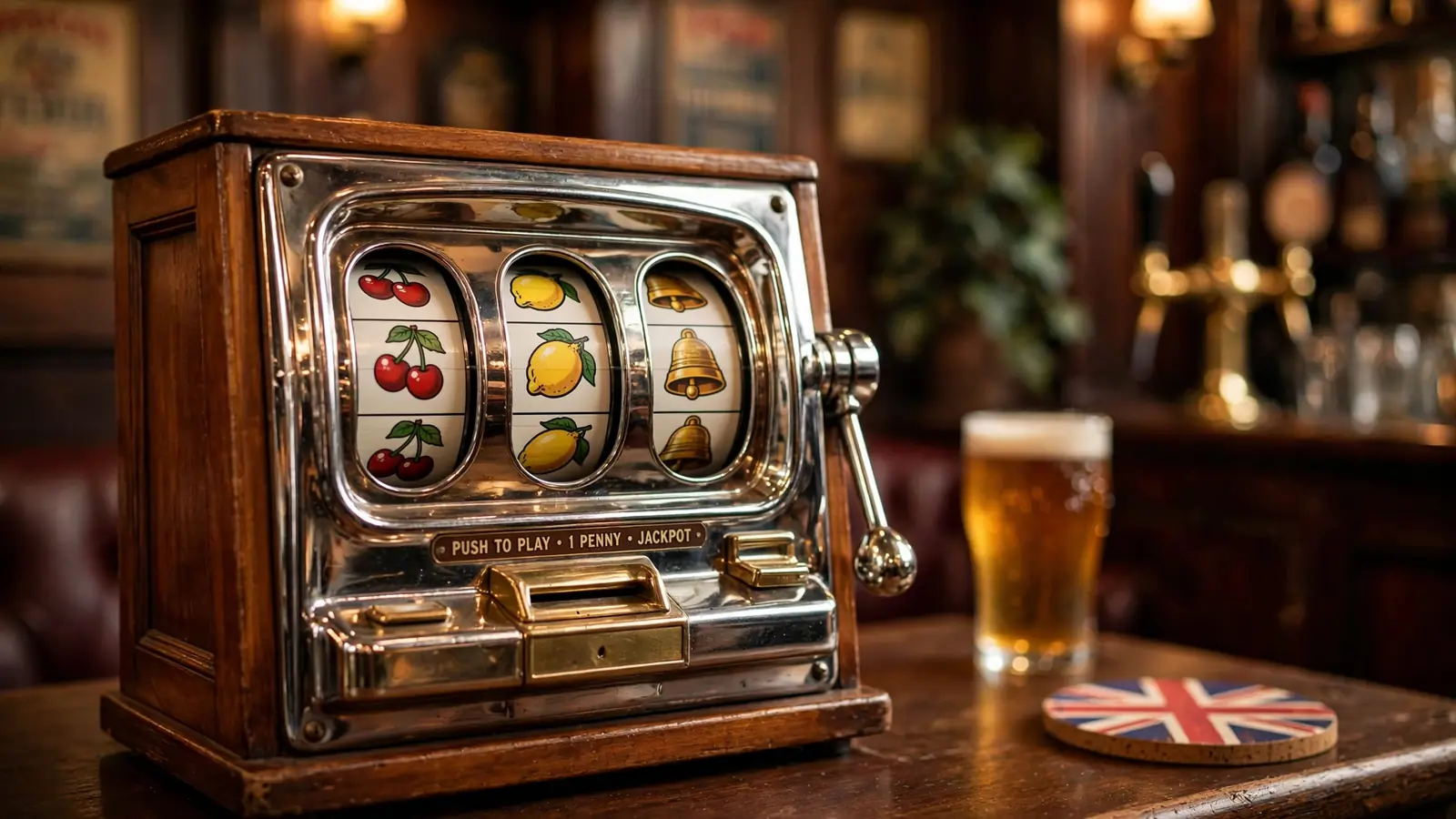
A classic slot is recognised less by its age than by its visual grammar: a compact set of reels, a small vocabulary of symbols and an outcome that can be read at a glance. The familiar picture is often three reels arranged in a row. That is an ideal, not a strict definition. Online versions may alter the layout, but the classic identity survives when the game still feels organised around simple reels and recognisable symbols.
Fruit, bells, bars and lucky numbers belong to this shared vocabulary. Their appeal is partly practical: distinct images are easy to scan as they pass, and a line of symbols is easier to understand than a screen crowded with instructions. The player does not need a story, a map or a collection of characters to grasp the basic premise. The reels turn; symbols settle into place. The winnings depend on which symbols the player lines up.
That clarity is cultural as much as visual. The fruit machine became a recognisable object in everyday life, with its bright face and visible moving parts. Its symbols were designed to be read quickly, even in a noisy room or during a brief pause in the day. Online, the cabinet disappears, but the shorthand remains. A row of fruit or bars can still suggest a classic slot before the title has explained anything.
The form also carries a particular kind of restraint. A classic game tends to keep attention on the reels themselves: their repeated movement, the small suspense before they stop, and the plain meaning of what appears. Modern online games can build much larger worlds around a spin, with extra screens, elaborate themes or layers of features. Those additions may sit alongside a classic layout, but they do not define the classic part. The distinction is not between old and new software; it is between a simple reel-led identity and a broader design that asks the reels to share the stage.
That is why a game can look contemporary and still feel classic. Polished animation, crisp sound and a digital interface do not erase the underlying arrangement. Equally, familiar fruit symbols alone do not necessarily make a game classic if its main appeal lies elsewhere. The label describes a compact form, not merely a decorative style.
The three-reel image has become a kind of visual promise: few moving parts, symbols with immediate meanings, and an outcome that can be seen rather than decoded. Online classic slots preserve that promise in a medium that can accommodate far more than the old machine ever could. The essential impression remains deliberately narrow. Reels first. Everything else is an addition.
A free version changes the meaning of a classic slot before it changes its appearance. The reels may look familiar, and the screen may present the same broad arrangement as a paid game, but no money is being risked. That makes a demo useful for orientation: it offers a chance to see how the game is laid out and what features it contains without making a wager part of the lesson.
For anyone approaching a three-reel classic slot machine, the first useful discovery may be how little needs explaining. The symbols, controls and general rhythm are visible on the screen. A demo can make the interface less opaque, particularly when a title has options or features that are not obvious at first glance. It is a rehearsal of the game’s presentation, not a rehearsal for winning.
The distinction matters because practice is often given more authority than it deserves. Repeated free spins can make a game feel familiar; they cannot show what a later paid session will produce. A run of matching symbols in a free classic slot is simply part of that demo session. It is not a promise that the same pattern will recur when money is involved, nor evidence that a losing run has somehow prepared the way for a win.
Free play can also make the pace of a title easier to assess. Some players value the plainness of classic free slots: a compact screen, a small set of visible elements and little need to navigate between layers of presentation. Others may find that a particular game includes more features than its old-fashioned look suggests. Either way, a demo reveals something about the experience of using that title. It reveals nothing reliable about the result of a future wager.
There is a quiet social history in this preference for trying before committing. Games have long been presented as entertainment that should be immediately legible, while the commercial arrangement around them can be less so. Free classic slots separate those two things for a moment. The game can be inspected on its own terms, without a deposit turning curiosity into a financial decision. A small but useful distinction.
That does not make free online classic slots a substitute for careful choices about money. A demo may help identify where controls sit or what a feature does, but it does not establish what a paid session will cost, how long it will last or what it will return. Those questions belong to a different decision. Setting deposit or time limits is recommended before wagering; free play can serve as a preliminary look, not as a method of deciding that a wager is safe.
The language around classic slots online free can imply a simple bargain: the same entertainment, minus the stakes. In practice, “free” describes the version being played, not a prediction about the paid one. A demo is useful precisely when its limits are understood. It can show a game’s layout and features. It cannot turn familiarity into foresight.
This is why playing free classic slots is best understood as inspection rather than training. The player can learn where the game places its information and whether its style is appealing. A session may be enjoyable in its own right, and that enjoyment need not be converted into a wager. The practice has a modest purpose, and modest purposes are often the most dependable ones.
The reels may spin in a demo, but the lesson is about the interface. It is not a rehearsal of fortune.
The old fruit-machine cabinet made its controls part of the ritual. Buttons sat below the reels, close enough to invite a quick decision while the symbols settled into place. Online, that physical arrangement becomes a row of touch targets or on-screen controls. The gesture is smaller; the question remains the same: what, if anything, can still be changed during the spin?
In fruit machine games, holds and nudges are the classic interventions. A hold keeps a reel’s displayed symbols in place while the others move; a nudge shifts a reel by a position. These are not simply decorative echoes of the cabinet. Where a title includes them, they can make the player’s attention move from the whole reel set to one particular reel, and from waiting for a result to choosing whether to act.
The software version is less tactile. A button can be tapped, but there is no mechanical resistance, no cabinet to lean towards, no physical pause that marks a decision. The interface has to show what action is available and when it can be taken. A hold may be offered on a particular reel; a nudge may appear as a separate choice. The details belong to the individual game, not to a universal rule for classic slot machines.
Some online titles may offer several holds or nudges during a single spin. Others make them available only under particular conditions, or omit them. That difference matters: a control that appears in one fruit-machine game cannot be assumed to work the same way in another. The familiar vocabulary survives, but the software decides when it applies.
This is where “classic” can describe a style without promising an exact replica. A digital slot machine classic may borrow the old cabinet’s sense of intervention while arranging its controls according to its own design. The reels remain visible; the decisions are presented through prompts, buttons or symbols on a screen. A player using a classic slot machine app encounters the same broad idea, though the controls are adapted to a smaller display.
The point of holds and nudges is not that they restore the old machine whole. They preserve a particular kind of pause: a moment when the reels are not merely watched, but considered. Software can reproduce the choice without reproducing the weight of a button or the sound of a cabinet. It can also make the choice conditional, or offer more than one intervention, depending on the title.
That is a modest transformation, but a telling one. The cabinet once made the player’s hand part of the machine’s language. Online, the interface translates that language into a tap. The old gesture remains legible. The machinery has changed.
A reel can look as if it is keeping score. A run of losing spins makes a win seem overdue; a recent win can lend the next spin an air of promise. The familiar symbols encourage this reading because they belong to a visual language built around repetition: cherries return, bells recur, and the same short sequence appears to invite comparison. But resemblance is not memory. On licensed online slots, a Random Number Generator (RNG) determines each result independently, so the previous spin does not leave a message for the next one.
That distinction matters whether the game is a classic slot or a newer title dressed in the style of a fruit machine. In regulated online games, past wins and losses do not alter the probability of the next spin. Nor does the moment a spin is started, or the size of the bet, steer its random outcome. A player may change the amount at stake, but that does not turn a cold run into a warmer one or make a result more likely because it feels due.
The mind is less tidy than the mathematics. People naturally look for patterns, especially where an action is followed quickly by a result. In a classic-themed slot, the repeated reel layout makes that habit easy to indulge: a symbol just missed can feel more significant than one that never appeared. Yet a near-match is not evidence that the game is moving towards a win. It is one outcome among many, not a clue about what follows.
This is why real-money classic slots should not be read as puzzles whose answer can be extracted from timing, a sequence of losses, or a change in stake. The machine’s look may carry the atmosphere of an old arcade cabinet, where buttons and reels seemed to invite a personal ritual. Online, the interface can preserve the ritual; the randomness does not join in. The symbols are familiar. The next result is not.
That does not make the format culturally empty. Classic slots borrow from the visual shorthand of shop-floor fruit machines and seaside amusements, where bright symbols made chance legible at a glance. Their appeal can lie in that compact, recognisable theatre, rather than in any belief that a pattern can be mastered. For people playing classic slots online for real money, it is useful to keep those two ideas apart: the game can feel familiar without becoming predictable.
A spin has no recollection of the last one. That is the point.
Playing classic slots online involves more than pressing the spin button. A game may ask for a stake, show a set of active lines and offer controls for changing them. The layout varies by title, so the amount displayed before a spin matters more than assumptions carried over from another game.
Some slots let players choose how many lines are active. That choice changes which lines can count towards a win; the game’s paytable explains the relevant combinations and any line rules. Where the control is available, it is worth checking the selected lines and total stake together before starting a spin. A familiar reel layout does not guarantee familiar settings.
The controls are only part of the arrangement. In Great Britain, online slot spins must last at least two and a half seconds, and autoplay is not permitted. The pace is therefore set partly by regulation, not just by a player’s preference for quick or deliberate play. There is no button that turns a regulated online slot into a continuous stream of automatic spins.
Stake limits also apply. For customers aged twenty-five and over, the maximum online slot stake is five pounds per game cycle; for those aged eighteen to twenty-four, it is two pounds. These limits apply to online slots in Great Britain, not to roulette or blackjack. They set a ceiling, not a suggested amount, and a game’s own stake controls may offer choices below it.
The distinction between a game setting and an account control is important. A line selector operates inside a particular slot; a financial limit applies more broadly to gambling activity on an account. Remote operators must prompt new customers to set a financial limit before their first deposit and make account-level limit controls accessible. Setting deposit or time limits can help make the boundary visible before play begins, rather than leaving it to a moment of frustration or excitement.
Age and identity checks shape entry as well. Online gambling is for adults aged eighteen and over, and operators verify a customer’s age before allowing a deposit. That check is not an optional extra attached to a particular classic game. It is part of the account conditions under which real-money play is offered.
Payment rules also narrow the available routes. UK-licensed casinos cannot accept credit cards for gambling, including credit-card funds routed through a money service business. A wallet cannot be used where it permits credit-card funds to be spent on gambling. The payment method therefore matters not merely at checkout but as part of the safeguards surrounding a gambling account.
The practical sequence is modest: review the game’s line and stake settings, note the account limits, and understand the controls before a spin. Online access can bring a broad selection of titles and stake options together, but convenience does not erase the conditions attached to wagering. The interface may look simple. The rules beneath it are not.
The familiar reels can remain in place while the game around them grows more elaborate. Online fruit machine games may add wild symbols, free spins or a pick-style mini-game without abandoning the compact, recognisable shape of a classic slot. The result is a hybrid: old visual grammar, newer interruptions.
A wild symbol can stand in for another symbol when a combination is formed, according to the game’s rules. It does not make every near miss a win; it changes what combinations may count. Free spins offer another stretch of play without requiring a fresh stake for each spin in that feature. Their value and conditions belong to the individual game, not to the phrase “free spins” itself.
Pick-style mini-games borrow from a different tradition: the player selects from presented objects or options, and the selection reveals an outcome. The reels may pause while this happens, briefly giving a slot the air of a game show. It is a small theatrical device, though the underlying product remains a slot.
Such additions alter the pace and texture more than the basic identity. A classic fruit slot game may still use a plain set of reels and familiar symbols, but a bonus round can make its rhythm less spare. That may suit players who want variation; it may also make a once-simple screen busier. The label “classic” describes an aesthetic and format, not a promise that every title will be mechanically modest.
The phone has changed the frame as well. Mobile compatibility means a game can be presented for smaller screens, with controls and graphics arranged to remain usable there. This is not merely the old machine shrunk into a pocket: software can reflow its display, while the same title may also appear on a larger screen. The cabinet has become optional. The habit of looking at reels has not.
Some interfaces elsewhere may advertise autoplay or quick-spin settings, but British online slots cannot use autoplay, and spins must retain the required minimum duration. Those restrictions matter because interface language can travel more freely than the rules governing it. A button familiar from another market does not establish that it is available in Britain.
The added features also make names less reliable as guides. Two classic casino slot games may look equally restrained in their base game, then diverge sharply when one introduces wilds and the other offers a selection round. The title and artwork say little about how often a feature appears or what its rules are; those are matters for the game’s own information.
Classic slots can borrow plenty. They need not pretend otherwise. The old shape survives, while the software keeps adding doors around it.
A classic slot may look like a small, self-contained amusement: reels, symbols, a button, perhaps a familiar fruit-machine rhythm translated into software. But an online casino is not simply a collection of games. It is a commercial gambling service operating within a public system of oversight, where the question of who is responsible matters as much as the appearance of the reels.
In Great Britain, that institutional role belongs to the UK Gambling Commission. It regulates commercial gambling in the country and is the sole regulator for that activity in Great Britain. Its remit includes online casinos, not merely gambling carried out in a physical venue. The same principle applies when a remote operator offers gambling to consumers in Great Britain: the location of the equipment running the service does not, by itself, take the activity outside the Commission’s reach.
That distinction matters in an online market built to make distance feel irrelevant. A casino may present itself through a screen, while its technical arrangements sit elsewhere; the regulator’s concern follows the service offered to consumers, rather than the geography of a server. The reels can be dressed as a London fruit machine or a glossy digital cabinet. The institutional question is less decorative: who is authorised to run the operation?
The Commission issues operating licences to businesses and personal licences to individuals working in roles that require them. These are different forms of permission. An operating licence concerns the business providing gambling; a personal licence concerns an individual operating within the regulated system. Together, they place responsibility both at the level of the company and, where required, the people whose work forms part of its operation.
That framework is the background to any classic slots casino serving the British market. The old visual language of a machine does not make the online service a nostalgic exception, nor does an attractive lobby alter the operator’s institutional obligations. A classic title remains part of a commercial gambling offer, and the offer sits within the Commission’s regulatory remit.
The word “casino” can suggest a place, with doors and a visible threshold. Online, the threshold is less obvious: a web page opens, a game loads, and the institution behind it may recede from view. Regulation supplies a boundary that the interface does not show. It identifies which public body oversees commercial gambling and establishes that remote provision to Great Britain is not detached from that oversight simply because the machinery is elsewhere.
This is a quieter part of the experience than the game itself. No flashing symbol announces it; no reel stops on a licence. Yet the framework shapes what an online casino is allowed to be in the market, including one whose most familiar attraction is the promise of an old-fashioned game. The costume is vintage. The responsibility is contemporary.
When choosing a UK site for classic slots in 2026, payout speed is one practical detail to consider alongside the games. This list gives a concise reference for the payout information available for each operator.
Zombillion
Zombillion lists a payout speed of 1–3 business days, a useful detail to consider when looking at classic slots.
Amunbet
Amunbet lists a payout speed of 1–3 business days. This provides a clear estimate of its stated payout timeframe.
Britsino
Britsino lists a payout speed of 1–3 business days, offering a concrete payout detail for players to consider.
Chanze
Chanze lists a payout speed of 1–3 business days. That is the available practical detail for assessing its payout timeframe.
SpinFormula
SpinFormula lists a payout speed of 1–3 business days, giving players a stated timeframe to bear in mind.
Dieselwin
Dieselwin lists a payout speed of 1–3 business days. This provides a straightforward reference point for its payouts.
NightLuck
NightLuck lists a payout speed of 1–3 business days, a relevant detail when considering where to play.
Jetsetspins
Jetsetspins lists a payout speed of 1–3 business days. Its stated timeframe is the available detail to consider here.
x3bet
x3bet lists a payout speed of 1–3 business days, giving a clear indication of its stated payout timeframe.
WinBeast
WinBeast lists a payout speed of 1–3 business days. This offers a practical payout detail for players reviewing their options.
“Best” is a slippery word when applied to classic slots. It can mean a familiar reel layout, a pace that suits a particular player, or simply a title that feels less cluttered than a newer game. None of those qualities can settle whether an offer attached to a game is worthwhile. That depends on its conditions, which tend to be less visible than the bright promise of extra spins.
A list of best classic slots would suggest that one game could be placed above another by a universal measure. But taste does not work like that. The appeal may lie in recognisable symbols and a straightforward arrangement, while another player may prefer a classic format with added features. The useful question is not which title wins a contest, but what the game and its accompanying terms actually ask of someone.
The same applies to choosing among classic slots sites or a classic slots casino. A broad lobby may contain familiar-looking games, but the presence of a title does not explain whether a particular promotion covers it. Nor does a game’s appearance establish that it is a sensible match for an offer. Promotion rules need to be read as their own small contract: the eligible game, the qualifying action and the conditions for receiving or withdrawing anything attached to it.
Some offers may include specific conditions, such as a forty-times wagering requirement for twenty-five extra spins, or a requirement that a bonus be wagered thirty times before withdrawal.
Some bonuses come with wagering requirements. In practical terms, a bonus may have to be played through under stated conditions before it can be withdrawn. A stated requirement of thirty times the bonus, for instance, is a condition to understand before accepting the offer, not a decorative footnote. The size of a headline offer alone cannot show how much play its terms demand.
One specialist affiliate review described a Sharkanade Slot offer in which a forty-times wagering requirement had to be met to receive twenty-five extra spins. That is a report about a particular offer, not a standing rule for classic slots or casinos generally. Offers can change, and the condition belongs to the offer as described by that review. It should not be mistaken for a general feature of the game itself.
There is also a stated condition that a bonus must be wagered thirty times before withdrawal. The wording matters: the requirement attaches to the bonus, and its effect depends on the complete terms presented with the promotion. A player comparing offers needs to distinguish the threshold for qualifying for an advertised extra from the requirement that applies before a bonus can be withdrawn. Similar-looking numbers in promotional copy may refer to different steps.
That distinction can make a modest offer clearer than a larger one. A promotion with plainly stated conditions can be easier to assess than one whose headline is prominent but whose qualifying rules are scattered through fine print. No ranking of the best online classic slots can resolve that comparison on its own. The title, offer and conditions must be considered together.
The old word “best” often carries a promise of certainty: that someone has already done the choosing. With classic slots online, it is more useful as a question of fit. A game may suit a preference; an offer may or may not suit the intended play. The small print decides the second part.
Quite a distinction.
A lobby presents games as a neat procession of titles and images. An account is less decorative: it is where a casino checks who is applying, sets the conditions for access and gives customers ways to manage their relationship with the service. The distinction matters whether the attraction is classic fruit slots or a newer game with a crowded screen.
Online gambling is for adults aged 18 and over. Operators verify a customer’s age and identity when an account is created, and they must check age before allowing a deposit. These checks are not an optional administrative flourish. They sit at the entrance to real-money play, before the game catalogue becomes relevant. A familiar set of classic slot symbols does not make the account any less consequential.
The account also contains controls intended to make spending and time more deliberate. Remote operators must prompt new customers to set a financial limit before their first deposit, and accessible account-level controls must remain available. A limit is useful only if it can be found and understood without becoming an expedition through menus. The design says something about the service: whether customer management is treated as part of the product or as an inconvenient footnote.
This is a different question from whether classic slots casinos offer the right kind of reels. A site may have a wide range of games, but the lobby cannot answer how limits are managed, how a complaint is handled or what happens when someone wants to stop gambling. Those arrangements belong to the customer account, not the game.
UK-licensed casinos must provide responsible-gambling tools, including self-exclusion. They must also have an internal complaints process and give customers access to an approved Alternative Dispute Resolution service. That creates a route beyond the cheerful surface of the lobby if a dispute arises. It does not mean every disagreement will be resolved in the customer’s favour; it means there is a defined process rather than a dead end.
Account management is therefore part of comparing online classic slots sites, even when the immediate interest is simply a familiar reel layout. The useful details are not only which games appear, but whether age and identity checks are clear, whether limits are accessible, and whether self-exclusion and complaints routes can be located when needed. These are ordinary parts of the service, and ordinary things tend to reveal the most.
The account is where a casual visit becomes a recorded relationship: identity established, access controlled, choices made. For classic slots casinos in the UK, that relationship matters as much as the old-fashioned symbols on screen. The lobby is the invitation. The account is the arrangement behind it.
A classic slot can appear in a browser without a separate game download. The browser provides the doorway: the game’s software is delivered through the page, rather than installed as a standalone program on the device. For someone looking for classic slots online in the UK, that can mean opening a responsive web version instead of adding another app to a phone or computer.
A download is a different route to access, not a different kind of reel. Where a game is offered as installed software, it may be launched from the device rather than loaded afresh in a browser. The distinction concerns where the program is opened and how it reaches the screen. It does not, by itself, say anything about the game’s design or its results.
This is an unglamorous difference, but a useful one. Browser play leaves no separate game installation to manage; a download may suit someone who prefers an app-like entry point. Neither description establishes that a particular title is available in both forms, or that downloading it makes play more reliable. The route depends on what the game and platform provide.
The same caution applies to free classic slots that run without a download. “No download” describes access, not a promise that every game can be opened without an account, nor a guarantee that a free version will match every aspect of another edition. Those details belong to the individual service and title.
Most importantly, delivery does not supply a shortcut to prediction. Some slots use a random generator to produce outcomes. Whether the game is opened in a browser or from installed software does not turn a random result into one that can be read from the way the previous screen looked. The old cabinet once hid its machinery behind a painted panel; software hides its processes behind a neat interface. A different curtain.
The practical choice is therefore modest: browser access avoids installing a separate game, while a download is another possible way to open software when offered. Neither changes the nature of a spin. The screen may arrive through a page or an app; randomness does not take instructions from the doorway.
Yes, demo versions let you explore a game's layout and features without wagering money. Free spins do not predict the results of later paid play.
Online slots are capped at £5 per game cycle for customers aged 25 and over. This limit does not apply to roulette or blackjack.
Setting deposit or time limits can help you manage your play. You can also try a demo to familiarise yourself with a game's layout and features before wagering.
Licensed sites use random number generators, making each spin independent and unpredictable. Previous wins or losses, timing and bet size do not change the odds of the next spin.
Yes. You must be at least 18 to gamble online, and operators verify customers' age and identity when they open an account.