Live blackjack combines a human dealer and physical cards with digital play, making clear rules, suitable limits and a reliable connection important.
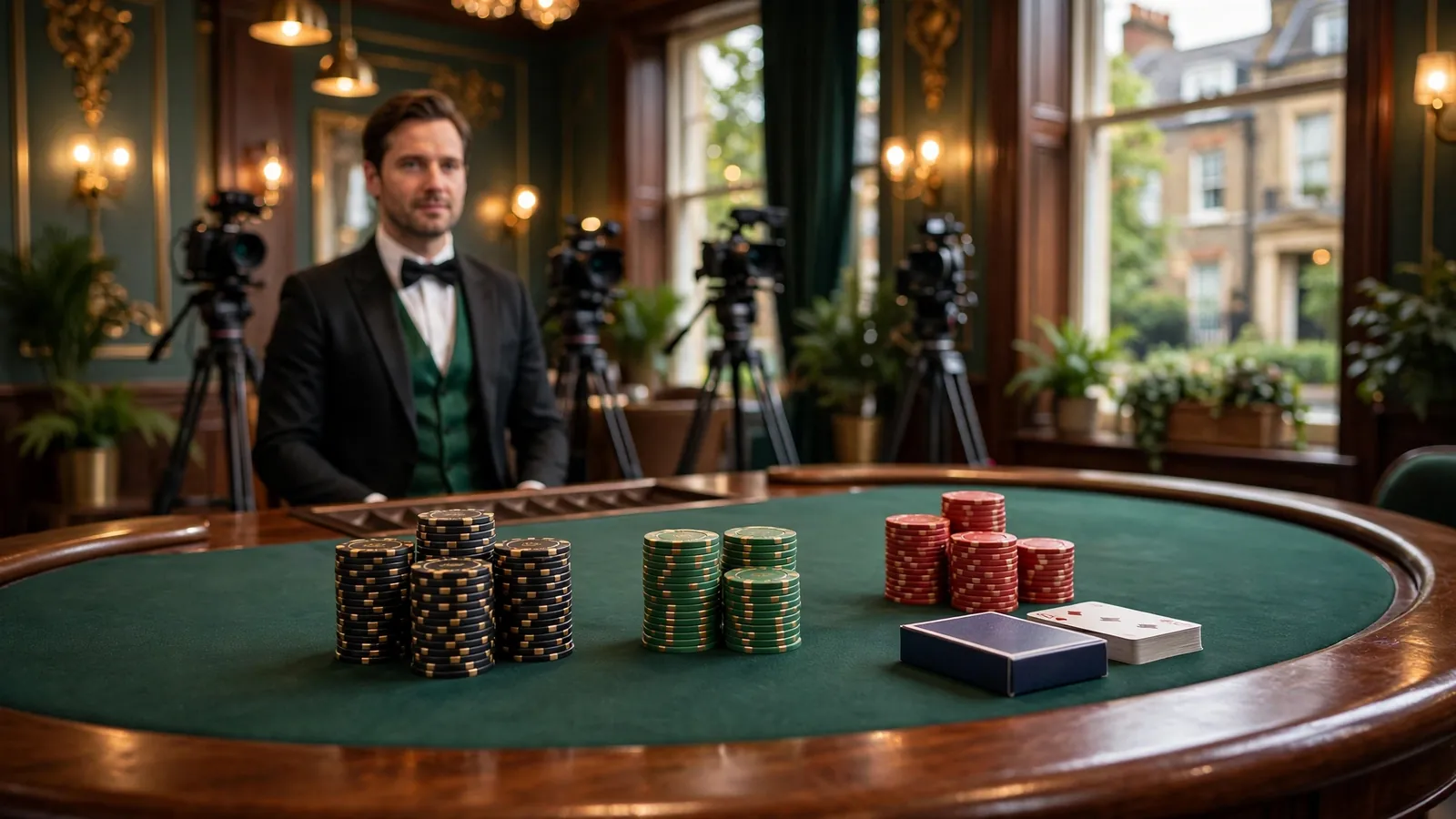
“Best” is a useful word until it is asked to do too much. In live blackjack, it might mean a table whose rules are easy to inspect, a stake range that fits a player’s budget, or an interface that makes decisions clear rather than hurried. Those are different qualities. A polished screen cannot make an unfavourable rule disappear, and a long list of tables does not, by itself, make a casino suitable.
A sensible comparison starts with the game rather than its decoration. Blackjack retains a house edge: over time, the casino has a mathematical advantage. That does not predict the result of any particular hand, but it does place a limit on what can honestly be promised. A player may win a session; no table label can turn that possibility into a reliable expectation.
The edge is not a mood or a marketing phrase. It is the underlying imbalance in the game’s terms. For that reason, the useful questions are concrete: are the table rules plainly presented, can the available limits be seen before play begins, and does the information explain how decisions and payouts work? If the conditions are hard to find, ambiguity becomes part of the experience. That is not a feature.
When choosing a live blackjack casino, it helps to consider practical details alongside the games themselves. The stated payout speed for each entry offers one useful point to check.
Zombillion
Zombillion has a stated payout speed of 1–3 business days, a practical detail to consider when assessing it for live blackjack.
Amunbet
Amunbet’s stated payout speed is 1–3 business days. This is the available information to weigh when considering it for live blackjack.
Britsino
Britsino lists a payout speed of 1–3 business days, giving readers a concrete point to consider for live blackjack.
Chanze
Chanze has a stated payout speed of 1–3 business days. Beyond that detail, no further operator-specific information is available here.
SpinFormula
SpinFormula’s listed payout speed is 1–3 business days, a useful practical consideration for live blackjack players.
Dieselwin
Dieselwin has a stated payout speed of 1–3 business days. That payout information is the available basis for considering it.
NightLuck
NightLuck lists a payout speed of 1–3 business days, offering one practical detail to check when considering live blackjack.
Jetsetspins
Jetsetspins has a stated payout speed of 1–3 business days. No other operator-specific facts are provided here.
x3bet
x3bet’s stated payout speed is 1–3 business days, which provides a practical point of reference for readers.
WinBeast
WinBeast lists a payout speed of 1–3 business days. This is the available operator-specific detail to consider.
Table rules deserve attention because blackjack is not a single, unchanging arrangement. The details governing a table affect how play unfolds, so a comparison should not treat every listing with the word “blackjack” as interchangeable. The point is not to turn a casual game into an examination. It is to know what is being offered before money is committed, rather than discovering an important condition mid-session.
Stake limits matter in a more personal way. A table can be attractive in every other respect and still sit outside the amount a player has decided is acceptable. The relevant question is not whether a minimum is low in the abstract, but whether the permitted stakes fit a pre-set budget without encouraging it to expand. A budget is most useful when it is settled before play, not rewritten in response to a run of wins or losses.
This is where claims about systems need a cool reception. Martingale and similar staking approaches change the size or sequence of bets; they do not change the house edge. A sequence of losses can require larger stakes, and losses can still occur. The system may create a feeling of control because it supplies a plan for the next wager. It supplies no control over the cards.
That distinction matters culturally as well as mathematically. Gambling has always offered a meeting between chance and human order-making: rituals, methods and rules promise a pattern against uncertainty. A staking plan can organise behaviour, but organisation is not an advantage over the game. The table does not become fairer because a player has named a sequence. The arithmetic remains indifferent.
A careful assessment also considers how clearly the offer is described. The table information should be accessible before play, with rules and payout details set out in a form that can be understood without guesswork. A comparison based only on striking imagery, a crowded lobby or claims of excitement measures presentation, not suitability. Atmosphere can be part of the appeal; it is a poor substitute for terms.
The same restraint applies to promotional language. Words such as “best” and “top” are conclusions, not evidence. They mean little unless the criteria are visible and relevant to the person making the choice. A practical shortlist, if one is being made, should be built around what can actually be checked: understandable rules, visible limits, clear information and a stake range compatible with a fixed budget. It need not become a ranking.
Nor should a single session be treated as a verdict on the table. A win does not prove that the offer was favourable; a loss does not prove that every feature was poor. Short-term outcomes are emotionally vivid, which is precisely why they can distort comparison. The more dependable basis is the structure of the offer and whether its terms are understood before play starts.
Live blackjack can be entertainment, but it is still gambling, not a method of earning income or a dependable way to recover losses. This guide is for entertainment purposes only and is not gambling advice. A good choice, in the limited sense available here, is not a promise of profit. It is an informed decision about a game whose house edge remains in place.
No system abolishes it.
A live blackjack table arrives through a studio stream rather than a sequence generated entirely on a screen. A human dealer handles the cards in real time; the player follows the table by video and places bets through controls displayed alongside it. The arrangement joins two kinds of action: the physical dealing at one end, and the digital decisions at the other. It is less like opening a self-contained game than taking a seat at a table that happens to be somewhere else.
The camera matters because it makes the dealer’s work visible. Cards are dealt from a standard deck, and the stream shows that process as it unfolds. The hand is not represented solely by symbols appearing on a screen: there is a person dealing, cards being handled, and a table whose activity can be watched as it happens. For some players, that visible sequence gives the game a social texture that an automated presentation cannot supply. For others, it is simply a different way to follow the same table. The distinction is in the experience, not in a promise of better outcomes.
The dealer is not a decorative figure placed beside the interface. Their presence organises the event: a hand is dealt, the table proceeds, and the player’s on-screen controls connect an individual wager to the shared session. That human element can make an online game feel less solitary, though it does not turn the player and dealer into companions in any substantial sense. The dealer is working within a streamed format, while participants may be watching from separate places, each with their own view of the table.
Some games add chat, allowing messages between players and the dealer, and sometimes among players themselves. It offers a small channel for acknowledgement or conversation, without changing the basic distance between the studio and the person at home. A greeting can be answered; the cards remain physical, the stream remains one-way in its central function, and the table continues according to its own course. Sociability, in this setting, is real but carefully bounded.
That boundary is part of the format’s peculiar appeal. Traditional casino tables gather bodies around a shared surface; a live online table presents the same kind of dealer-led scene through a camera, while the interface handles participation. The image conveys presence, but not shared room or shared circumstance. Each player sees the dealer and the cards, yet the social world of the table is assembled from separate screens. A modest fiction of company.
The stream also gives the dealer a role that is both practical and symbolic. They carry out the visible dealing, while the camera makes that action legible to people who are not in the studio. The player does not handle the cards, but can observe them being handled. That difference may sound slight; it is the defining human detail of live blackjack. The experience depends not only on what appears on the screen, but on the fact that someone is physically doing it in real time.
This is why “live” describes more than a visual style. It means a human dealer and physical cards are part of the streamed game, rather than an animated substitute for them. The online interface still mediates the player’s involvement, and the screen still separates the table from its audience. Yet the dealing is happening now, not merely being rendered as a convenient imitation of a casino scene.
The result is neither a visit to a casino nor just another digital display. It is a remote encounter with a working table: visible, mediated and, in some games, faintly conversational. The camera cannot abolish distance. It can give distance a dealer.
A blackjack casino site is more than a page carrying a green baize design. It is the online face of an operator arranging gambling: customers access games, place real-money bets and receive the operator’s services through a digital account. In a live-dealer game, the screen connects that account to a table streamed from a studio. The setting may look distant from a British high street, but the operator’s regulatory status is not determined by the studio’s address.
For real-money live blackjack offered to people in the UK, the essential legal condition is a licence from the UK Gambling Commission. A live dealer casino is legal in this market when it holds that licence. Remote operators serving the British market must be licensed even if they are based elsewhere. A foreign office, a polished interface or a familiar game name does not replace the relevant UK authorisation.
This makes a UK blackjack site a regulatory category as well as a gaming destination. The licence belongs to the operator, not to the felt, the camera or the particular blackjack table. A site can present many games and services, but its legal standing rests on the licensed business behind them. The screen is the shop window; the licence is attached to the business that opens it.
That distinction matters because online design can make separate companies and jurisdictions appear to dissolve into one seamless service. A player may see a dealer in a studio, a menu of tables and a balance displayed in an account, all within the same interface. Yet the visible experience does not tell the whole story of who is taking the bets or under which regulatory system the service operates. The UK Gambling Commission’s role is to license and regulate operators serving the British market.
The Gambling Act 2005 provides the wider legal framework for gambling in England, Wales and Scotland. It defines a casino in terms of an arrangement that gives people the opportunity to take part in casino games. The law therefore concerns the organised provision of gambling, not simply the building traditionally associated with a casino. Online blackjack belongs to that wider change: the institution has moved from a room with doors to an account accessed through a screen. The obligations have not disappeared with the architecture.
Legal access is also distinct from the question of whether a particular site is suitable or enjoyable. A licence establishes the operator’s regulatory position; it does not mean every table has the same rules, atmosphere or pace. Nor does the phrase “blackjack casino” itself certify anything. Marketing language describes an offer. It is not a regulatory document.
For a site serving customers in Great Britain, the operator must hold the relevant UK Gambling Commission licence to offer real-money gambling. The Commission’s public register provides a way to establish whether an operator is licensed, rather than relying on a badge reproduced on a webpage. That is a question of status, not a verdict on the quality of the games.
Age is part of the legal framework too: online gambling is permitted for people aged eighteen and over when the operator holds the required UK licence, and operators must verify a customer’s age before allowing deposits. These conditions sit behind the apparently simple act of opening a blackjack table. The dealer may be visible; the structure that makes the wager lawful is less theatrical.
The screen shows the game. The licence identifies the operator responsible for offering it. A modest distinction, with real consequences.
Blackjack gives each hand a plain objective: finish closer to twenty-one than the dealer without going over. That is the shape of the contest, not a promise about its outcome. A hand can be well judged and still lose; a poor decision can happen to win. The distinction matters because people often look for a method that turns a game of uncertain results into a dependable income. No staking pattern can do that.
The appeal of a system is easy to understand. A sequence gives decisions an appearance of order: stake this amount, increase after a loss, return to the starting point after a win. The best-known example, Martingale, calls for raising the next stake after a loss in the hope that a later win will recover the earlier losses and produce a small gain. On paper, the sequence looks tidy. At a real table, tidy arithmetic meets a run of losing hands.
Each increase makes the next stake larger, while a player’s available money does not expand to match it. A long enough losing sequence can make the planned next bet impossible. Even before that point, the approach concentrates risk in the hope of collecting a modest return. It does not make the next hand more likely to win, nor does it remove blackjack’s house edge. The system changes the size and timing of stakes, not the underlying contest.
That is the quiet weakness in many advertised routes to “how to win” at casino blackjack. The phrase can suggest that a repeatable technique exists, waiting to be discovered. In practice, a player may improve the quality of decisions by learning the game, but a staking scheme is not a substitute for that knowledge and cannot guarantee a winning session. A run of favourable outcomes may feel like proof; it is only a run.
Blackjack’s social history helps explain the attraction. Games built around cards and wagering have long offered a meeting between calculation and luck, and a system lets a player feel that calculation has taken charge. It also turns losses into a supposed stage in a plan: the next larger stake is described as recovery rather than increased exposure. That is a persuasive story, especially when the earlier losses are still fresh. It remains a story.
The dealer is not the only force setting the terms. The house edge means that the game is structured to favour the casino over time, even though individual hands can go either way. A staking system cannot reverse that structure. It may produce short stretches of wins, just as ordinary play may; neither pattern establishes that the advantage has changed.
A more honest aim is modest: understand what a hand is trying to achieve, decide in advance what amount can be lost without consequence, and stop when that boundary is reached. A budget is not a strategy for defeating the casino. It is a way of keeping the cost of entertainment from quietly becoming something else. No system changes that arithmetic.
The main blackjack wager is not always the only one available. Some live tables add side bets or a Bet Behind option, turning the felt on screen into a small menu of choices around the central game. These features are optional; they do not replace the hand itself, and their presence depends on the table.
A side bet is a separate wager offered alongside the main one. Its outcome is assessed under the conditions shown for that particular bet, rather than being treated as part of the main wager. That distinction matters: a table can present several choices together while giving them different rules. The visual unity of the interface can make separate bets look like one package. They are not.
The label alone is not enough to establish what a side bet requires or how it pays. Those details belong to the table’s rules and paytable, which can vary between games. A name may sound self-explanatory, but the operative detail is the condition attached to it. Without that, a side bet is simply another way to commit money to a result that is not the main wager.
There is a social history in the arrangement. Casino games often acquire extra wagers as they are adapted for tables and audiences: a familiar central contest stays in place, while the surrounding choices invite different forms of participation. Online, the options are arranged in a neat interface, but neatness is not simplicity. Each additional selection has its own terms.
Separate wagers with their own specific rules and paytables, distinct from the main hand.
Allows a player to place a wager on a hand being played by another person at the table.
Bet Behind offers a different kind of choice. It allows a player to place a wager in connection with a hand being played at the table by someone else. The player’s money is attached to that hand, not to a separate side-bet condition. It can therefore make participation possible without taking the active seat in the same way as the player whose hand is on screen.
The distinction is worth keeping clear. A side bet adds a separate proposition; Bet Behind links a wager to another player’s hand. Neither feature changes the basic identity of blackjack, and neither should be mistaken for a method of controlling the game’s outcome. They are table options, not shortcuts.
The interface may give these extras prominent buttons, especially when the main hand is already familiar. That prominence is design, not evidence that an option is necessary or favourable. A restrained approach begins with the rules attached to each choice and the total amount set aside for play. Optional does not mean inconsequential.
Live blackjack can thus contain more than one kind of decision, even before the main hand is considered. Side bets and Bet Behind widen the ways to join a table, but they also make it easier for separate wagers to blur together. The table is offering choices, not instructions. The distinction is useful.
This content is for entertainment purposes only and is not gambling advice.
Live blackjack brings a familiar casino scene into an online setting: a human dealer, physical cards and a table seen through real-time video. The cards are not generated as images by the game software. They are dealt in a studio, while players use an on-screen interface to take part.
That combination is the defining feature of a live table. The setting is digital, but the visible action is physical. A dealer handles cards from a standard deck; the camera carries that action to the screen, and the interface provides the means to place bets. The result sits between two kinds of play: a wholly digital game and a visit to a casino room. It borrows the room’s ritual without requiring a room.
The distinction matters because “blackjack online” can describe quite different experiences. A digital version presents a game through software alone. Live blackjack instead makes the dealer and the dealt cards part of what is being watched. The screen is not merely a display for the hand; it is the window onto a table where the cards are physically in motion.
There is a small social element, too. Players can see the dealer and may interact with them, and some games provide chat with the dealer or other players. This does not make an online table equivalent to a crowded casino floor. The exchange is mediated by the interface, and the shared room exists as a stream rather than a place. Still, a greeting or a brief comment can make the session feel less like operating a piece of software and more like joining a public ritual.
That ritual has a history older than the screen. Card games have long depended on visible handling: a shuffle, a deal, the turn of a card. Visibility helps establish that the same physical objects are being used for everyone at the table. In a live online game, the camera makes that handling available to people who are not present in the studio. The table travels; the cards stay put.
For a UK audience, the phrase “live blackjack” therefore describes a particular arrangement, not simply a theme or graphic style. A human dealer conducts the game in real time, physical cards are dealt, and a remote player participates through the screen. Each part has its own role: the dealer performs the game, the camera makes it visible, and the interface connects the player to the table.
It remains an online activity, shaped by a screen and its controls. But the object at its centre is not an animation of cards. It is a real hand being dealt somewhere else. A small distance, and a real one.
Blackjack has a compact central rule: the player is trying to beat the dealer with a hand worth twenty-one points, without exceeding that total. The number is both destination and boundary. A hand that goes beyond it has crossed from advantage into defeat; more points do not make it stronger.
That simple arithmetic gives the game its name and its tension. Each hand is judged by its total in relation to the dealer’s, not by the number of cards or by how impressive the cards look individually. The objective is not to collect cards indiscriminately, nor to pursue a high score for its own sake. It is to reach the useful edge of the limit and remain on the right side of it.
The distinction between “twenty-one” and “over twenty-one” is the heart of casino blackjack rules. The first is the target stated by the game; the second is the point at which a hand has gone too far. A player can therefore lose through excess as well as through failing to beat the dealer. Blackjack is a contest shaped by a ceiling, not a race in which every additional point helps.
That makes the basic rule different from the various additions that may appear on a table. A side bet, where offered, is an extra choice alongside the main wager; it does not change what the central hand is trying to do. The same is true of other table options. They may add another decision or another condition, but the main comparison remains between the player’s hand and the dealer’s, with twenty-one as the limit that must not be passed. The ornament does not alter the frame.
This distinction matters because a casino’s blackjack display can contain several kinds of information at once: the main hand, available choices and any additional betting feature. The central rule is the least elaborate of them, and the easiest to lose sight of when the interface gives every option equal visual weight. Yet the main hand still turns on its total and whether it beats the dealer without going over. Optional features are not a substitute for understanding that.
Blackjack rules at a casino can be presented alongside table-specific details, so the posted instructions remain relevant to the particular game. But the governing idea is plain enough to survive the screen: beat the dealer, reach twenty-one if possible, and do not exceed it. Nothing in an extra feature turns twenty-two into a better answer.
A narrow margin. That is the design.
A live blackjack table keeps time differently from a digital one. Each hand unfolds through a dealer’s actions, rather than being dealt and resolved almost instantly by software. Cards have to be handled, decisions registered and the table moved on. The result is a slower rhythm, with pauses that belong to the format rather than signalling a fault. For anyone accustomed to rapid digital play, the change is practical as much as atmospheric: fewer hands can be completed in the same stretch of time.
That slower pace can make it easier to follow what is happening, but it also changes how long a session lasts. A pause between hands is not an invitation to increase a stake or recover money already lost. A set budget, decided before play, gives the session a boundary; sticking to it matters more than trying to make the table’s pace work in one’s favour. Losses should not be chased.
The other practical difference is the cost of joining a table. Live blackjack often has higher starting limits than digital versions, so the minimum stake can rule out a table even when its presentation looks appealing. A specialist review has cited some live roulette and baccarat tables starting at roughly 20p, while describing higher starting limits for blackjack. That is one review’s snapshot, not a dependable price label for the whole market. Table limits vary, and the displayed minimum is the relevant figure before a hand begins.
A low minimum is not automatically the best fit. The pace of live play leaves less room for rapid changes between hands, and a stake that feels small in isolation can accumulate over a longer session. Checking the table’s displayed limits and setting a firm spending boundary helps keep the decision grounded in the cost of play, rather than the polished room on screen.
A reliable internet connection is part of the practical setup, not an optional refinement. Live games depend on a continuous stream; an unstable connection can interrupt the view or make it harder to follow the action as it happens. A stable connection helps keep the visual sequence and the on-screen interface in step. That is especially relevant where decisions must be made while the table is moving.
Free-play blackjack, where available, is separate from real-money play: it offers no real payouts. It can show the interface and pace, but it cannot reproduce the financial pressure of staking actual money. Live play is slower, and connection-dependent. That is the bargain.
A blackjack casino bonus can look like an invitation to sit at a live table, while the offer itself is built for another part of the casino. A specialist review of UK welcome promotions reports that most such offers are free spins on slots, which cannot be used at live tables. The distinction is easy to miss when a promotion is presented as a general welcome package rather than a benefit tied to particular games.
A casino Blackjack bonus may also come with wagering requirements: conditions that specify how bonus funds, or winnings from them, must be played through before withdrawal. Live blackjack may count towards those requirements at a reduced rate. Live games often receive only a small share of the contribution, with 10% given as an example. In practical terms, that means eligible play at a live table can make much less progress than the same amount staked on a game with full weighting.
The percentage is not a promise about every offer. Each operator sets out its own terms, and the weighting can depend on the promotion and the game. The offer page and its full terms are therefore more useful than the headline. They should make clear whether live blackjack is included, how it contributes, and whether any other conditions apply. A bonus that cannot be used at the table is not a blackjack bonus in any meaningful playing sense.
The same caution applies to a no-deposit promotion. The label alone does not establish that live blackjack is eligible, nor does it explain what must happen before any resulting funds can be withdrawn. A Blackjack casino no-deposit bonus UK offer, if encountered, needs to be read by its conditions rather than its name. “No deposit” describes one feature, not freedom from restrictions.
Bonus terms can turn a generous-looking figure into a narrow route through the games the casino has chosen to include. Before opting in, the relevant checks are wagering requirements, game weighting and any maximum bet limits. A set budget matters too: a promotion does not make additional play costless, and it should not become a reason to extend a session or chase progress. The small print is part of the price.
A casino may advertise blackjack in its game lobby, but that label says only that the game is offered. It does not, by itself, establish the legal status of the service or make the venue suitable for every player. In Britain’s online market, the distinction matters: a familiar table-game name can sit behind a screen, while the operator remains responsible for meeting the rules that govern remote gambling.
For live blackjack, the legal test is specific. A live-dealer casino serving players in the UK may operate legally if it holds a licence from the UK Gambling Commission. The licence attaches to the operator, not to the game’s title or the appearance of its digital table. A polished interface is decoration; regulatory permission is the substance.
This is why “casino with blackjack” and “licensed casino offering live blackjack” are not interchangeable descriptions. The first identifies a game in a catalogue. The second also makes a claim about the operator’s standing. A blackjack casino site can present the game as one option among many, but its presence should not be mistaken for proof that the site is authorised to provide it to UK customers.
The same distinction applies whether blackjack is played through an online casino or at a live table. The word “live” describes the format; it does not create an exemption from licensing. In the UK, legal live-dealer play depends on the relevant UK Gambling Commission licence.
Availability, then, is a narrow fact, not a recommendation. A game can be present without being appropriate for a particular person, and a listing is not an endorsement. This article is for entertainment purposes only, not gambling advice. Any play should be planned within a set budget, rather than used to recover losses or extend a session beyond its limit.
No. The house edge depends on the game’s rules, so check the table conditions before betting.
The dealer does not always win: players can win individual hands or sessions. The house edge gives the casino an advantage over time, but it does not determine the outcome of any particular hand.
Choose a UK Gambling Commission-licensed casino, then check that the table rules, payouts and stake limits are clearly shown and that the limits fit your pre-set budget.
Live roulette includes European, American and French roulette. American roulette has both 0 and 00, while European roulette has a single 0; in French roulette, an even-money bet loses only half when the ball lands on 0.