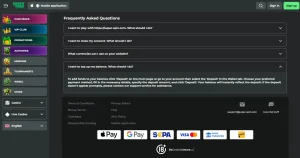
A Revolut option in the cashier does not by itself confirm bonus eligibility or determine how withdrawals will be handled.
A casino account and a Revolut account can look like a neat pairing on a screen: one holds the balance for play, the other supplies the payment details. The important question is not whether the names sit comfortably together, but what the casino’s cashier and bonus terms say about the particular transaction. A payment route appearing somewhere on a site does not, by itself, settle whether a promotion applies to a deposit made through it.
That distinction matters most when an offer is involved. Bonus terms may define which payment methods qualify, how a deposit must be made, and whether the promotion has to be selected before payment. Those conditions belong to the offer, not to the visual presence of a payment logo. A Revolut deposit that reaches a casino balance and a Revolut deposit that qualifies for a bonus are separate outcomes.
Before accepting an offer, the useful detail is the payment-method wording in its terms. It may name permitted routes, exclude particular categories, or direct customers to check eligibility with the casino. If Revolut is not mentioned, that silence should not be mistaken for confirmation. The promotion may still be available, but its terms or the operator’s response are needed to establish that.
Payment exclusions are not peculiar to Revolut. A specialist review has reported that PayPal, despite its appeal for speed and convenience, may be excluded from bonus eligibility. That is a reported qualification, not a rule that can be applied to every casino or offer. The broader lesson is less glamorous: a familiar payment name does not decide the bonus question.
A useful reading separates three things: whether the cashier permits the route, whether the casino credits the deposit, and whether the promotional terms count that deposit. The first two do not automatically answer the third. If the terms are unclear, the operator’s own written clarification is more useful than an assumption based on a general payment page.
Searches linking Revolut with slots often bundle several wishes into one: a playable casino account, a deposit route and a bonus that can be used alongside the games. Yet these are different parts of the arrangement. A site may offer slots without a particular payment option; a payment may be available without qualifying for a promotion; an offer may carry conditions that shape how its balance can be used.
No slot title can be called the “best” choice on the strength of a payment method. Revolut does not establish a game’s quality, and a bonus label does not explain the conditions attached to it. The relevant documents are the casino’s game information and the specific promotion terms. Claims that a payment method unlocks a special set of slots or guarantees a bonus need evidence from the operator, not inference from the cashier.
For a bonus, the small print deserves attention beyond the headline amount. It can specify the eligible deposit route, how the offer is activated, and what restrictions apply to using the promotional balance. Those details are particular to the offer. Treating one casino’s wording as a general rule for Revolut deposits would turn a local condition into a false market-wide promise.
A routine transaction, without an offer, is simpler to assess: the cashier either presents the route for that account or it does not. Adding a bonus introduces another set of terms and another possible point of refusal. The bonus is not an automatic passenger.
A general payment page is a useful starting point, not a binding answer to every account’s circumstances. A specialist review’s list of Visa and Mastercard options, for instance, cannot prove that every card product is currently available to UK customers or eligible at a given casino. The cashier is where current availability and product eligibility have to be checked. Nor does a listing of card networks establish that Revolut itself is accepted.
That is why the phrase “Revolut casino” can conceal several different propositions. It might mean a casino that accepts a Revolut-branded card, a casino where a Revolut account can fund a payment, or simply a casino whose payment page mentions a route that the player associates with Revolut. Each requires its own confirmation. Bonus eligibility adds a further question rather than resolving any of them.
The practical record is therefore modest: the casino’s current cashier, the terms attached to the chosen promotion, and any direct clarification from the operator. Save the terms that apply at the time of the transaction. Offers can change, while a remembered headline tends to remain fixed long after the qualifying conditions have moved.
For UK players, the setting also matters. Real-money online casinos serving the British market must hold a UK Gambling Commission licence; the payment method does not alter that requirement. The cashier can answer a payment question, but it cannot turn an unlicensed operator into a regulated one.
The fine print is doing ordinary work: separating a deposit from a promotion, and a payment logo from an approved route. Not thrilling. Useful.
A casino’s general acceptance of debit cards does not settle whether a deposit from Revolut will go through. UK casinos commonly list Visa and Mastercard, but that describes card networks, not every card product or every route through which a payment might be presented. The useful evidence is narrower: what the casino’s own cashier offers for the account in question, and whether it accepts the intended Revolut payment there.
This makes the cashier less a decorative menu than the point where broad claims meet an actual transaction. A site may discuss card deposits in general terms, while the available methods shown after login are more specific. The method list can vary between casinos, and a payment option described elsewhere on a site should not be treated as confirmation that it is available for every account.
The check begins inside the casino account, at the deposit stage. If a card option appears, its presence confirms that the cashier offers a card route; it does not, by itself, establish that every Revolut card will be accepted. If Revolut is named explicitly, that is more direct evidence of support, although the displayed conditions still matter. If neither Revolut nor a relevant card route appears, a general statement that the casino takes debit cards leaves the practical question open.
The order matters. A casino’s public payment page may be useful for orientation, but the logged-in cashier is the more relevant view of what can be selected for that account. A payment logo or a mention in general terms is not the same thing as a live deposit option. Nor should a different payment category be mistaken for a Revolut deposit simply because it involves banking. “Instant banking” can describe a separate route; it does not automatically mean that a Revolut card or account is supported through it.
Currency deserves its own check before anything is submitted. A specialist review reports that GBP is supported on the pages it examined, but the account currency still needs confirmation before the first transaction. A payment can be available while the casino account is set to a different currency, leaving conversion in the path. The amount shown at the deposit stage and the currency attached to the casino balance should therefore be read together. Familiar pound symbols are not a substitute for checking the account setting.
This is a small distinction with an ordinary consequence: payment availability and currency alignment are separate questions. A cashier may show an eligible method while the account is denominated differently. Conversely, a GBP balance does not prove that the cashier accepts a particular Revolut route. Neither detail can stand in for the other.
The phrase “casinos that accept Revolut deposits” can make acceptance sound like a permanent property of a brand. In practice, it is more useful to treat it as a claim to verify at the moment of deposit. Payment menus can be updated, and the available methods may depend on the account and the cashier’s current configuration. A saved description, an old logo, or a list assembled elsewhere may not reflect what is presently selectable.
The same care applies to casinos promoted as new, mobile-friendly, or suitable for slots. Those labels say nothing decisive about the deposit screen. An app may provide access to the same account without displaying precisely the same information as a desktop page, so the payment option should be checked in the interface being used. The relevant detail is not the casino’s style of presentation but whether the deposit method is actually offered there.
Bitcoin-related searches also do not change the test. A casino that offers cryptocurrency deposits is not thereby confirming that Revolut can fund them. These are distinct payment routes. The cashier must show the route intended for the transaction; a list of unrelated methods cannot fill the gap.
A careful check does not require a theory about what a Revolut payment ought to count as. It requires reading the account’s deposit options, distinguishing an explicit Revolut reference from a generic card logo, and confirming the currency before proceeding. If the cashier is ambiguous, the payment claim remains ambiguous too. That is less satisfying than a confident list, but more useful than mistaking a familiar card brand for a guarantee.
The cashier is the final test.
When considering a casino for Revolut use in the UK, check that Revolut is supported for deposits and withdrawals before signing up. The available detail here is payout speed, which can help set expectations but does not confirm Revolut acceptance.
Zombillion
Zombillion lists a payout speed of 1–3 business days. This information does not confirm whether it accepts Revolut.
Amunbet
Amunbet lists a payout speed of 1–3 business days. Revolut availability is not specified.
Britsino
Britsino's stated payout speed is 1–3 business days. The available information does not say whether Revolut is supported.
Chanze
Chanze lists payouts as taking 1–3 business days. This alone does not establish Revolut acceptance.
SpinFormula
SpinFormula gives a payout speed of 1–3 business days. Its Revolut payment options are not specified.
Dieselwin
Dieselwin lists a payout speed of 1–3 business days. No information is provided about whether it accepts Revolut.
NightLuck
NightLuck's stated payout speed is 1–3 business days. Revolut support is not confirmed by the available details.
Jetsetspins
Jetsetspins lists payouts at 1–3 business days. The information provided does not specify Revolut availability.
x3bet
x3bet lists a payout speed of 1–3 business days. Whether Revolut is accepted is not stated.
WinBeast
WinBeast gives a payout speed of 1–3 business days. This detail does not confirm support for Revolut.
“Accepts Revolut” can describe more than one thing. A casino might support a payment route associated with Revolut, but that does not mean every Revolut account or product will work there. The phrase is useful only when it is tied to a specific transaction route and to the casino’s own rules.
That distinction matters because payment systems are not interchangeable labels. An account, a card and a transfer route can involve different checks. A casino’s general statement that it accepts a familiar payment brand does not, by itself, confirm that a particular Revolut route is eligible. Nor does a successful transaction at one site establish acceptance at another. Each operator sets its own payment arrangements.
There are online casinos where Revolut may be usable, but the claim needs to be read narrowly: acceptance depends on the route offered by that casino and whether it suits the account being used. “Revolut accepted” is not a permanent guarantee or a promise that every customer will see the same options. The practical meaning is specific to the operator, the customer’s account and the transaction.
Ownership is the quieter part of compatibility. The casino account and the payment route should belong to the same customer. When names and other basic account details align, there is less scope for an avoidable ownership mismatch to interrupt a transaction. When they do not, the operator may need to clarify who controls the funds or the gambling account. Paperwork has a talent for becoming interesting at precisely the wrong moment.
This is not a claim that matching details guarantees acceptance. It simply removes one preventable source of friction. A payment can still be unavailable under a casino’s rules, or fail for reasons unrelated to identity. The important distinction is between the route being supported in principle and the specific transaction being acceptable under the operator’s conditions.
The same care applies to the casino itself. In the UK, real-money online gambling is legal only through operators holding the relevant UK Gambling Commission licence. A payment method does not establish that status; it says nothing about the operator’s regulatory position. Licence and payment acceptance are separate checks, because the first concerns who may lawfully provide gambling services and the second concerns how a particular account can transact.
So, can Revolut be used at online casinos in the UK? It can be an option where an operator supports the relevant route and the customer’s details are consistent. It should not be treated as a universal pass across casino sites, account types or transactions. The difference between “the casino accepts Revolut” and “this route is available for this account” is small in wording, but large in practice.
The careful answer is the less theatrical one: acceptance is conditional, and account ownership matters. A casino’s broad payment label is not a substitute for its own terms or for a clear match between the gambling account and the payment route. No magic door.
A casino cashier showing Visa or Mastercard has identified a card network, not confirmed that every card carrying its mark can be used. That distinction matters for Revolut: a general payment-method label does not establish that a particular Revolut card product is eligible at a particular casino.
A specialist review may list Visa and Mastercard among a site’s payment methods, but that is only a starting point. The current UK cashier is the more relevant check, because availability and card-product eligibility can change. Even when a network appears on a site’s information page, the deposit screen may not offer it in the account’s circumstances. Network acceptance and product acceptance are separate questions.
The card’s own classification also matters. UK-licensed casinos cannot accept credit-card payments for gambling, including credit-card funding routed through a money service business. A card displaying a familiar network logo therefore cannot be treated as eligible solely on that basis; the relevant question is whether the specific payment card is permitted for gambling deposits under the casino’s rules and the UK restrictions. The ban has been in place since 2020. A logo does not repeal it.
This leaves a narrower and more useful meaning for “Revolut accepted”: the casino must currently present a card route that supports the particular Revolut card, and the transaction must meet the operator’s payment rules. A site’s general statement that it accepts cards is not the same as confirmation that it accepts Revolut cards. Nor does the fact that a card works elsewhere settle the matter. Payment acceptance is decided at the point where the casino processes the transaction.
The wording in a cashier can be broad. “Visa” or “Mastercard” may describe the network without spelling out every eligible issuer or card product. If Revolut is not named, the label alone cannot settle compatibility. The practical evidence is whether the cashier offers the route and accepts the card details when the deposit is attempted. A failed attempt is not proof that the network is unsupported everywhere; it may reflect the casino’s current rules or the product being used.
Mobile presentation can make the distinction less visible, not less important. A compact payment screen may show only a network name or card icon. That is a description of the route, not a promise that every card under that network will pass. The same standard applies whether the account is opened on a phone or a computer.
For anyone comparing casinos accepting Revolut cards in the UK, the careful claim is therefore modest: Visa or Mastercard acceptance may make a Revolut card worth checking, but it does not confirm eligibility. The cashier has the final word on card compatibility. Logos are not verdicts.
A casino payment method and its game catalogue answer different questions. Revolut may be relevant to how an account is funded; it does not identify which slots a casino offers, whether those games work on a mobile device, or whether a newly opened site has a particular selection. A label such as “Revolut casino” can make these separate features sound like one package. They are not.
That distinction matters when promotional language is involved. A welcome offer is governed by its own terms, and the payment route may affect eligibility. A deposit that reaches an account does not, by itself, establish that the deposit qualifies for a bonus. Nor does a casino’s general acceptance of a payment method confirm that the method is permitted for every promotion. The decisive wording is the offer’s payment-method clause, not the broad description on a landing page.
This is not peculiar to Revolut. A specialist casino review reports that Skrill and Neteller are excluded from promotions at some sites. That is a warning about the kind of restriction an offer can contain, not a rule that can be transferred to every casino or every e-wallet. Promotional terms are site-specific. A payment name appearing in a cashier and a payment name being eligible for a bonus are separate claims.
The same care applies to lists of games. Search results and promotional pages may place a payment brand beside slots, but that pairing does not verify a game title, its availability, or its presence in a mobile lobby. A game catalogue belongs to the operator; a payment route belongs to the cashier. Neither should be inferred from the other. A “best” label does not turn an unverified catalogue into a checked one.
Newly launched casinos bring another uncertainty: a recent opening does not establish that Revolut is accepted, that an advertised bonus applies to it, or that the site has a particular range of slots. Each claim needs its own support. The same is true of mobile play. A site’s mobile presentation says nothing on its own about bonus eligibility, while a payment option says nothing about how a game behaves on a smaller screen.
There is a small but useful discipline in reading these claims separately: identify the promotion, identify its payment exclusions, and treat game availability as a different matter. If the wording does not specify Revolut, a confident conclusion cannot be extracted from a general list of accepted methods. If a game is not named and confirmed, a payment-related search phrase is no substitute for a catalogue.
The distinction is less glamorous than a combined offer promising games, bonuses and easy funding. It is also the only one that keeps a payment claim from pretending to be a game review.
A casino cashier may offer several routes besides Revolut, but the menu is not the same everywhere. The useful distinction is not simply between familiar and unfamiliar names. It is between methods that can fund an account, those that can also receive a payout, and those with narrower uses.
Debit cards remain a familiar option in the UK. Visa and Mastercard are commonly accepted, though the cashier determines which methods are available at a particular casino. Credit-card payments for gambling are not permitted at UK-licensed casinos; a card alternative therefore means an eligible debit card, not a credit card dressed up as a payment route.
Bank transfers and open banking offer another route. A specialist review reports that these services can support immediate deposits and prompt withdrawals at many sites, although availability and processing depend on the casino and the payment service. The appeal is directness: money moves through a bank-linked route rather than a separate prepaid balance. The cashier’s terms still matter.
E-wallets sit between cards and bank transfers: they hold or move funds through a separate payment account. A specialist review describes Skrill as a frequently listed deposit choice at UK-facing casinos in 2026. That is a snapshot of review coverage, not a promise that every casino accepts it or that it can be used for every transaction. Neteller is another name that may appear in cashiers, but no single wallet should be assumed to work across the market.
Commonly accepted via Visa and Mastercard networks, provided they are not credit cards.
Direct routes, including open banking, that support immediate deposits and prompt withdrawals.
Separate payment accounts such as Skrill or Neteller used to move funds.
One-way funding options, like Paysafecard, used for deposits only.
A prepaid option works differently. Paysafecard is a voucher for deposits, not a route for receiving withdrawals. That makes it a one-way funding choice, rather than a substitute for an account that handles money in both directions. It may suit someone seeking to keep a deposit separate from a bank card, but the deposit-only condition is decisive when considering what happens to a balance later.
Apple Pay is accepted for deposits by some UKGC-licensed casinos. Its presence at one site says little about another, and a digital wallet should not be treated as a way around restrictions on credit-card gambling. Payment routes remain subject to the rules that govern their underlying funding.
There is no universal best Revolut alternative for casino payments. A card, bank-linked service, e-wallet or voucher solves a different part of the task. The cashier’s list and the method’s stated purpose are more informative than a broad claim that a casino accepts “e-wallets” or “bank transfer”. The label is only the beginning.
A casino’s general list of payment brands is a starting point, not confirmation that a Revolut account will be accepted. The useful check happens on the individual site: sign in, open the cashier and inspect the methods currently offered for the account. A payment logo on a promotional page may describe the operator’s wider service, while the cashier shows what is available for that customer.
The route should be identified precisely. “Card” does not necessarily answer whether a Revolut debit card is supported, and a named Revolut option should not be assumed to mean every Revolut product or account type. If the cashier presents a card route, the relevant question is whether that particular card can be selected and submitted there. If Revolut is not named, a general Visa or Mastercard listing is not a promise of acceptance.
Currency deserves the same unglamorous attention. A specialist review reports GBP support on the pages it examined, but a casino’s account currency still needs to be confirmed before the first transaction. If the casino account and payment route use different currencies, conversion may enter the picture. The displayed balance alone does not establish which currency will be used to process a deposit.
Account details should also line up. Using one named account consistently for deposits and withdrawals is often the cleanest route; matching the casino account information to the payment account reduces avoidable questions about ownership. A payment method belonging to someone else can turn a routine check into an obstacle. There is little advantage in making the transaction harder to explain.
Before funding an account, the site itself should be checked as well as the payment screen. Remote gambling licensees serving Great Britain must hold the relevant UK Gambling Commission licence. The licence number can be checked on the Commission’s public register; a familiar payment logo cannot establish that status. UK rules also require operators to verify age before allowing a deposit, so account checks are part of the process, not an optional flourish.
A label such as “instant” describes a claim about the payment route, not a guarantee that every transaction will complete without interruption. The cashier’s current options, the currency shown for the account and the identity details attached to both accounts are more useful evidence than a broad claim that a casino “takes Revolut”. If any of those details differ, the sensible course is to clarify them with the operator before sending money.
There is no universal directory that settles the question for every account and every moment. Payment menus can change, and the route shown after signing in is the practical record of what that casino is offering then. A careful check is less glamorous than a payment badge. It is also more useful.
A deposit and a payout are separate stages in a casino’s payment process. Seeing Revolut accepted for funding does not establish that the same route will be offered when a balance is withdrawn. The casino’s own withdrawal rules, payment options and checks determine how a payout can be made.
UK anti-money laundering rules generally require winnings to be returned to the original payment source. This closed-loop principle helps casinos trace funds and reduce fraud, but it is not a promise that every deposit method can receive a withdrawal in every case. If Revolut was used to fund an account, the casino may still need to confirm that the relevant Revolut route is available and suitable for the payout.
Ownership matters as well. Casino account details and payment details should belong to the same customer; mismatches can create avoidable questions during a transaction. Before a withdrawal is approved, the casino may request KYC documents to establish identity and verify the account. A first payout can therefore involve checks that were not needed, or not yet completed, when the deposit was made.
A specialist review identifies internal approval and completed verification as factors in withdrawal speed, and notes that a first withdrawal may take longer while checks are carried out. That is not a fixed timetable for every casino or Revolut account. The casino must first review the request; only then can the payment provider’s part of the process begin. Instant deposit does not mean instant withdrawal.
For anyone comparing casinos with Revolut withdrawals in the UK, the relevant detail is not simply whether Revolut appears beside the deposit button. The cashier or withdrawal terms need to state how payouts are handled, and the casino’s account team can clarify any method-specific condition. A site that accepts a Revolut deposit but offers another approved route for return is not necessarily contradicting the original-source principle; the operator must explain its process and meet its compliance duties.
A casino without the required UK Gambling Commission licence is outside the UK regulatory system. Payment convenience does not change that status. For licensed operators, the payout still depends on approval and verification.
The money travels back through rules, not symmetry.
A deposit can feel immediate without being cost-free. A specialist review reports that a card deposit may reach a casino account instantly, but that describes a possible processing experience, not a promise for every Revolut card or cashier. The casino’s payment screen is where the available route, amount and any charge should be visible before the transaction is submitted.
Minimums are similarly set by the payment method and the casino, rather than by a universal Revolut rule. A specialist review puts the starting deposit range at £10–£20 across the methods it considers. That range does not establish a £5 minimum for Revolut: a small amount appearing in a search or promotion headline does not prove that the cashier will accept it. The amount shown for the selected route is the relevant one.
The distinction matters because a deposit has several possible points of cost. A specialist review identifies casino charges, payment-provider fees, fees from the card issuer or bank, exchange-rate spread and network fees as possible components. Not every transaction incurs each one, and the applicable charges depend on the route and currency. A displayed fee is only part of the picture if conversion is involved; the exchange rate used can affect the final cost too.
For a Revolut-funded deposit, the useful comparison is therefore between the amount debited and the amount credited, alongside any fee or conversion details shown by Revolut and the casino. A transaction can be accepted while still costing more than its face value suggests. Money has a talent for arriving with paperwork.
The same caution applies to timing. An instant card credit, where available, says little about whether the casino has applied the correct amount or currency. A declined or pending transaction may also leave the payment provider’s record out of step with the casino balance until the status is resolved. Keeping the transaction confirmation makes that discrepancy easier to identify.
There is no sound basis for assuming that a Revolut deposit will have one fixed minimum, speed or total cost across UK casino cashiers. The payment screen, the provider’s terms and the final credited balance together show what the particular deposit actually involves.
A Revolut payment route says nothing about whether a casino is connected to GamStop. The same is true of Visa, a bank transfer or any other way to fund an account: payment compatibility is not a test of a site’s status, nor does it alter a person’s self-exclusion arrangements.
That distinction matters in searches for casinos that accept Revolut but are described as “not on GamStop”. A payment brand cannot make a site suitable or lawful for British players. Remote gambling operators serving Great Britain must hold the relevant UK Gambling Commission licence; a casino’s licensing status should be checked independently on the Commission’s public register. A payment logo is not a regulatory credential.
Self-exclusion is an account-level safeguard, not a banking setting. If someone has chosen to exclude themselves from gambling, changing the card or payment service does not undo that choice. Nor should a site’s willingness to process a deposit be read as evidence that gambling controls no longer apply. The financial route and the decision to gamble are separate matters.
For licensed remote operators, safeguards apply regardless of how an account is funded. New customers must be prompted to set a financial limit before making their first deposit, and account-level limit controls must remain accessible. UKGC-licensed casinos must also provide responsible-gambling tools, including self-exclusion. These controls are part of the regulated service, not optional features attached to a particular payment method.
A casino’s own account tools and its regulatory status therefore deserve more attention than claims built around a Revolut logo. If a site presents itself as outside GamStop, that description alone does not establish its licence or the protections it provides. The practical check is the operator’s status and the controls available on the account—not whether Revolut appears in the cashier.
A payment method is not a safeguard.
Returning funds to the original payment source is a common anti-fraud and anti-money-laundering control. Using the same account for deposits and withdrawals can also reduce avoidable ownership checks.
PayPal, open banking services and debit cards linked to fast payout systems are generally among the quickest. The casino’s approval process and whether your account is fully verified also affect the time.
Minimum deposits commonly start at £10–£20, depending on the payment method.
No. Withdrawal speed depends on the casino’s approval process and your verification status; first withdrawals may take longer while checks are completed.
UK casinos commonly accept Visa and Mastercard debit cards, and many also offer bank transfers, e-wallets and other methods. Check the casino’s cashier for the options available to your account.
No. The card-network logo alone does not confirm that a particular card product is eligible. Check the casino’s cashier, and note that credit-card gambling has been banned in the UK since 14 April 2020.
Yes, GBP is supported, but confirm your account currency before depositing to avoid conversion.