A practical guide to the dealer-led stream, baccarat betting and scoring, real-money limits, table formats and the terms attached to bonuses.
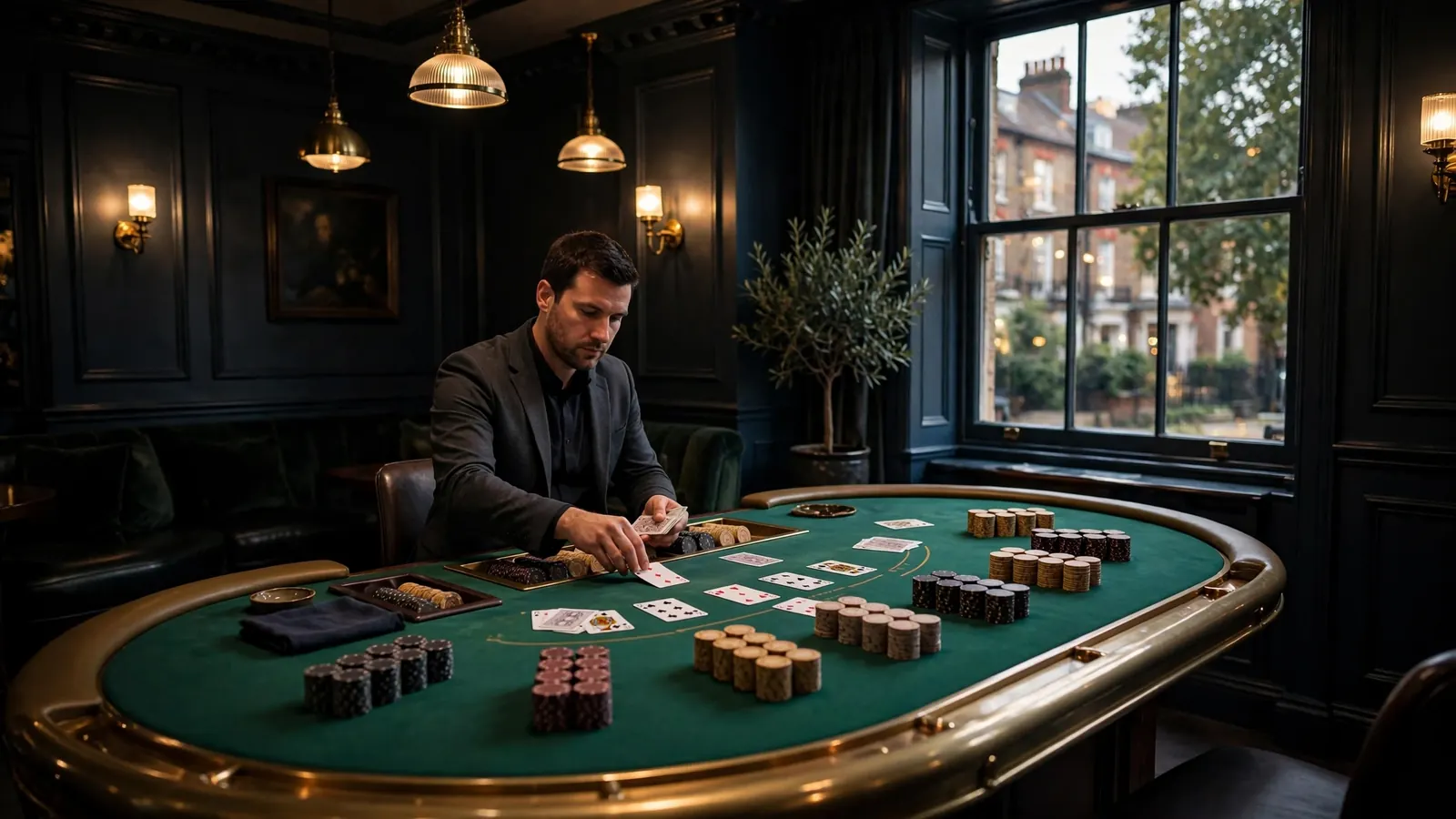
The old picture of baccarat arrived with its own stage dressing: polished rooms, formal clothes and a table that seemed to belong to people who already knew the rules. Online, that image has survived more stubbornly than the barriers it suggests. A live baccarat table is not a private room transported intact to a screen. It is a real-time game streamed from a studio, where a human dealer conducts the action while players use an on-screen interface to place bets.
That distinction matters. The camera brings the dealer and table into view; the interface carries the player’s decisions back into the game. Neither element is quite the same as being seated across from a dealer in a physical casino. The stream offers a visible human presence, while the buttons and betting areas belong to the language of software. Live play sits between the two: a staged physical setting, transmitted through a digital service.
There is theatre in that arrangement, but it is not necessarily the velvet-rope kind. A studio gives the game a human centre. The dealer’s gestures make the process legible in a way that a sequence of animated graphics cannot quite imitate, and the live feed gives each round a sense of unfolding in the present rather than being generated as a private screen event. The appeal is partly social, even when the player’s participation is mediated by a display.
The table itself is also a production. Lighting, camera angles and the dealer’s place within the frame turn a working studio into something that resembles a casino floor. The resemblance is deliberate, but it should not be confused with physical presence. The player does not share the room, and the room does not become less of a studio because the camera makes it convincing. It is a performance of place, supported by a real dealer and a live feed.
The interface is the less romantic half, and the more consequential one. It is where the player sees the available betting areas and submits a choice. A camera can make a table feel close; it cannot remove the software layer between the player and the dealer. That layer is not a flaw. It is the arrangement that makes a baccarat table accessible through an online casino at all.
This is why live baccarat online has a different texture from a digital version of a table game. The human dealer and real-time stream create interaction and an immersive, real-casino feel, while the on-screen controls keep participation within the familiar grammar of online play. The two parts work together, but they do not erase each other. Human presence does not turn a screen into a casino floor; digital controls do not make the dealer an animation.
There is a small social history folded into the format. Casino games have often used ceremony to suggest that entry belongs to a certain class of person. The live stream borrows the visual cues of that ceremony, then delivers them through a domestic screen and a betting interface. The old atmosphere remains; its old gatekeeping does not have to. Less velvet rope, more glass rectangle.
A UK baccarat casino offering a live table therefore sells neither a purely physical encounter nor a purely automated one. It offers a mediated event: a dealer working in real time, a studio arranged for viewing, and a player acting through software. The format’s appeal lies in that mixture, not in pretending the screen has vanished.
A baccarat site is more than a page on which a table happens to appear. It is the service through which a player reaches a live game: the account, the betting interface and the streamed table sit together, even when different businesses supply parts of the experience. The dealer is visible on screen; the site is the regulated front door through which the game is offered.
That distinction matters in Britain. A polished stream is not evidence of lawful operation, and a familiar game does not make every website offering it equivalent. For real-money online gambling, an operator serving customers in Great Britain must hold the relevant operating licence from the UK Gambling Commission. A live dealer casino is legal in the UK when it holds a UKGC licence. The licence attaches to the operator’s authority to serve the market, not to the velvet lighting or the confidence of the dealer.
The rule reflects a broader choice about how gambling is governed. The screen may make a casino feel placeless: a studio could be elsewhere, and a table can be reached from a sofa. Regulation, however, follows the customer-facing service into the British market. An operator’s location does not remove the licensing requirement when it sells remote gambling to British consumers. The stream crosses borders; the obligation does not evaporate with it.
For a person considering baccarat casino sites in the UK, this is the first distinction to establish: whether the site offering real-money play belongs to the UK licensing system. A live table’s appearance cannot answer that question. Nor can a general claim that a company is licensed somewhere. The relevant condition is a UK Gambling Commission operating licence for the service offered to the British market.
That is not a decorative seal. Licensing places the operator within the local regulatory framework for online gambling. It separates a legal UK-facing service from an offshore site that operates outside the UKGC system. The fact that a page loads, accepts a visit or displays a dealer does not, by itself, establish that the operator is authorised to offer real-money gambling here. Availability and legal standing are different matters.
The distinction is especially easy to overlook because live baccarat is presented as a continuous scene. Cards are dealt in a studio, a human dealer is on screen, and betting takes place through the website’s interface. The machinery behind that scene is less visible than the felt and the cards. Yet the operator remains responsible for offering the gambling service under the required licence, whether the studio is nearby or thousands of miles away.
“Baccarat online casino sites” can therefore describe quite different arrangements. Some provide a licensed service for the British market; others may be accessible without belonging to its regulatory system. For legal real-money play in the UK, the dividing line is not the language on the homepage or the apparent nationality of the studio. It is the operator’s UKGC authorisation.
This does not turn licensing into a verdict on every detail of a site. It identifies the legal footing on which the service is offered. A licence is necessary for a legal UK-facing casino, but it does not make every table identical or settle whether a particular site suits a particular preference. That is a separate question from whether the service is authorised at all.
The distinction is plain, if not glamorous: the dealer is on camera; the licence is behind the service. A stream can look convincingly like a casino. Legality depends on more than the set.
A useful comparison begins at the table, not with its decoration. A polished studio can make a game look settled and effortless; the details that shape a session are less theatrical. Table rules, the paytable, the pace of play and the demands of the stream all matter. The strongest choice is not necessarily the one with the grandest backdrop, but the one whose conditions are clear before the first bet.
Rules deserve close attention because baccarat tables can differ in how they handle particular bets and payouts. The familiar names on the betting interface do not, by themselves, establish that every table works identically. A comparison should therefore turn on the rules displayed for the specific game, rather than assumptions carried over from another version. That small pause is useful. The table is not obliged to match its neighbour.
The paytable belongs beside the rules, not in the small print of memory. It sets out what a winning bet returns and any deductions attached to it. In standard baccarat, a winning Banker bet typically carries a 5% commission; the way that charge is shown can affect how easy it is to understand a return. A clear paytable lets the terms be considered before play begins. A handsome interface cannot make an unclear one clearer.
Pace is another practical distinction. Live games unfold more slowly than digital versions, because the action is streamed from a real table rather than resolved entirely by software. That interval between bets and results is part of the format, not a defect to be corrected. It may suit a session built around watching each hand; it may feel cumbersome to someone who expects the brisk rhythm of a digital game. Speed, here, is a matter of temperament as much as technology.
The connection has a role in that experience. A stable internet connection is needed to follow a live stream and use its betting interface without interruption. This is not an ornamental consideration: the game depends on a moving image and a live exchange between table and screen. A site can present a well-designed table, but the experience still relies on the route into it. The stream is only as useful as the connection carrying it.
Minimum bets also belong in a comparison, though they should be read at the individual table rather than guessed from the word “baccarat”. Live games tend to require higher minimum bets than their digital counterparts. That difference can narrow the practical choice of tables, even where the game itself is familiar. A table’s terms matter more than its label.
There is a quiet social history in these distinctions. Casino games have long been arranged not only around chance, but around how people spend time together: at a physical table, in a room, or now before a screen. Live baccarat preserves some of the visible ceremony while moving the setting into a domestic space. Its pace and minimums are part of that bargain. Not quite a parlour, not quite a machine.
A sensible assessment, then, looks for readable rules, an intelligible paytable, a connection suited to live video, and a pace and minimum that fit the intended session. No single feature makes a baccarat site the best online choice for everyone. The format asks for time as well as a stake, and its appeal depends on whether those terms feel worthwhile. This is entertainment, not financial advice.
A baccarat hand is organised around a simple comparison: which of two hands will finish closer to nine? The betting choices are Player, Banker and Tie. “Player” and “Banker” name the hands on the table; they do not describe two people competing for control of the game. The dealer handles both sides, while the wager marks which result is being backed.
The Player bet backs the Player hand to finish nearer to nine. The Banker bet backs the Banker hand to do so. A Tie bet backs the hands to finish level. These are bets on the outcome of the comparison, not on a particular card appearing or on a player making a decision during the deal.
Backs the Player hand to finish nearer to nine.
Backs the Banker hand to finish nearer to nine.
Backs the hands to finish level.
That distinction makes baccarat unusually easy to follow from the outside. The two hands are visible as separate contenders, and the question is not which one looks stronger after the first card, but which final total is nearer to the target. A promising start is not a result. The hand is not settled until the deal is complete.
The dealer gives two cards to the Player hand and two to the Banker hand. The totals are then considered under the table’s rules. Depending on those totals and the specific rules in use, a third card may be dealt to one of the hands. It is not a free choice made by the person who placed the bet: the draw follows the game’s rules.
This is why the initial deal is only the beginning of the comparison. A hand with a lower opening total may receive another card, while the other may stand; the precise decision depends on the applicable rules. The sequence can feel procedural, but each card changes the numbers being compared. The dealer’s actions resolve the hand; the bettor does not steer it.
The labels can also mislead newcomers. “Player” may sound like the person sitting at the screen, and “Banker” like the casino, but at the table they identify the two hands. The wager is placed on one of those hands, or on a tie between them. Baccarat gives the choices familiar names, then asks them to do a more modest job.
Nine is the target total. When a hand’s total goes beyond nine, only its final digit is counted. So a total above nine is not treated as a larger number that automatically beats a smaller one; it is read by its second digit, then compared with the other hand’s total on the same basis.
The aim is therefore proximity, not simply accumulating the highest-looking cards. Once both hands have completed their permitted draws, the one closer to nine wins the comparison. If they finish level, the Tie outcome applies. A hand can pass nine and still remain in contention, because the excess is discarded from the reading rather than added to the target.
The rhythm is built around that compact arithmetic: select Player, Banker or Tie; watch the two opening hands; follow any third-card draw required by the rules; then compare the final totals against nine. The apparent simplicity is real, though it rests on a fixed dealing procedure rather than on choices made by the person betting. No tactical flourish is needed to understand the central question. Just the totals, and the last digit.
With real-money baccarat, a stake is not an abstract marker on a screen. It is money exposed to an uncertain result, and a sequence of wins does not turn that uncertainty into a dependable income. The measured pace of a live table can make each decision feel deliberate; it cannot make the next hand more predictable.
The Banker bet carries a particular cost. When the Banker hand wins, the casino typically charges a 5% commission on that winning bet. The deduction is part of the price of the wager, not a fee that appears only after an unusual run. A return that looks straightforward on the table can therefore be reduced by the commission. The exact way it is shown or settled can depend on the table, so the displayed terms matter.
That cost also makes it useful to distinguish a betting system from an advantage. A system may prescribe how much to stake after a win or loss, or how to divide a bankroll between choices. It cannot control which hand wins, and changing the size of a wager does not make a losing result less real. A progression can make stakes rise quickly while giving the appearance of orderly recovery. Arithmetic is not a dealer.
For anyone considering a baccarat real-money casino, the sensible financial starting point is a budget decided before play begins. It should be money that can be lost without interfering with rent, bills, savings or other obligations. Once set, the budget is a boundary, not a target to be replenished when the session turns against it. Nor should a run of wins be treated as permission to keep playing beyond the planned limit. Chasing either losses or winnings is a way of letting the table set the terms.
A budget is more useful when it is connected to the intended length of a session and the pace of live play. Real-time dealing leaves pauses between decisions, but pauses can encourage a person to reconsider a stake or continue longer than planned. Keeping a clear stopping point can prevent the session from expanding simply because another hand is available. The atmosphere may be composed. The exposure remains financial.
Baccarat online for real money is still gambling, whether the screen shows a live dealer or a digital table. A staking plan can organise decisions, but it cannot promise profit, remove the house’s advantage or protect a bankroll from a sustained run of losses. The Banker commission is one visible deduction; uncertainty is the larger condition around every wager. There is no clever sequence that abolishes it.
This is entertainment, not gambling advice. The distinction is plain, though casinos have never been short of devices for making money feel briefly theoretical. A budget gives play a limit; it does not convert play into an investment.
A baccarat table has its own small constitution. Before a hand begins, the rules and paytable establish what counts as a winning result and what the return will be for each available bet. The familiar names on the betting area can make tables look interchangeable; the wording beside them is where differences become consequential. A stake is only one part of the decision. The terms attached to it matter just as much.
The paytable deserves attention before play, not after an unexpected settlement. It sets out how winning bets are paid and may clarify deductions or conditions that affect a return. Rules explain how the hand proceeds and how its outcomes are treated. These details are not decoration around the game. They are the agreement between table and player, displayed in a form that can be checked before money is committed. A brisk click through the interface is no substitute for reading them.
Live play also changes the rhythm. A digital version can move from one result to the next with little ceremony; a live table has a human dealer and a sequence of actions unfolding on screen. That makes the game more like a public ritual than a private calculation, but it also means a hand takes longer. The pace is part of the product, not a technical flaw waiting to be corrected. The table has to be watched as well as played.
Minimum stakes can be higher at live tables than in digital versions. That difference narrows the room for experimentation, particularly when a session is being approached as a way to learn the interface or observe how a table operates. A displayed minimum is a condition of entry, not a suggestion about what anyone ought to wager. If it does not fit a planned budget, the table is simply the wrong setting for that session. There is no virtue in making the numbers fit by force.
The slower pace can make each decision feel more deliberate, though it does not make an outcome more predictable. Nor does a polished studio or a familiar layout turn the paytable into a formality. Rules should be checked on the specific table in use, because assumptions carried over from another version can be unreliable. A table’s name may stay constant while its terms do not.
Connection matters, too. Live games need a stable internet connection; interruptions can break the continuity of a hand and make the interface harder to follow. That practical requirement belongs beside the minimum stake and the published terms when judging whether a table suits a session. The atmosphere may invite lingering. The conditions still deserve a sober reading.
A good baccarat table, in this modest sense, is not defined by theatrical lighting or a busy screen. It is one whose rules and paytable are clear, whose minimum is compatible with the intended spend, and whose pace can be accepted without impatience. Baccarat offers few shortcuts around those conditions. The small print deals first.
When choosing a UK site for live baccarat, it helps to check practical details alongside the game itself. This list highlights the payout-speed information available for each operator.
Zombillion
Zombillion lists a payout speed of 1–3 business days, a useful detail to consider when choosing a live baccarat site.
Amunbet
Amunbet lists a payout speed of 1–3 business days. This provides a practical point of reference for live baccarat players.
Britsino
Britsino’s stated payout speed is 1–3 business days, giving players a clear expectation for withdrawals.
Chanze
Chanze lists payouts as taking 1–3 business days, a relevant detail for players considering live baccarat.
SpinFormula
SpinFormula states a payout speed of 1–3 business days. That timing is the available practical detail for assessing it here.
Dieselwin
Dieselwin lists a payout speed of 1–3 business days, which gives players a stated withdrawal timeframe to consider.
NightLuck
NightLuck’s stated payout speed is 1–3 business days. This is the available factual point to weigh when considering the site.
Jetsetspins
Jetsetspins lists payouts as taking 1–3 business days, offering a straightforward withdrawal-time reference for players.
x3bet
x3bet states a payout speed of 1–3 business days, a useful practical consideration for live baccarat players.
WinBeast
WinBeast lists a payout speed of 1–3 business days. This stated timeframe is the available detail for evaluating it here.
A live casino puts games with very different habits under one roof. Baccarat can sit beside roulette and blackjack, sharing the dealer’s camera and betting interface while asking for a different kind of attention. The room looks continuous; the rules are not.
Roulette makes its central event visible at a distance. In a live game, a dealer spins a physical wheel and the ball settles on a number; a winning selection is one that matches it. Computerised roulette replaces that wheel with a Random Number Generator. The distinction is not merely decorative. One format shows a physical sequence unfolding on screen; the other produces its result electronically. Either way, roulette is organised around a single landing point.
Blackjack is more conversational in shape. A human dealer appears in the live stream, dealing the game in real time and allowing players to see and interact with the dealer. Its aim is to finish closer to 21 than the dealer without going over. The tension belongs to the changing value of a hand and the decision about what to do with it. The dealer is not just the face of the table, but part of the visible contest.
Baccarat is quieter by comparison. Its drama comes from the comparison of two hands, rather than a ball’s path around a wheel or a player’s decisions against a dealer. The game has an old-fashioned air that can make its simplicity look like ceremony: a small number of possible outcomes, dealt at a measured pace, with the action easy to follow once its conventions are familiar. It is less a test of improvisation than a ritual of watching the result take shape.
That difference matters when baccarat appears in a live-casino lobby. The label “table game” groups formats by setting, not by experience. Roulette offers a wheel and a numbered field; blackjack places the dealer and hand decisions in the foreground; baccarat centres on the comparison between player and banker hands, with a tie also available. Each produces its own rhythm, even when the same studio lighting and on-screen controls make them look like neighbours.
There is a small social history in that arrangement. Casinos have long made games into both spectacle and procedure: the table gives the action a stage, while fixed rules keep the stage legible. A live stream carries that old division into a domestic screen. Baccarat’s appeal is not that it behaves like roulette or blackjack, but that it does not need to. The nearby games supply contrast.
No wheel to follow. No hand to steer.
This is entertainment content, not gambling advice.
A casino offering baccarat online sells more than a set of betting choices. In the live version, play unfolds in real time, with a human dealer and a sense of being present at a shared table. That atmosphere is part of the appeal: the game is not simply reduced to buttons and an instant result. There is a social rhythm to it, even when the other people at the table remain strangers.
The attraction is partly theatrical. A live dealer gives the proceedings a human centre, while the table creates a small public space: decisions are made alongside others, and each hand has a beginning, a pause and an outcome. It is a modest kind of ceremony. The digital alternative may move more quickly, but speed is not the only measure by which a game is experienced.
That distinction matters when comparing casinos with baccarat. A live table asks for patience as well as attention. Hands take longer than in digital versions, because events happen at the pace of a real table rather than being resolved immediately by software. For some, that interval is precisely the point; for others, it can make a session feel drawn out. Neither response changes the format. It simply reveals that pace is part of the product.
The practical terms are less romantic. Live games require a stable internet connection, and their minimum bets are higher than those of digital versions. These conditions shape who can comfortably take part and for how long. The real-casino feeling arrives with real-world constraints: a connection can falter, and a table may ask for a larger starting stake than its electronic counterpart.
A live baccarat casino site therefore offers a particular balance: human presence and real-time interaction in exchange for a slower tempo and more demanding access conditions. The experience may feel closer to a casino table, but it is still mediated by a screen and dependent on a functioning connection. Atmosphere has its infrastructure.
For a casino with baccarat in Britain, the format is not a decorative layer around the game. It changes the pace of play and the conditions under which a session can happen. The distinction is worth noticing before the table is joined. A little less instant. A little more present.
A live baccarat table arrives as a broadcast from a studio, not as a sequence of animated cards. A human dealer handles the game in real time; the camera carries that activity to the screen while a separate on-screen interface lets players place bets. The picture and the controls share the same space, though they perform different jobs. One shows the table; the other records a decision.
On a phone, that division matters. The dealer’s movements occupy the visible scene, while the betting interface must fit around it. A compact screen can make the display feel less like a room and more like a carefully framed window. It does not change the format: the game still proceeds at the pace of the live table, and the controls remain the route for placing a wager.
That pace is slower than in a digital version. A real person deals, and the stream follows events as they happen rather than compressing them into instant animation. The pause is part of the arrangement. It gives the table a human presence, but it also means that a session cannot be treated as a rapid sequence of clicks. A live dealer Baccarat online casino is built around watching and waiting as much as acting.
The stream depends on a stable internet connection. If the picture freezes or drops behind the action, the table becomes harder to follow; a reliable connection is therefore part of access, not a decorative technical extra. The betting interface and the video must work together, so a brief interruption can unsettle the sense of timing even when the game itself continues.
There is a practical cost to the live setting, too: live games have higher minimum bets than digital versions. The phone may reduce the distance between a person and the studio, but it does not make the table faster or lower its entry point. Technology brings the dealer closer. It does not remove the terms of the room.
This is entertainment, not gambling advice.
A baccarat casino bonus can look like extra room to play, but its value depends on the terms attached to it. Wagering requirements determine how much qualifying play must take place before bonus funds or related winnings can be withdrawn. The headline offer says little about whether baccarat counts fully towards that requirement.
A specialist review of casino promotions reports that baccarat may receive less than full weighting, and that live games can contribute only a small share. One stated example is a 10% contribution. In practice, that means a stake may count for only a fraction of its face value when progress is calculated. The precise treatment depends on the offer’s terms; it should not be assumed from the word “baccarat” in a promotion.
That distinction matters for a baccarat online casino bonus because live tables are not necessarily treated like every other game. Terms may separate live dealer play from other casino games, or exclude particular games altogether. The wagering rules, game weighting and maximum bet conditions belong together: reading only the headline amount leaves the important arithmetic in the small print.
A specialist review of UK welcome offers describes slot free spins as a common form of promotion, while noting that they cannot be used at live tables. A baccarat casino welcome bonus, deposit offer or no-deposit offer therefore needs to be checked on its own terms. The label does not establish that live baccarat qualifies, nor that any bonus funds can be placed on a live table.
The same caution applies to offers advertised around a particular payment method, including Bitcoin. A payment option and a bonus are separate conditions; neither guarantees that baccarat play will count towards wagering. No-deposit wording likewise says nothing by itself about game eligibility or withdrawal conditions.
Promotions are arrangements with rules, not spare money. Before opting in, the relevant terms should be checked for wagering requirements, game weighting and maximum bet limits. This is entertainment, not gambling advice.
Choose a casino that holds a UK Gambling Commission operating licence for serving customers in Great Britain.
Live roulette includes European, American and French versions. American Roulette has both 0 and 00, European Roulette has one 0, and French Roulette halves the loss on an even-money bet when the ball lands on zero.
Place your bet through the on-screen interface while a live dealer spins a physical wheel. You win when the ball lands on a number you selected.
You win when the ball lands on a number you selected. The odds are 1 in 37 in European Roulette and 1 in 38 in American Roulette.