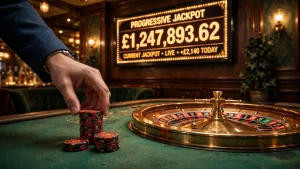
Volatility describes how slot returns are distributed, with high-volatility games tending toward less frequent payouts that may be larger.

A slot’s volatility describes the shape of its returns: not whether it pays, but how those returns tend to be distributed. High-volatility slot machines are associated with less frequent payouts that may be larger when they arrive. Low-volatility games spread returns across more frequent, smaller wins. The distinction is about pattern, rather than a promise attached to any particular spin.
That can sound like a fine distinction until the word “high” starts doing its usual work. It suggests a raised level of something desirable, as though a high-volatility slot simply offers more. In fact, the label refers to unevenness. The game’s returns are less evenly scattered across play: smaller wins appear less often, while larger ones account for more of the payout pattern. It does not mean that every win is large, or that a large win is due.
The same idea appears under several names, including variance and risk. For a player trying to understand what high volatility means on a slot machine, the useful point is not the vocabulary but the contrast: one game may return small amounts more often; another may leave longer spaces between wins and concentrate more of its returns in larger payouts. Those are different distributions, not different ways of guaranteeing a result.
High-volatility slots can involve substantial swings in results, so it is worth checking the available operator information before choosing where to play. This list offers a concise reference for that decision.
Zombillion
Zombillion lists a payout speed of 1–3 business days.
Amunbet
Amunbet lists a payout speed of 1–3 business days.
Britsino
Britsino lists a payout speed of 1–3 business days.
Chanze
Chanze lists a payout speed of 1–3 business days.
SpinFormula
SpinFormula lists a payout speed of 1–3 business days.
Dieselwin
Dieselwin lists a payout speed of 1–3 business days.
NightLuck
NightLuck lists a payout speed of 1–3 business days.
Jetsetspins
Jetsetspins lists a payout speed of 1–3 business days.
x3bet
x3bet lists a payout speed of 1–3 business days.
WinBeast
WinBeast lists a payout speed of 1–3 business days.
Low volatility is not simply the opposite in every imaginable feature. It describes a tendency for returns to be spread among many smaller wins. High volatility describes a tendency for payouts to come less often and in larger amounts. Neither phrase says that every round will follow its category neatly. A label summarises a game’s expected pattern, not a script for what happens next.
That matters because a sequence of individual spins can look unlike the pattern associated with the game. A high-volatility slot can produce a small win; a low-volatility one can produce a comparatively larger result. The classifications concern the shape of returns across play, rather than sorting every outcome into one fixed size. A single result cannot establish a game’s volatility, any more than one change in the weather establishes a climate.
The language can also be confused with the size of a stake or the overall appeal of a game. These are separate questions. “High volatility” does not itself specify what a player must stake, nor does it name a particular feature on the reels. It describes how wins are distributed: less often and in larger amounts, rather than more frequently in smaller ones. The label is about payout pattern.
There is a useful image in the word “distribution”. Imagine returns laid out along a line, from small to large. In a lower-volatility pattern, more of the returns fall among smaller wins. In a higher-volatility pattern, returns are less frequent and more heavily represented by larger payouts. The picture is only a way to grasp the distinction; it should not be mistaken for a forecast of the next result, or a map of exactly when a payout will appear.
So what is a high-volatility slot machine? It is a slot whose payout pattern is characterised by fewer wins, with larger amounts when payouts occur, rather than a stream of smaller, more frequent wins. The phrase high-volatility slots meaning is sometimes flattened into “big wins”. That misses half the description. The intervals between payouts matter too; without them, the label loses its meaning.
“Very high volatility” intensifies the same description, but it does not turn it into a promise of exceptional returns. It signals a more pronounced contrast between the less frequent payouts and their larger amounts. The wording can tempt the imagination towards a dramatic result, because dramatic results make tidy stories. The distribution itself is less theatrical.
This is why comparisons between slot machines with high volatility and lower-volatility games should begin with the return pattern, not a claim that one category is inherently superior. One spreads wins more broadly across smaller amounts; the other pays less often, in larger amounts. The terms describe how rewards are arranged, not which game will suit every player or what any particular session will contain. A label is a description, not a forecast.
An online slot in Great Britain is not simply a machine transferred to a screen. It is part of a commercial gambling system in which the operator, the game and the act of placing a stake sit within a regulatory framework. The UK Gambling Commission oversees gambling activity, including online casinos, and is the sole regulator for commercial gambling in Great Britain. Its reach does not stop at the border: remote operators serving people in Great Britain are subject to its rules even when the equipment running their games is elsewhere.
The Commission grants operating licences to businesses and personal licences to individuals working in the industry. That division reflects a quiet feature of British regulation: responsibility attaches both to the organisation offering a game and to people in designated roles. For a player, the practical distinction is that an online slot offered legally to the British market belongs to a regulated service, not merely a website that happens to load.
There is a geographic qualification. The Gambling Act 2005 governs gambling in England, Wales and Scotland, but not Northern Ireland. References to British rules in this context concern Great Britain; the UK is not one uniform regulatory territory simply because it is often spoken of as one.
A specialist review reports different online slot stake ceilings according to age: £5 per game cycle for customers aged 25 and over, and £2 for those aged 18 to 24. The limit concerns the total stake in a cycle, not the amount that a game happens to display as a headline bet. These thresholds belong to the regulated environment in which high volatility slots online are offered, rather than to a special category of game. Volatility does not exempt a slot from the rules governing its stake.
Age checks come before depositing: operators must verify a customer’s age before allowing money to be added to a gambling account. New customers must also be prompted to set a financial limit before their first deposit, with account-level limit controls available afterwards. These requirements make the opening of an account less like entering an arcade and more like entering a service that records who is playing and under what boundaries.
The rhythm of online play is regulated too. A slot spin cannot be compressed into an instantaneous click: at least 2.5 seconds must pass from the start of one game cycle before another can begin. Autoplay is banned in Britain, so a sequence of spins cannot simply be set running unattended. The rules put a human action back between cycles. Not much theatre, but a deliberate pause.
Payment methods also have boundaries. UK-licensed casinos cannot accept credit cards for gambling, including credit-card funding routed through a money service business. Nor can they accept wallet payments where the wallet permits credit-card funds to be used for gambling. The point is not a preference for one payment brand over another; it is a restriction on using borrowed credit to fund play.
That is the practical setting for anyone looking for high volatility slots online in the UK. A game’s label does not decide whether it may be offered, how quickly it may run or what stake may be placed. Those conditions belong to the regulated service around the game. In Britain, the slot is software; the rules are part of the experience.
A high-volatility slot changes the texture of a session before it changes its arithmetic. A long stretch without a substantial return can make each spin feel like a prelude; when a larger payout arrives, it may seem to redeem the silence that came before it. The sense of drama is real as an experience. It is not evidence that the game has become more generous.
That distinction matters because a payout pattern can shape how outcomes are remembered. A cluster of small returns tends to blur into the ordinary business of play. A conspicuous win, arriving after a quiet run, occupies more space in memory. The interval gives it a narrative: suspense, then release. But the slot has no memory of the interval, and the next spin does not owe anything to the previous one.
This is where the promise attached to high volatility can mislead without being literally false. Larger payouts are part of the pattern, but their possibility is not a schedule. A session may end before one appears; a run of play may contain several returns, or very few. The dramatic shape is something the player experiences after the fact, not a plot the game is obliged to complete.
There is also a more prosaic measure beneath the atmosphere. Where a game has a positive house edge, its expected result is negative for the player when considered across enough sessions. The pace of that disadvantage can vary in appearance: losses may arrive gradually, or the balance may remain unsettled before a more pronounced change. Neither version alters the underlying direction of the expectation.
That is why a large payout cannot be read as proof that the game has turned favourable. It is one possible outcome within a system whose house edge still works in the operator’s favour over time. Nor does a quiet spell establish that a compensating win is approaching. The machine offers no account of what has already happened.
The contrast with a lower-volatility game is useful here, not as a verdict but as a way to see how rhythm affects perception. More frequent, smaller returns can make play feel less abrupt; high-volatility slots can leave longer pauses between noticeable payouts. Yet a smoother session is not automatically a better financial proposition, just as a more dramatic one is not evidence of greater value. The pattern describes the distribution of returns, not a promise about the final balance.
This distinction is easy to lose when the language of a game leans on possibility. A potential large win is vivid; the mathematical disadvantage is abstract. One has a scene attached to it, the other a ledger. Still, the ledger is the more reliable account of what repeated play means.
Drama is not an advantage.
A casino is not one kind of game repeated under different lighting. Its rooms—physical or online—hold different ideas of what a game should be. A slot turns play into a sequence of individual spins, with its imagery and sounds arranged around each one. A live table game, by contrast, gathers attention around a shared event: bets are made, a round begins, and an outcome appears in view.
Play is centered on individual spins with a payout pattern characterized by the game's volatility.
Attention is gathered around a shared event where bets are made before a single round outcome appears.
That distinction matters when high volatility slot games are discussed alongside the wider casino. Volatility describes the pattern of a slot’s returns; it is not a general label for every game in the building. Roulette has its own structure. It is organised around a wheel, a ball and a round, not a reel sequence. Calling roulette a high-volatility slot would confuse two separate forms of play.
In European-style roulette, the wheel has thirty-seven pockets, running from zero through thirty-six. Before the ball is released at the start of a round, players place their bets. Then the table waits for the result. The pause is part of the arrangement: a group of separate choices is gathered around one visible event, and the round ends when the ball settles.
A slot keeps a different sort of time. Its play is centred on the individual spin rather than a table-wide round. There may be no shared pause in which a group watches the same ball travel, and no single moment that belongs equally to everyone at the table. The contrast is not simply between a screen and a wheel. It is between private repetition and a public, round-based ritual.
Live casino presentation can bring a dealer and table into the online setting, giving the game a visible human centre. Yet the underlying arrangement remains distinct from a slot. The table’s bets precede the round; the slot’s action is built around its own spin. One format stages a common event. The other frames each turn as a separate piece of play.
This helps explain why lists of “high volatility casino games” can be misleading. The phrase may sound as though volatility were a single scale shared by every casino game, but the useful comparison here is narrower: slots can be described by their payout pattern, while roulette is understood through its wheel and betting rounds. Neither format needs to borrow the other’s vocabulary to make sense.
Nor does the casino setting make every game interchangeable. A slot beside a roulette table may share the same lobby, account or screen, but proximity is not equivalence. The slot is not a miniature roulette wheel, and roulette is not a reel game with a dealer. One offers repeated individual spins; the other gathers bets before a ball is released. Different customs, different clocks.
Calling a slot “good” can mean several things: that its play feels lively, that wins arrive often, or that a large payout remains possible even through a quiet stretch. Volatility answers none of those questions on its own. It describes the shape of returns, not the quality of the game or the likelihood that a particular session will end well.
A high-volatility slot tends to offer fewer payouts, with larger amounts when they arrive. That pattern can appeal to someone who values the possibility of a pronounced result more than a steady succession of small ones. The trade-off is written into the experience: long pauses between wins may be part of the game’s character, not evidence that a payout is due. The next spin has no memory.
Low-volatility slots spread returns among more frequent, smaller wins. That steadier rhythm may suit someone who prefers regular signs of activity over stretches without a payout. It does not turn small wins into profit, however, or make the overall result dependable. A sequence of payouts can keep the play moving while the balance still declines.
Neither preference is inherently wiser. Some players find a sparse pattern dull; others find its quieter stretches easier to accept than a more constant stream of small returns. Some value the possibility of a larger payout; others would rather see modest wins appear along the way. These are differences in what feels engaging, not evidence that one setting is financially safer or more generous.
The word “better” tends to smuggle in a promise. High volatility does not mean a slot is more likely to pay a particular person a large amount, just as low volatility does not mean that small wins will cover the stakes. A payout pattern describes what a game is designed to distribute over time. It cannot tell a player what will happen in a short session.
There is also a limit to what preference can change. Where a game’s rules give the casino a positive house edge, its expected result for the player is negative when play is considered across enough sessions. The pace of losses can differ: a game may return money in smaller, more frequent amounts or in larger, less frequent ones. The underlying disadvantage remains.
This is why the choice between high and low volatility is better understood as a choice of texture. One offers a more uneven sequence of outcomes; the other tends towards a more even flow of smaller returns. Neither makes the house edge vanish, and neither guarantees that a session will resemble the pattern associated with its label.
High volatility can be appealing without being “good” in any universal sense. Low volatility can feel more comfortable without being “better” in a financial sense. A player’s preferred rhythm matters; it simply cannot rewrite the mathematics. Dry distinction, but an important one.
A return-to-player figure and a volatility label can sit beside one another on a game page, but they describe different things. RTP is a theoretical measure of how much of the money wagered a game is designed to return over extended play. Volatility describes the shape of that return: whether payouts tend to arrive in a more even trickle or in less frequent, larger bursts.
Neither label can stand in for the other. A high RTP does not mean that a particular session will be profitable, nor does it say when a payout might arrive. A high-volatility setting does not, by itself, tell how much a game is expected to return over time. One measure concerns the overall return model; the other concerns its distribution.
That distinction matters when considering the appeal of high RTP, high-volatility slots. A strong return figure may sound reassuring, while the volatility label suggests the possibility of more dramatic payouts. Together, they can make a game appear to offer the best of both worlds. But the combination does not turn an uncertain sequence of spins into a predictable one. A return estimate is not a schedule.
RTP (Return to Player) is a theoretical measure of the total amount a game is designed to return over extended play, whereas volatility describes the shape and frequency of those returns.
The phrase “very high volatility” is often used to signal a particularly uneven pattern of outcomes. It does not supply a precise forecast for a session, or establish that larger payouts will arrive. Nor does it make a title superior to another simply because both labels sound favourable. Comparisons depend on the details of each game, and labels are not a substitute for those details.
There is no sound basis for naming a single best high-RTP, high-volatility slot in the UK without comparable game information. A list assembled from the two labels alone would turn a broad description into a ranking it cannot support. The distinction is useful; the supposed verdict is not.
The arithmetic beneath the presentation remains unromantic. A game with a house edge is structured so that, over enough play, its expected result is a loss for the player. A higher RTP may mean a smaller theoretical disadvantage than another game, but it does not erase that disadvantage. Volatility changes how unevenly results arrive, not the direction of the underlying expectation.
So a return figure can help describe a game’s long-run design, while volatility describes the experience of its payout pattern. Neither is a promise about an individual outcome, and neither settles the question of which game is “best” for every purpose. The labels are different instruments, not competing grades. Dry distinctions, but useful ones.
A slot session is often remembered less as a sequence of spins than as a sequence of pauses. In a high-volatility game, those pauses may occupy much of the experience: the reels settle, a result appears, and the balance may show little sign of movement. A payout can arrive less often, but when it does, it may be larger. The contrast gives the session a stop-start quality, though the timing of any particular win cannot be read from the pattern.
The quieter stretches can make each result feel unusually legible. A small return in a game that pays more frequently may register as part of the ordinary texture of play; after a longer dry spell, a payout can seem to break the spell. That impression belongs to the player’s sense of time, not to a promise encoded in the next spin. A run of misses does not make a win due.
Low-volatility games tend to distribute returns among many smaller wins. Across most titles, winning combinations typically appear every three to six spins on average. That broad pattern can lend a session a more continuous beat: the balance may be interrupted by modest returns, even when those returns do not amount to a lasting change. Frequent is not the same as substantial.
High volatility reverses the emphasis. There may be fewer moments of visible return, with more weight placed on the occasional larger payout. This can make a session feel uneventful and then suddenly animated, but not in a reliably timed sequence. The same game may produce a different rhythm on another occasion. The reels are indifferent to the narrative being built around them.
Characterized by longer gaps between payouts and a greater weight on occasional larger wins.
Characterized by a more continuous beat with winning combinations appearing more frequently on average.
That is why a session can feel longer than its clock time suggests. Attention gathers around the possibility of a result, then has to sit through the ordinary spin after ordinary spin. A modest, recurring win and a rare, larger one occupy different places in memory: one provides continuity; the other supplies a vivid episode. Neither changes what has already happened, and neither tells what is coming.
There is no single answer to whether high or low volatility suits a session. The distinction is partly mathematical and partly temporal: one pattern tends to make returns feel more scattered, the other more intermittent. Someone seeking a steady sequence of small interruptions may experience the latter as lulling; someone drawn to sharper contrasts may find the former more absorbing. Preference, however, cannot turn an uneven pattern into a schedule.
The feeling is real. The forecast is not.
A bonus can make a volatile slot feel like a more attractive place to play, because promotional funds may seem to soften the wait between payouts. But that impression belongs to the offer, not to the game’s mathematics. A bonus does not alter a slot’s house edge, and it cannot turn a game with a positive house edge into one with a favourable long-run expectation for the player.
The distinction matters when considering a high-volatility casino bonus strategy. There is no reliable method by which a promotion can make infrequent payouts arrive on schedule. A bonus may change how much play is possible under its terms, but it cannot make the underlying results predictable. Treating promotional funds as protection against a dry spell confuses a temporary balance with an improved chance of winning.
Time limits add another pressure. A specialist review describes bonuses as typically having a lifespan of 48 hours. That is a source’s account, not a rule that applies to every offer. Even so, a ticking clock can shape behaviour: a player may feel compelled to use a promotion before it expires, rather than deciding whether the conditions suit the way they intend to play. The clock is part of the offer’s design.
This is where the question of whether high volatility is good in slots meets the promotional world. For someone drawn to the possibility of larger but less frequent payouts, a bonus may look like extra room to continue. For someone who prefers a calmer pattern, the same terms may add urgency without adding comfort. Neither preference changes the house edge. Nor does a headline bonus amount explain how an offer works in practice; its conditions and expiry are part of the value being presented.
A careful reading of an offer is therefore less a winning strategy than a way to understand what is being asked in return for accepting it. The promotional label may be bright; the underlying arithmetic remains plain. Over enough sessions, every game with a positive house edge carries a negative mathematical expectation, however slowly losses accumulate. A bonus can change the shape of a session. It cannot repeal that result.
A slot’s layout is more than decoration. On a 5 reel slot game, a wager may cover all five reels, so the arrangement of symbols across the full screen matters to how a result is formed. That is a useful detail when comparing games: the same broad label, such as high volatility, does not tell the whole story of what a player is being asked to watch.
The reels are the visible framework; the rules attached to them determine how combinations are treated. A feature description can therefore tell more than a title alone. It helps distinguish the game’s format from its payout character, which is a separate question. Two slots with high volatility need not look or behave alike in every respect merely because both are described with the same volatility label.
This is also why a high volatility slots list, however neat its ordering, is not a substitute for reading the game information. A name cannot establish which reels a wager covers, how symbols are arranged or what the game counts as a qualifying result. Those details belong to the individual rules. A list can serve as a starting point, not as evidence that the games share a format or that one is better suited to a particular preference.
The same caution applies when a search is for slots with high RTP and volatility together. Return figures and volatility describe different aspects of a game, while its reel structure describes its format. One does not answer the questions raised by the others. A screen may present a familiar row of reels, but the rules decide how that structure works.
There is no need to pretend that a short catalogue can settle those distinctions. Before comparing high volatility slots in the UK, the relevant information is the game’s own layout and explanation of how bets and combinations operate. A five-reel format may allow a wager to span the entire set of reels; that is a concrete feature, not a prediction about what any spin will return. Form matters. Titles alone do not.
The difference between low- and high-volatility slots is easiest to notice in the spacing between wins. A low-volatility game tends to return smaller amounts more often, making its play feel punctuated by frequent outcomes. A high-volatility game leaves longer gaps between payouts, with larger wins occurring less often. Neither pattern dictates what happens on a particular spin; it describes the shape of returns across play.
Across most low-volatility titles, winning combinations typically appear every three to six spins on average. That rhythm can make a session seem busy, though a winning combination is not necessarily a large payout or a net gain. The return may simply be modest, arriving often enough to keep the balance moving in small increments.
High-volatility play has a different cadence. Many spins may pass without a payout, while an eventual win can be substantially larger. The longer quiet stretches are part of the pattern, not evidence that a game is due to pay. Each spin remains uncertain; the sequence does not keep an appointment.
The contrast is therefore not simply “more wins” against “fewer wins”. It is a choice between a distribution of smaller returns and one in which returns are more unevenly spaced. In a low-volatility slot, the screen may register winning combinations more regularly, but that does not turn every result into profit. In a high-volatility slot, a larger payout may stand out sharply against the spins before it, but its size does not make it predictable.
These different paces also shape how a session is remembered. Frequent small wins can make low volatility feel steady, even as the balance rises and falls. Longer gaps can make high volatility feel dramatic, because each payout is more conspicuous against the silence around it. The impression of activity is not the same as the amount returned.
Put plainly, low volatility tends to deliver more frequent, smaller wins; high volatility tends to deliver less frequent, larger ones. The distinction is about timing and distribution, not a promise about what any individual session will produce. One pattern ticks along. The other waits.