Follow the decisions from the visible card through live and single-deck formats, and see how different rules shape each round.
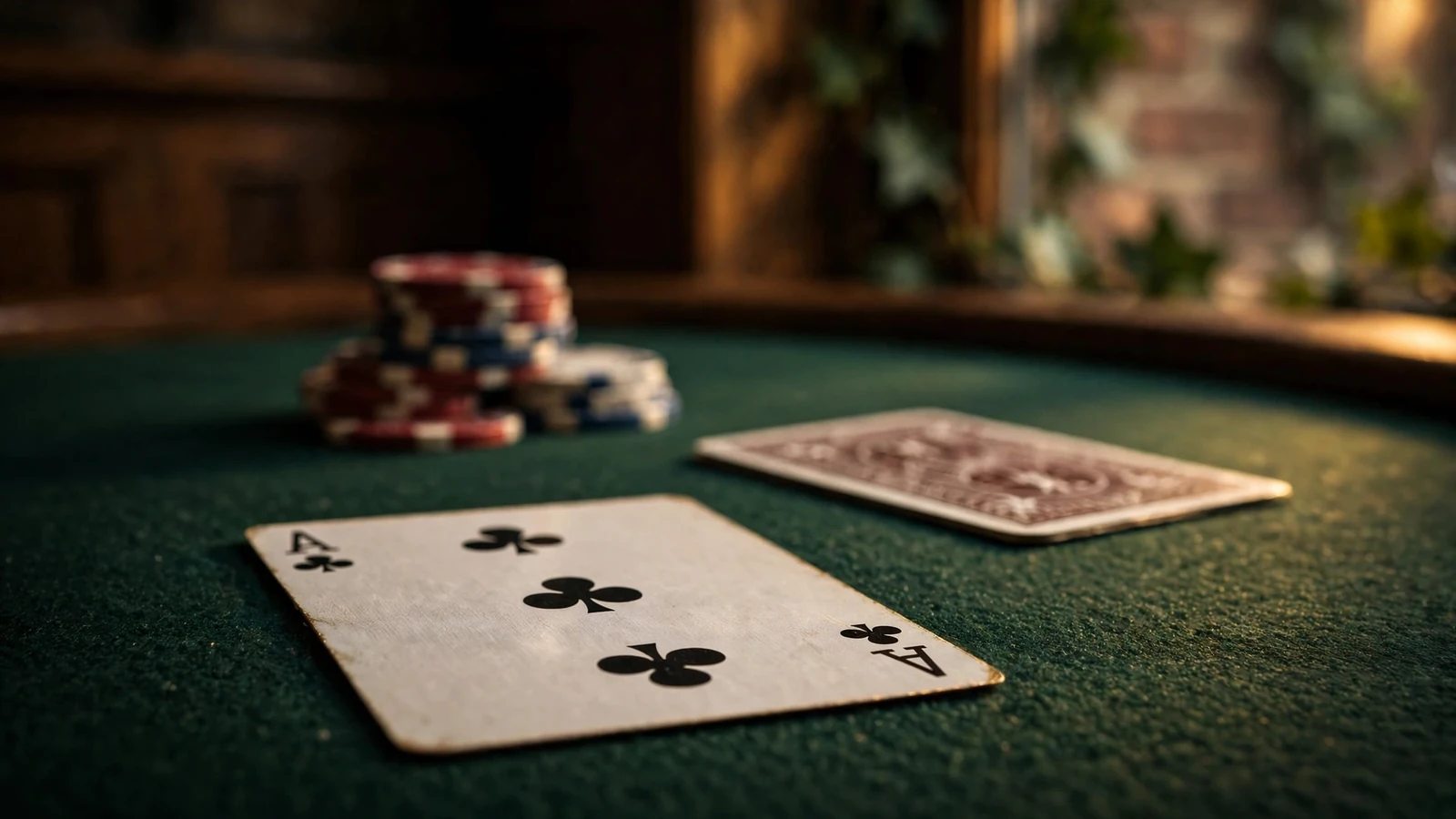
Hi-Lo begins with a comparison. A card is visible; the next decision is whether the card to come will rank higher or lower. The revealed card is not just part of the scenery. It sets the reference point, turning each guess into a small judgement about what might follow.
That simple arrangement gives the Hi-Lo casino game its shape. A low card leaves many ranks above it; a high one leaves fewer. The choice is still made in uncertainty, but the reference card makes the uncertainty legible. The game does not ask for a prediction in the abstract. It asks for one against something already on the table.
Some versions add a third possibility: betting that the next card will match the current value. Where that option is absent, the choice remains higher or lower. The distinction matters because a matching card is not automatically treated as a win for either side. In versions that offer only Higher and Lower, both bets lose if the next card has the same value as the exposed card. A tie is its own awkward little event.
The exposed card also gives the round a memory. Whatever comes next becomes the new point of comparison, so the decision changes with the card rather than repeating unchanged. A guess that seemed sensible against one value may look quite different against another. Hi-Lo is therefore less a matter of choosing a permanent side than of responding to the latest evidence.
This is the common premise behind games that may otherwise handle cards and decisions differently. The visible card supplies the terms; the next card tests the guess. No elaborate story is required. One value, one comparison, and the possibility that neither direction wins. A modest rule, with a sharp edge.
A round begins with a card revealed as the point of comparison. The player then predicts whether the next card will rank higher or lower. It is a small decision with an unusually visible consequence: the first card is not merely an opening result but the measure against which the next one is judged.
The values run from ace, worth one point, to king, worth thirteen. That gives the sequence a numerical order, even though the cards belong to a familiar deck. The game’s central task is to read that order one step ahead. There is no need to assemble a hand or match a combination; the question is simply whether the next reveal will sit above or below the current card.
A correct call adds winnings to the pot. The player can then face another higher-or-lower choice, with the newly revealed card becoming the reference for the next decision. Each successful step extends the run and increases what is at stake. The pot gives the round its accumulating shape: a modest opening decision can lead to a larger total, but every new guess puts that total in jeopardy.
An incorrect call loses the money placed on that decision and voids winnings collected in the game. That is the sharp edge of the format. A growing pot can look like a record of progress, yet it is not secure merely because earlier predictions were right. The next card does not know what came before; the player’s accumulated success offers no protection against a wrong direction.
The sequence is therefore straightforward, but not necessarily comfortable. Reveal a card, choose higher or lower, then see whether the next card confirms the call. If it does, the pot grows and another decision may follow. If it does not, the round’s accumulated winnings are gone. The suspense comes less from complicated rules than from the way one visible result keeps setting the terms for the next.
Descriptions of online Hi-Lo do not all agree about the card machinery behind that sequence. One account describes a single deck, while another describes six 48-card decks with continuous shuffling. Those are materially different arrangements, not interchangeable details, so the label alone cannot establish which one a particular game uses. The basic higher-or-lower decision remains recognisable across the descriptions; the deck rules belong to the specific version.
That distinction matters because the simple surface can make unlike games seem identical. A card appears, a prediction follows, and the pot either grows or disappears. Beneath that shared rhythm, the rules may set different conditions for what can be drawn next. The sequence is simple. Its foundations may not be.
Live Hi-Lo gives the card a visible history. Rather than dealing from a small deck that gradually empties, the game is described as using a shoe and a continuous shuffler: cards from the previous round go straight back into the machine. The display, meanwhile, keeps the last winning card in view. It becomes the reference for the next hand, so the game carries one piece of its past forward even as the physical cards return to circulation.
That arrangement is the defining rhythm of live play. A new round does not begin with a clean table and a forgotten result. The previous winning card remains exposed, and the next decision is framed against its value. The card is both a record of what has just happened and the starting point for what comes next.
A specialist review describes a shoe made up of six decks of 48 cards, with tens removed. That account also says the exact deck count could not be confirmed in writing, so the stated configuration should be read as that review’s description, not as a settled feature of every live Hi-Lo game. The important procedural distinction is the shoe-and-shuffler arrangement: cards are dealt, the result is shown, and the previous round’s cards are returned to the continuous shuffler.
Before the next winning card is revealed, three cards are burned. In card-game procedure, a burned card is removed from view rather than presented as the outcome. The sequence therefore has a hidden passage between the displayed reference and the next result: the shuffler supplies cards, three are set aside, and the winning card is exposed.
The card that wins the hand does not vanish from the screen when the round closes. It remains available as the reference for the following round. That visible continuity makes the table feel more like a running sequence than a string of unrelated draws. Each new result answers the same compact question against a changed reference.
The shoe itself, however, does not become a progressively depleted inventory. The continuous shuffler takes cards from the previous hand back into circulation immediately. The visible card and the physical card are thus doing different jobs: one persists as a displayed reference, while the cards used in the hand are returned to the machine. The distinction can be easy to miss if the screen is read as a literal view of every card’s location.
A live table translates the familiar higher-or-lower premise into a staged procedure. There is a shoe, a reveal, a result left on display, then another cycle. The exposed card gives the game its thread; the shuffler prevents that thread from being a count of cards steadily disappearing from play.
That combination of repetition and return is a small piece of theatre. The outcome remains visible, lending the next hand a memory, while the machinery resets the card supply behind the scenes. The display says: this is the card that matters now. The shuffler says: the previous hand has already gone back into circulation.
The burned cards add another layer of separation. They are part of the process, but not part of the result shown as the winning card. Three cards pass out of sight before the next winning card appears. The audience sees a clean outcome; the procedure contains a concealed interval.
This is not the same structure as a single deck in which each used card stays out until the game ends. In the live shoe described here, the continuous shuffler returns cards from the previous round immediately. So the apparent progression on screen—the reference changing from one winning card to another—does not mean the shoe is simply losing those cards one by one.
A live Hi-Lo table therefore has two clocks running. The visible one advances hand by hand, replacing the reference card after each result. The mechanical one cycles cards back through the shuffler. One creates continuity; the other keeps the supply moving. The contrast is the point.
The exposed card may make a previous result seem unusually present, but its role in this section of the game is straightforward: it supplies the reference for the next round. The next card is revealed after the burn, and the winning card then takes the place of the old reference. Nothing in that visible sequence requires the old card to remain physically out of circulation.
For anyone trying to understand live Hi-Lo as a format rather than a screen effect, this is the useful distinction: the table preserves the last result on display, but the shoe is continuously replenished by cards returning from the prior hand. The process is not a parade of unique cards moving permanently out of play. It is a repeating cycle with one exposed marker carried forward.
A tidy illusion. A moving shoe.
In live Hi-Lo, the exposed card is more than a record of the previous hand. It changes what can happen next. That matters most when a wager names a particular outcome rather than simply asking whether the next card will be higher or lower. A proposition bet may look like a question about the future; in practice, it is also a question about which possibilities remain available.
The key detail is easy to overlook: the exposed winning card is no longer in the shoe. If a proposition would pay when that exact card appears, the bet is aimed at an outcome that cannot occur on the next draw. The card is visible, but visibility is not the same as availability. That distinction is the whole point.
A specific rank makes the logic plain. If the proposition pays for a card matching the exposed card’s rank, that card cannot supply the win while it remains out of the shoe. The same principle applies to any proposition whose winning condition includes the card already on display. The label on the wager may make the outcome sound possible; the shoe says otherwise.
This is not a matter of choosing a daring or cautious style. The wager is structurally wrong for that moment. A player can know the card that would satisfy the proposition and still be unable to receive it. In live online play, where an exposed card sits in view beside the betting choices, the interface can make the impossible seem merely unlikely. A neat display is not an argument.
The practical rule is therefore narrow: before placing a proposition bet, compare its winning condition with the exposed card. If that card itself would make the proposition win, leave that outcome alone. The check does not require a prediction about what the next card will be. It requires noticing what has already been removed from the possibilities.
This is different from treating every bet as a general forecast of card movement. A higher-or-lower choice concerns the next card in relation to the reference card. A proposition bet has its own condition, and that condition may depend on a card or value that is no longer available. The reference card can therefore matter in two ways: it frames the ordinary directional choice and can rule out a proposition outcome. The details of the wager, not its name, determine which consequence applies.
There is no need to turn that observation into a promise of advantage. Avoiding an impossible winning condition does not make the remaining propositions certain, nor does it predict which card will appear. It simply removes a wager whose stated route to a win has been cut off. Gambling interfaces often place choices side by side as though they were equally live. They are not always so.
The habit is modest: read the condition, look at the exposed card, and ask whether the card that would complete the win is still in play. If it is not, the proposition is not a clever long shot. It is a closed door with a betting button beside it.
Draw Hi-Lo gives chance a physical memory. Its deck contains 52 cards, and once a card has been dealt, it stays out of play. A card already seen cannot return later in that same game. That changes the meaning of a guess: the possible next cards are shaped not only by the current card, but also by what has disappeared from the deck.
Aces are always low. The remaining cards rise in value through the ranks, so the choice is whether the next draw will sit above or below the card on screen. If the guess is right, the game pays according to its pay table. If the next card ties the current value, the bet pushes; a wrong guess loses. The pay table matters because a correct prediction does not necessarily produce the same return for every card or choice.
The removed cards make this format unlike a live shoe that feeds used cards back into a continuous shuffler. In a single-deck game, the deck is a dwindling record. A high card that has already appeared cannot be drawn again, and neither can a low one. The player’s view of previous cards is therefore relevant to later decisions, though remembering them is not the same as controlling the result.
There is a distinction between a game’s mathematics and the confidence with which it is sold. A specialist review reports a 96.07% return when basic strategy is followed, and 100.36% for a card-counting strategy. Those are reported calculations, not fixed promises attached to every Hi-Lo table. The return depends on the game’s rules and pay table; the figures should not be treated as a guaranteed outcome or as evidence that a session will end in profit. A percentage can describe a long-run model. It cannot tell a particular hand what to do.
A specialist review reports a 96.07% return for basic strategy and 100.36% for card-counting strategy. These are reported calculations from a long-run model and not guaranteed outcomes for any specific session.
Card counting has an obvious appeal here: cards leave the deck and do not come back, so the remaining composition can, in principle, be tracked. But the practical demand is less glamorous than the phrase suggests. Every exposed card must be accounted for, while the next draw remains uncertain. Basic strategy is less dependent on perfect memory, but its reported return is lower in that specialist analysis.
The single deck also imposes a natural limit on repetition. As cards are used, the range of possible draws narrows; when the game begins again, the conditions reset with a fresh deck. That rhythm gives the format a different character from a live shoe whose cards are continually returned. There is no endless stream of recycled cards here, only a finite set and the choices made as it thins.
A quiet rule, then: what has appeared is gone.
A Hi-Lo game may turn on a single card, but the account behind it sits within a much larger system of commercial gambling regulation. In Great Britain, the UK Gambling Commission is the sole regulator of commercial gambling. Its remit covers remote gambling offered to consumers in Great Britain even when the operator’s key equipment is located elsewhere. The location of a server does not remove the obligation to hold the appropriate licence.
The Commission issues operating licences to gambling businesses and personal licences to individuals working in relevant roles. For a customer, the first practical check is whether the casino holds a current operating licence for the service it offers. The Commission’s public register allows licence details to be checked; a logo or licensing statement on a website is not the same thing as confirming the entry. A licence is a regulatory requirement, not a promise that every game or account decision will suit every customer.
Account checks begin before gambling is funded. Operators must verify a customer’s age before allowing a deposit, and online gambling is for people aged 18 or over where the operator holds a UK Gambling Commission licence. Identity checks are part of that process, rather than an optional formality to be postponed until a withdrawal is requested.
Limits are another part of the account’s design. Remote operators must prompt new customers to set a financial limit before their first deposit and make account-level limit controls accessible. Those controls matter more than a reassuring label: a limit can only help if it is visible and usable in the account. Self-exclusion must also be available through UK-licensed casinos, giving customers a way to block their own access when continuing to play is no longer acceptable. The national self-exclusion scheme, GAMSTOP, is at gamstop.co.uk.
A complaint has a route beyond the game’s own interface. UK Gambling Commission licensees must provide an internal complaints process and access to an approved Alternative Dispute Resolution service. The operator’s process is the first channel; if the dispute remains unresolved, the approved ADR service offers an independent route. The Commission regulates licensees, but it is not a substitute for following those complaint steps.
These protections make a Hi-Lo site more than a place to place a bet: it is a regulated account with checks, controls and avenues for challenge. They do not make gambling risk-free, nor do they settle the rules for every part of the United Kingdom. Great Britain has the Commission’s commercial-gambling framework; Northern Ireland is not governed by the Gambling Act 2005. Licensing still deserves a careful check.
Choosing a hi-lo casino in the UK involves finding an option that suits your preferences and gives you a clear expectation for withdrawals. This list highlights the payout timing information available for each operator.
Zombillion
Zombillion lists a payout speed of 1–3 business days, giving players a stated timeframe to consider when planning withdrawals.
Amunbet
Amunbet lists a payout speed of 1–3 business days. This provides a stated timeframe for players to keep in mind when considering withdrawals.
Britsino
Britsino lists a payout speed of 1–3 business days, offering a clear withdrawal timing detail for players to consider.
Chanze
Chanze lists a payout speed of 1–3 business days. That stated timeframe can help players set expectations for withdrawals.
SpinFormula
SpinFormula lists a payout speed of 1–3 business days, a useful detail for players considering how long withdrawals may take.
Dieselwin
Dieselwin lists a payout speed of 1–3 business days. Players can use this stated timeframe when considering withdrawal timing.
NightLuck
NightLuck lists a payout speed of 1–3 business days, giving players a stated expectation for withdrawal timing.
Jetsetspins
Jetsetspins lists a payout speed of 1–3 business days. This provides a specific timing detail for players weighing withdrawal convenience.
x3bet
x3bet lists a payout speed of 1–3 business days, offering a stated timeframe to consider for withdrawals.
WinBeast
WinBeast lists a payout speed of 1–3 business days. This gives players a clear timing detail to bear in mind when planning withdrawals.
A search for the best Hi-Lo casino in the UK sounds as though it ought to end with a podium: one site above another, each awarded a place for some combination of speed, sparkle and confidence. But a list of operators says little about the game beneath the branding. For Hi-Lo, the more useful comparison begins with the choices on the screen and the returns attached to them.
Higher and Lower are not necessarily equal propositions. A game may offer different payouts for the two directions, and the recommended approach is to select the direction carrying the larger stated return. That does not make the choice safe, nor does it turn a payout table into a forecast of what will happen in a particular hand. It simply keeps the arithmetic in view instead of letting a familiar label do the persuading.
The distinction matters because an attractive payout can be attached to a less likely result. The comparison is not between the words “higher” and “lower” in isolation, but between what the game pays for each available selection. A sensible assessment therefore starts with the displayed rules and pay table: what choices are offered, what each pays, and whether the explanation makes clear how those figures apply. If the rules are vague, a confident-looking return figure cannot repair them.
A specialist review reports a highest return of 96.23% for bets on a card higher than 4 or lower than 10. That figure belongs to the particular account given by that review; it should not be treated as a settled return for every Hi-Lo game or every casino site. The game’s rules and payout structure matter. A number detached from those details is less a comparison than a decoration.
This is where the phrase “best Hi-Lo online casino” can mislead. The operator’s name is not the game’s mathematical property. Two pages may use similar artwork and the same basic higher-or-lower language while presenting different betting options or payouts. Conversely, a polished game screen may offer no advantage if its return is not stated clearly. The useful question is not which site looks most persuasive, but whether the particular game discloses enough for its choices to be compared.
For a player weighing Hi-Lo casino sites, the first distinction is between the game’s stated return and the experience of a single session. A return figure describes the result implied by the game’s design, not a promise about an individual run. A short streak can look like evidence; it is only a short streak. The house does not need a dramatic explanation for that difference.
Next comes the relationship between the choice and its payout. If one direction pays more, that is the direction the stated strategy favours. Yet the larger payment should be read alongside the threshold or condition that activates it. “Higher” is not a complete description when the current card and the game’s rules define what counts as a winning result. The same is true of “lower”. A comparison that ignores the condition is comparing labels, not bets.
A strong presentation makes these mechanics legible before play: the available selections, their payouts, and the rules governing a win or loss. This is not a demand for elaborate prose. Plain rules are a practical advantage because they allow the game to be assessed on its own terms. When the payout table is difficult to interpret, the uncertainty belongs to the product, not to the person trying to read it.
The word “best” can also refer to preference rather than mathematical return. Some players may favour a simpler choice; others may care more about the range of selections or the way the game presents its information. Those preferences are not evidence that one option produces better results. They describe different tastes in play, and should not be smuggled into a claim about value.
A site comparison that ranks operators without showing which Hi-Lo game is being assessed can therefore miss the point. The game name alone does not establish identical rules. Nor does a ranking settle whether a displayed return applies to the available bets in the way a reader might assume. The decision has to be made at game level, with the rule text and pay table in sight.
There is no honest universal crown available from a single reported return. The 96.23% figure is worth noting precisely because it is specific: a specialist review associates it with particular higher-than or lower-than selections. Its usefulness ends where its stated context ends. Treating it as a market-wide standard would make a narrow claim look broader than it is.
For anyone comparing the best Hi-Lo casinos, the most grounded measure is thus not an operator’s slogan or a ranking badge. It is whether the game explains its betting choices and payouts clearly, and whether the stated return can be connected to those choices. A larger payout is not automatically a better bet; the recommended comparison is the one that favours the option paying more, while keeping the game’s own terms in view.
No grand mystery. Just the table.
Not every Hi-Lo game asks a card to follow another card. In a reel-based version described by a specialist review, the decisive object is a single reel, and the choice is whether it will stop higher or lower than its current position. The familiar vocabulary remains; the mechanism has changed.
The player selects a direction. If the reel settles on a number in that direction, the bet wins. If it lands in the opposite direction, the bet loses. A tie is also a losing result in this account of the game, rather than a pause or a returned stake. There is no exposed card to consult and no shrinking deck to track: the visible movement is the whole drama.
That difference matters because a reel can make chance look like a simple sequence of steps. A number sits in view; a direction is chosen; the reel turns and stops. The eye is invited to read movement as a pattern, although the stated rule offers no promise that a previous result makes the next one more predictable. It is a small theatre of expectation. The house needs no elaborate scenery.
After a win, the same specialist review says the player may either collect or parlay: the original bet and its winnings can be carried into another decision. Collecting ends that run and allows a fresh start. Parlaying keeps the accumulated amount at risk, so a later wrong guess can wipe out winnings gathered during that game. The choice is not merely between stopping and continuing; it is between securing what has already been won and exposing it again.
Reel-Based Play
Select Direction
Choose whether the reel will stop higher or lower than its current position.
Observe Result
If the reel stops in the chosen direction, the bet wins; otherwise, or in the event of a tie, the bet loses.
Decide Outcome
Choose to either collect the winnings or parlay the original bet and winnings into another decision.
A losing result has a sharp edge. A wrong guess voids winnings collected in that game, rather than leaving a balance from earlier successful turns intact. The possibility of a tie belongs on the losing side too, according to the described reel rules. That makes the direction choice only the first part of the decision. The second is whether a win is enough.
The format therefore rewards a different kind of attention from card-based Hi-Lo. There is no card history to weigh here, only the selected direction, the stopping point and the decision after a win. The reel supplies the event; the player supplies the appetite for another one. A neat little machine.
A single-deck Hi-Lo site version has a simple rule with a lasting effect: once a card has been used, it is not put back into the deck. The game begins with one standard pack of 52 cards, and each card can appear only once during that game. A king already dealt is out of the running; it cannot return as the next card.
That makes the deck a record of what has happened. In a live shoe with continuous shuffling, cards from a completed round go back into circulation. In the single-deck version, used cards remain absent. The difference is not decorative. It changes what “the next card” can mean: the possibilities depend on the cards still in the pack, not on a fresh, restored supply.
Descriptions of Hi-Lo site games do not all agree on the arrangement. One describes a single 52-card deck with used cards kept out; another describes six 48-card decks with continuous shuffling. Those are materially different rules, not two ways of describing the same table. A game’s stated rules therefore matter more than the broad label “Hi-Lo casino”.
For a player, the single-deck rule gives each round a memory. Cards already seen cannot recur within that game, so the remaining deck changes as play proceeds. That does not make the next result certain: it only defines which cards remain possible. The distinction is worth keeping clear, particularly when a site presents a card game beside a live version that returns cards to a shuffler.
There is also a practical boundary to the claim. “Single deck” describes the game’s stated card supply; it should not be taken to mean that every online Hi-Lo title follows the same procedure. One rule, one consequence: in this version, a dealt card is gone from that game.
A draw-based Hi-Lo round begins with a card dealt at random. The player then decides whether the next card will rank higher or lower than it. The first card is not a prize or a prediction; it is the point of comparison.
Once the choice is made, the next card determines the result. A correct call pays according to the game’s pay table. If the cards tie, the wager is pushed; a wrong call loses. In this version, a wrong guess also wipes out winnings accumulated during that game. The distinction matters: a growing total on screen is not money secured until it is collected.
After the first decision, the player can stop and take the winnings accumulated so far, or continue with another guess. Continuing puts that total back in the path of the next outcome. The practical sequence is therefore brief: receive a card, choose higher or lower, see the result, then decide whether to collect or risk the running total again.
The pay table sets what a correct guess returns, while the stop-or-continue choice determines whether any accumulated winnings leave the round. Neither changes the basic uncertainty of the next card. A streak can make continuation feel like a natural extension of success; mathematically, it is simply another decision with something already at risk.
Stopping is part of the game. Not an afterthought.