A practical guide to wheel odds, betting layouts, table formats and rules that can change roulette payouts.
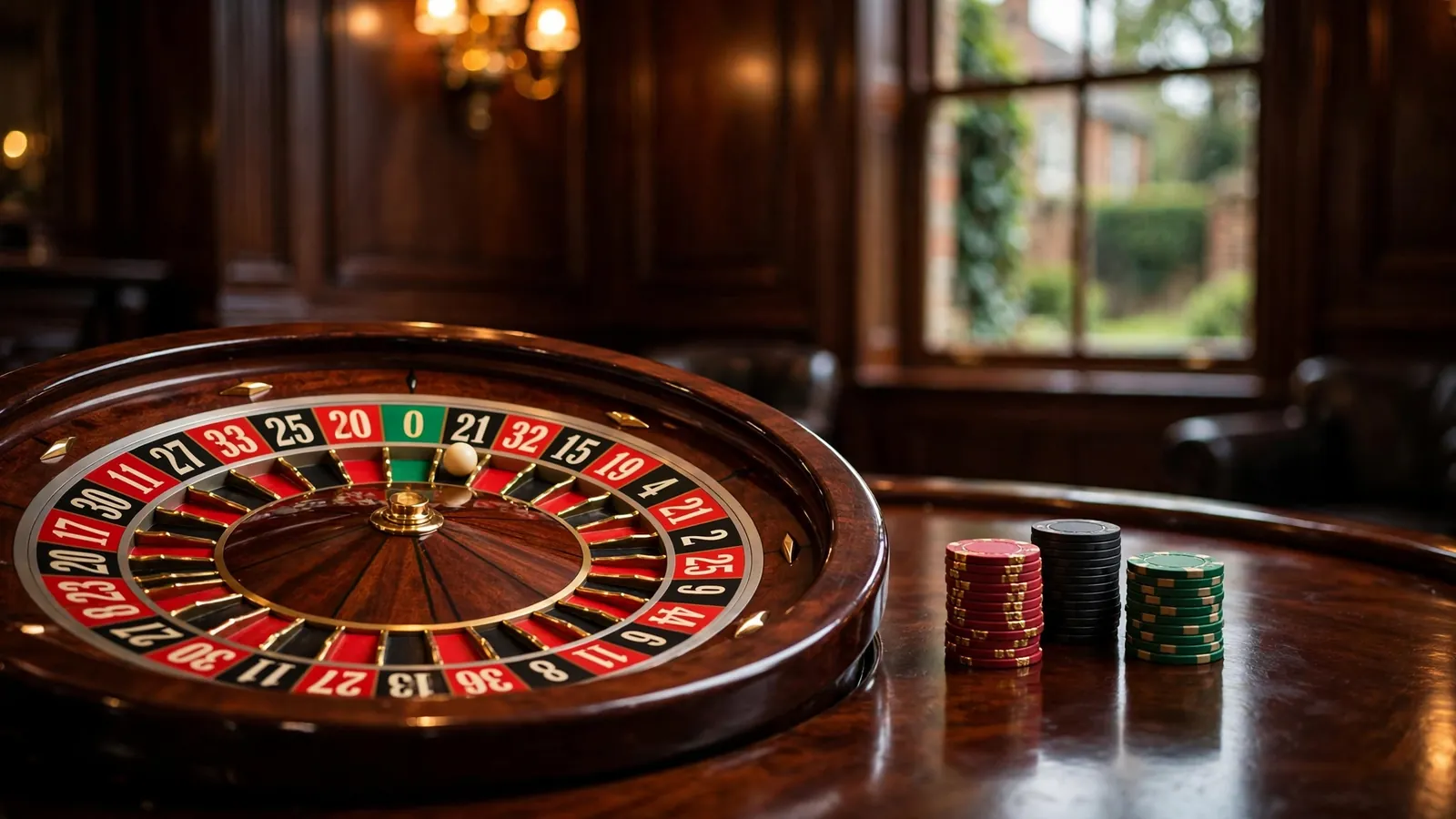
European roulette is defined by a small, conspicuous absence: there is no second zero. Its wheel has 37 pockets, numbered from 1 to 36, plus one green pocket marked zero. That single green interruption is not decoration. It is the feature that sets the game’s basic mathematics and gives the casino its advantage.
The house edge for European roulette is 2.70%. Put another way, its theoretical return to player, or RTP, is 97.30%. The two figures describe opposite sides of the same calculation: over a sufficiently large volume of play, the model assigns 97.30% of stakes back to players and retains 2.70% as the house edge. This is a statistical expectation, not a promise about an individual session. A result in a particular stretch can sit far from the long-run average.
RTP is often presented as if it were a simple quality label, detached from the game’s structure. Here it has a physical explanation. The numbered pockets offer a broad field of possible outcomes; the single zero belongs to the wheel but not to the numbered sequence. Its presence is enough to make the expected return lower than the total amount staked. The casino does not need to alter the wheel from one spin to another. The price is built into the arrangement.
For someone comparing online European roulette in the UK, the RTP figure should be easy to find in the game’s information or rules panel. UKGC-licensed operators offer games whose rules and details can be read before play; the precise presentation varies by game. The displayed RTP is more useful than a promotional description because it gives a measurable account of the game’s long-run mathematics. It should be read as a property of the game, rather than as a forecast for a particular player.
That distinction matters. A return figure can sound reassuring when written as a percentage, but it does not describe a sequence of outcomes or protect a balance from short-term swings. The wheel has no memory of what happened before. A run of results does not change the stated RTP, and the figure does not say what will happen next. It is a summary of the underlying probability model, not a personal receipt.
The single-zero design has made European roulette an especially recognisable version of the game. The name is attached to a format, not a guarantee of identical presentation across every online table. A digital game may be visually spare or richly dressed, and its controls may differ, while the central mathematical feature remains the same: 37 pockets and one zero. That common structure is why the RTP is a useful starting point when looking at an online casino European roulette game.
The surrounding market has its own rules. In Great Britain, online casinos selling gambling to local customers must hold a licence from the UK Gambling Commission. A legal operator’s status is not a decorative badge; it places the service inside a regulatory system. The Commission is the sole gambling regulator for Great Britain, while the Gambling Act 2005 governs gambling in England, Wales and Scotland. Northern Ireland sits outside that Act’s scope. Legal online casino play in the UK is for adults aged 18 and over, and an operator must verify a customer’s age before allowing a deposit.
These rules do not alter the wheel’s arithmetic. Regulation concerns the conditions under which gambling is offered; the house edge belongs to the game itself. Keeping those ideas separate helps prevent the licence from being mistaken for a promise of favourable results. A regulated environment can establish obligations for the operator, but it cannot make a chance outcome predictable.
There is a social neatness to the single zero. One pocket, visibly set apart in green, carries the small structural advantage that sustains the table. The arrangement is plain enough to be understood and stable enough to be sold in many forms, from a live table to an online game. Its elegance should not be mistaken for generosity. The wheel looks balanced; the arithmetic is not.
In online European roulette casinos, the most useful first question is therefore not whether the graphics are polished or the wheel looks familiar. It is what game is being offered, and what its published RTP says. A figure of 97.30% describes the theoretical return associated with a 2.70% house edge. Neither figure predicts the next spin.
A clean design. A fixed price.
When choosing an online casino for European roulette in the UK in 2026, payout timing is one practical detail to consider. This list gives a concise reference point for that aspect.
Zombillion
Zombillion lists a payout speed of 1–3 business days.
Amunbet
Amunbet lists a payout speed of 1–3 business days.
Britsino
Britsino lists a payout speed of 1–3 business days.
Chanze
Chanze lists a payout speed of 1–3 business days.
SpinFormula
SpinFormula lists a payout speed of 1–3 business days.
Dieselwin
Dieselwin lists a payout speed of 1–3 business days.
NightLuck
NightLuck lists a payout speed of 1–3 business days.
Jetsetspins
Jetsetspins lists a payout speed of 1–3 business days.
x3bet
x3bet lists a payout speed of 1–3 business days.
WinBeast
WinBeast lists a payout speed of 1–3 business days.
A European roulette table does not become more favourable because it sits beneath a polished lobby or carries a casino’s preferred label. The useful comparison is less theatrical: what version of the game is offered, how clearly its rules and return are shown, and what conditions attach to any bonus funds used there. Those details separate a sound offer from a handsome page of decoration.
Table format matters, but not as a promise of better odds. A casino may offer several European roulette tables with different interfaces, presentation styles or rules for particular bets. The game information should identify the rules applying to that table, rather than leaving players to infer them from a familiar-looking layout. A table’s displayed name is not a substitute for its rule sheet.
Game information should also make the return to player (RTP) accessible. For UKGC-licensed operators, the relevant roulette RTP should be available with the game information, so that a comparison rests on published figures rather than on claims such as “premium” or “exclusive”. RTP describes a theoretical return across play, not a forecast of what a particular session will produce. A clear figure is useful; it is not a promise.
Terms deserve the same scrutiny as the game itself. The minimum stake, any table-specific conditions and the rules for withdrawing bonus funds can affect whether an offer suits a player’s circumstances. They should be stated before play, not hidden behind promotional language. The word “best” has little meaning if the conditions that shape the offer are harder to find than the game.
Bonuses introduce a separate calculation: game weighting, the share of wagering that a roulette stake contributes towards a bonus requirement. UK operators commonly count roulette at 10% to 20%, rather than treating every pound staked as a full pound of progress. The rate is operator-specific and may differ between game formats. A specialist review reports that live roulette may be assigned a 10% or 20% contribution, while RNG roulette may count at 100%; the operator’s own current terms remain the necessary check, since those conditions can change.
That difference can make a headline bonus look more generous than its practical value at a roulette table. If a game contributes only a fraction of each stake, the stated wagering requirement takes longer to clear through that game alone. Some terms also exclude particular tables or restrict which funds can be used. The relevant question is not simply whether roulette is permitted, but how the chosen game is weighted and whether its contribution applies to the specific bonus.
A UK gambling-industry regulatory briefing reports that, from January 2026, bonus wagering requirements for licensed operators are capped at a maximum of 10 times the bonus amount. The cap sets an upper boundary; it does not make every offer equally accessible or erase game-weighting rules. A lower contribution rate can still determine how much qualifying play is needed within that boundary. Reading the cap alongside the operator’s contribution table gives a more accurate picture than reading either in isolation.
The most useful comparison therefore combines three plain checks: the game’s published rules and RTP, the conditions attached to its table, and the bonus terms that define game weighting. None makes one casino universally superior. Together, they show whether the offer is legible before money is committed. That is a modest standard. It is also the point.
A roulette layout offers bets that cover different amounts of the table, and their payouts reflect that choice. A straight-up bet names one number and pays 35:1 if it wins. A split covers two adjacent numbers and pays 17:1; a street covers a horizontal row of three and pays 11:1. These are fixed payouts, not forecasts. A larger return accompanies a narrower winning condition, not a hidden method of making the result more likely.
Outside bets cover broader groups. Red or black, even or odd, and high or low each pay 1:1. Their compactness is part of their appeal: the choice is easy to read, and the return is straightforward. But a familiar-looking bet is not a more informed one. Each wager is resolved by the spin, not by the pattern of previous outcomes.
That distinction matters when systems enter the conversation. The Martingale is among the simplest to describe: after every loss, the player doubles the next bet, intending a later win to recover earlier losses and leave a small profit. On paper, the sequence looks orderly. In play, it asks a bankroll to absorb a run of losses while the required stake keeps growing. A losing streak can damage that bankroll long before the hoped-for recovery arrives.
The system changes the size of the wager, not the odds behind it. Roulette outcomes remain a matter of chance; no betting sequence can identify or predict the final result. A run of black does not make red due, just as a series of losses does not put the next spin under an obligation to repay them. The wheel keeps no account.
There is a social logic to systems like Martingale. They turn uncertainty into a procedure, and procedure can feel like control. Casinos have long offered games in which numbers and rituals give chance a respectable costume. The arithmetic underneath is less accommodating: doubling after a loss increases exposure precisely when the bankroll has already taken a hit. A finite budget cannot support an indefinitely rising sequence, and a table’s permitted stakes may also constrain it.
For anyone learning how to play European roulette, understanding the payout board is more useful than memorising a betting system. It shows what a selected bet covers and what a winning result pays, without implying that one choice can command the next outcome. Free-play versions can be useful for getting familiar with placing selections and reading the interface, though practice does not alter the odds when money is involved.
The same distinction applies to online tables, including those presented as European VIP roulette. Presentation and table labels may differ; a system still cannot turn chance into a schedule. The bet is a choice about exposure and potential payout, not a prediction.
No recovery is promised.
In an online casino, a European roulette wheel may appear as a graphic, but its movement does not always come from a wheel in a room. RNG roulette produces each spin through a random number generator. The screen presents the familiar turning wheel and ball; behind that image, software selects the result. There is no physical ball to watch settle, only a digital animation of the event.
That difference changes the rhythm. With no dealer handling a ball or waiting for it to fall, simulated games can move more quickly, and their minimum stakes can be lower. Some RNG tables accept bets from 10p. For a small stake, that can make the format less imposing; for anyone watching a succession of results, the shorter pauses can also make play feel less reflective. Speed is a feature, not a neutral backdrop.
Auto-roulette and speed formats can push the entry point lower still: some begin at 5p. The labels do not mean exactly the same thing as RNG, however. Auto-roulette commonly describes a format in which a machine operates the wheel, while speed roulette refers to a faster round schedule. The categories can overlap in online menus, so the title alone may not explain whether the result comes from software or a physical mechanism. Game information on the table screen is the place to establish which format is being offered.
The pace figures show why the distinction matters. A specialist review reports speed roulette at more than 150 spins an hour, against 80–100 for a standard table. These are reported comparisons, not a promise that every game will keep the same tempo. Even so, they describe a meaningful change in the amount of time between decisions. A quicker round does not alter chance; it compresses the interval in which a player might pause.
Minimums tell a quieter story about access. UK live roulette tables can be listed with entry stakes from 10p, while some auto-roulette and speed tables admit bets from 5p. Those figures are possible starting points, not a universal tariff: the available stake depends on the particular table. A low minimum reduces the amount needed to join a round, but it does not slow the game or make its outcomes more predictable.
The screen therefore conceals several different arrangements beneath one familiar image: software simulating a wheel, a machine-operated wheel, or a faster presentation of play. The wheel may look much the same in each case. The source of the result, the interval between spins and the smallest accepted stake are what separate the experiences. One image, different machinery.
On a European roulette single-zero wheel, zero is not merely another number on the table. It is the outcome that interrupts the familiar division of outside bets into pairs: red or black, odd or even, low or high. When the ball settles there, neither side of such a pair wins. Without a special rule, the stake on an even-money bet is lost.
La Partage changes that settlement. If zero appears, half of an even-money stake is returned and half is lost. The bet does not become a win, and the return is not a reward for predicting zero. It is a rule governing what happens to a particular wager when the wheel produces the outcome that defeats both sides.
That distinction matters because roulette rules are expressed not only in the numbers printed on a layout, but in the treatment of the awkward result between the alternatives. Red and black look like opposites; zero sits outside their promise of a simple choice. La Partage softens the cost of that interruption without removing it. The player still loses part of the stake.
The rule applies to even-money bets, not every wager placed on the table. A bet tied to a specific number or smaller group of numbers is settled according to its own terms; La Partage does not turn those wagers into protected bets. The relevant question is therefore not simply whether a table has a single zero, but whether its rules specify what happens to even-money stakes when that zero appears.
Where La Partage is in force, the house edge on those bets falls to 1.35%. That figure describes the mathematical effect of the rule over time, not a promise about an individual session. On any particular spin, the result remains a win, a loss or, when zero interrupts an eligible wager, a partial loss. A lower edge changes the long-run price; it does not make the next outcome more predictable.
This is why the wording attached to a table matters. Two displays can offer the same basic choice between red and black while settling zero differently. One returns nothing on that result; another returns half the stake under La Partage. The difference is easy to overlook when the betting interface foregrounds colours and numbers, yet it changes the cost attached to the same apparent decision.
There is a small social history in the rule. Gambling has always needed a way to define who bears the cost of an unusual result, and roulette makes that division visible in a single pocket. La Partage is a concession to the player, but a limited one: the house gives back part of a stake only in a defined circumstance. The wheel keeps its advantage. Just less of it.
The rule belongs to the table’s terms, not to a player’s method. It cannot be summoned by choosing a particular colour, nor does it alter what zero means for bets that are not even-money wagers. Its value is precise and narrow: when zero lands, an eligible stake is divided between return and loss, rather than disappearing in full.
A European roulette table turns the wheel’s sequence into a working map. On the wheel, pockets follow a fixed circuit; on the cloth, the numbers are arranged for placing bets rather than tracing that circuit. The European wheel has thirty-seven pockets, numbered 1 to 36 with one zero. Its table layout gives those outcomes a more orderly address.
The central grid holds the numbered spaces. Numbers run across three vertical columns, with each horizontal row grouping three consecutive numbers. The green zero sits separately at the head of the grid, outside those rows. It is not simply another space in the pattern: its position makes clear that it belongs to the same game while standing apart from the numbered field.
Around the grid, marked areas gather numbers into broader groups. Boxes beside the numbered spaces correspond to the columns; bands beyond the end of the grid organise numbers into dozens. Along the outer edge are the familiar broad categories: red or black, odd or even, and low or high. These labels turn a crowded field of individual squares into a set of larger territories.
The design is practical, but it also tells a small story about how the game is played. A player may point to a single numbered square, a boundary between spaces, or one of the larger marked zones. The placement itself is the declaration. The dealer can read it from the cloth, and the layout makes the chosen area visible to everyone at the table.
On an online European roulette table, the same map is usually rendered on screen. The proportions may be smaller, and controls can sit around the grid, but the underlying organisation remains recognisable: numbered spaces in the centre, grouped areas around them, and zero separated at the top. A digital table is therefore not merely a picture of green cloth. It is an interface whose geometry carries the rules of placement.
The wheel and table are counterparts, not copies. One arranges pockets around a physical circle; the other makes possible selections legible in rows, boxes and bands. The circle gives chance its machinery. The cloth gives human choices their address. A map, not a prediction.
A roulette-themed slot borrows the wheel’s imagery: a ball, numbered segments, perhaps the familiar red and black. The resemblance is decorative. It is not a roulette table, and its symbols do not create the same betting choices as a physical or simulated wheel. A spin resolves according to the slot’s own design, not by placing a stake on a number or colour on a roulette layout.
That distinction matters when a game is described as a European roulette slot. The phrase may signal its visual influence, but it does not establish that the game uses a European wheel or carries European roulette odds. Nor does a title such as “Gold” or “Platinum” tell anything reliable about its rules. Those words are branding, not a technical specification.
The same applies to a three-dimensional presentation. A 3D European roulette slot may make the imagery feel more like a rendered table, but depth and animation do not turn the product into table roulette. The relevant information is the game’s own rules and paytable: what symbols matter, how a result is formed and what the stated returns refer to. A roulette table’s odds cannot be transferred to a slot simply because both feature a spinning circle.
There is a social history in that borrowing. The wheel carries the theatre of a public game—one visible object, a collective pause, a result everyone can watch. A slot compresses that theatre into a private sequence of screen events. The familiar image remains; the underlying bargain changes.
British rules recognise the difference. Online slot autoplay is banned, so a slot cannot keep starting spins on its own. Each spin must also last at least 2.5 seconds. These requirements apply to the slot format, including one dressed in roulette colours; the theme does not create an exception. The pause is modest, but deliberate: the next result cannot be turned into an endlessly self-running stream.
For anyone comparing a themed slot with a roulette table, the useful question is not whether the graphics look convincing. It is whether the game is actually a slot or a roulette product, and which rules govern its results. Names can borrow freely. Mechanics cannot.
Live European roulette brings a physical wheel into the room, even when the room is a screen. A camera carries the studio feed; a human dealer releases the ball, waits for it to settle and announces the result. The small ceremony matters. An RNG game produces an outcome digitally, while live play makes the wheel, dealer and ball drop visible. It is not a guarantee of fairness by appearance, but it gives the game a public, observed sequence.
That studio is also part of a regulated service. In Great Britain, the UK Gambling Commission is the sole regulator of online casino activity. A company’s location does not remove its licensing duty: operators serving British customers with remote gambling must hold the relevant UKGC licence. A platform without a valid UKGC licence cannot legally offer real-money live roulette to British residents. The distinction is not a decorative badge; it determines which rules and routes for redress apply.
For a UKGC-licensed live casino, the rules shape the account as well as the table. Operators must provide deposit and loss limits, session-time reminders and reality checks, alongside cool-off options and access to GamStop self-exclusion. New customers must be prompted to set a financial limit before making their first deposit, and account-level controls must remain accessible. Age verification must take place before an operator allows a customer to deposit. These measures make the casino responsible for more than transmitting a wheel and taking bets.
The result is a curious arrangement: a game built around a visible physical object, delivered through a remote service whose obligations are largely invisible until needed. The dealer handles the ball; the operator handles the account, the safeguards and the complaint process. UKGC licensees must provide an internal complaints procedure and access to an approved Alternative Dispute Resolution service. That institutional layer is less theatrical than the studio, but it is the part that gives a live table its legal address.
A camera can show every bounce. It cannot, by itself, show whether the room behind it is accountable.
The differences between roulette variants are small enough to fit on a wheel and large enough to alter the price of a bet. European roulette has 37 pockets: numbers 1 to 36 and one zero. Its house edge is 2.70%. American roulette adds a second green pocket, the double zero, bringing the total to 38. That extra pocket raises the house edge to 5.26%.
Features a single-zero wheel with 37 pockets and a house edge of 2.70%.
Includes a double-zero wheel with 38 pockets, increasing the house edge to 5.26%.
Uses a single-zero structure and includes rules like La Partage to lower the house edge on even-money bets.
The layout still looks familiar, and a straight-up number bet still pays 35:1 on both versions. But the American wheel gives the casino another winning outcome that does not pay a number bet. The arithmetic changes while the table’s appearance offers little warning. An online European roulette casino game and its American counterpart may therefore look like close relatives, but the extra pocket is not decorative.
A specialist casino review also describes American tables with a third green pocket, marked 000, and gives a 7.69% house edge for that format. That is a reported table variation, not a figure to assume applies across the market. The double zero already makes a substantial difference.
French roulette shares the single-zero structure, but its rules include La Partage and En Prison. These rules can soften the house advantage on eligible even-money bets, which is why French roulette has the lowest house edge among standard variants. La Partage reduces the edge on those bets to 1.35%; En Prison is another rule that can affect how a bet is treated after zero. The details depend on the table’s stated rules.
So “European roulette vs American roulette” is not merely a question of preference or presentation. It is a comparison between different pocket counts and different costs of chance. French roulette changes the terms again, rather than adding another pocket. Small changes, plainly priced.
A free European roulette game and a real-money table may look alike on screen, but they answer different questions. A demo lets a player handle the interface and place simulated bets without risking a gambling balance. It can show how the table responds to a selection or how a session feels, but it cannot show what it is like to lose money that belongs to the player. The distinction is less technical than human: pretend funds remove the consequence that gives each decision its weight.
That makes a European roulette demo useful for orientation, not prediction. The outcomes in roulette are determined by chance; practice cannot teach a player to know what will happen next. Nor does a run of simulated wins establish that the same pattern will continue when real money is involved. A demo is a rehearsal with the most consequential part removed.
The phrase “free online European roulette” can also describe very different things. Some games offer a practice mode alongside a cash table; others may not. The word “free” should be understood in context: it does not mean that a real-money game can be played without a deposit, or that any winnings shown in a practice mode can be withdrawn. The terms attached to a game explain whether it is a demonstration or a cash game.
With real-money European roulette, the balance is no longer an abstract counter. Deposits and losses have financial consequences, which is why the legal status of the operator matters as much as the appearance of its table. In Great Britain, online gambling is legal through operators holding the relevant UK Gambling Commission licence. A foreign location does not remove the requirement to hold that licence when serving the British market. A licence can be checked on the Commission’s public register.
There are practical safeguards before play begins. Operators must verify a customer’s age before allowing deposits, and new customers must be prompted to set a financial limit before their first deposit; account-level controls must remain accessible. Credit cards cannot be used to fund gambling with a UKGC-licensed operator. These are not decorative notices around a game. They mark the boundary between a simulated pastime and a regulated transaction.
The choice between demo and cash play is therefore not simply a choice between free and paid entertainment. A demo can make unfamiliar controls less obscure; it cannot remove chance, forecast a result or make a real-money session financially neutral. Cash play carries consequences that practice mode deliberately withholds.
The screen may be the same. The stakes are not.
European roulette has the lower house edge: 2.70%, compared with 5.26% for American roulette. That means its long-run theoretical odds are more favourable to the player, though neither version predicts the result of a particular spin.
European roulette has 37 pockets: numbers 1 to 36 and one zero. American roulette has 38 pockets, adding a double zero; some tables also have a third green pocket marked 000.
In Great Britain, online casinos must hold a UK Gambling Commission licence to offer gambling legally to local customers. The licence places an operator within a regulatory system, but it does not guarantee gambling outcomes.
European roulette has a 2.70% house edge, while American roulette has a 5.26% edge. Some American tables with a 000 pocket have a 7.69% edge.