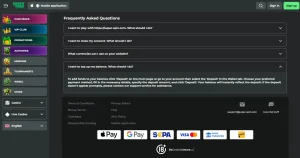
Skrill access depends on the casino’s live cashier, while limits, account ownership and withdrawal rules shape how payments work.
Skrill is still a prominent way to fund casino accounts in the UK-facing market. A specialist review describes it as one of the more commonly available deposit methods in 2026, though that is a description of the market, not a promise about every cashier. Payment menus differ between operators and can change, so the useful question is not whether Skrill exists in the abstract but whether it appears as a deposit choice on the particular account.
That distinction matters because a payment brand can be familiar without being universally accepted. A casino may show several ways to pay, while an individual account’s cashier presents only some of them. Skrill’s presence should therefore be confirmed where a deposit is actually initiated, rather than inferred from a general description of a site. A name in a payment list is a starting point; the live cashier is the practical test.
There is a small history of convenience in this arrangement. E-wallets make payment feel like a separate layer between a person and a merchant: a balance is held with the wallet provider, then used to fund another account. The interface can make the movement seem almost frictionless. Yet the casino’s own deposit conditions still govern whether that route is available, and the wallet’s recognisable name does not settle the details of a particular transaction.
When choosing a UK casino that accepts Skrill, payment options and withdrawal timing are worth checking before you sign up. This list gives you a concise reference point for considering your options.
Zombillion
Zombillion lists a payout speed of 1–3 business days. This gives Skrill users a stated timeframe to consider when reviewing the site.
Amunbet
Amunbet lists a payout speed of 1–3 business days. That is the available timing information to consider when reviewing it for Skrill payments.
Britsino
Britsino lists a payout speed of 1–3 business days. This provides a stated withdrawal timeframe for readers considering the site.
Chanze
Chanze lists a payout speed of 1–3 business days. It is a useful point to keep in mind when looking into Skrill-friendly casino options.
SpinFormula
SpinFormula lists a payout speed of 1–3 business days. This is the available information about its payout timing.
Dieselwin
Dieselwin lists a payout speed of 1–3 business days. Readers can use this stated timeframe as one detail when assessing the site.
NightLuck
NightLuck lists a payout speed of 1–3 business days. This provides a clear point of reference for its payout timing.
Jetsetspins
Jetsetspins lists a payout speed of 1–3 business days. That timing is the main available detail for readers considering it.
x3bet
x3bet lists a payout speed of 1–3 business days. This gives readers a stated timeframe to factor into their review.
WinBeast
WinBeast lists a payout speed of 1–3 business days. This is the available factual detail about its payout timing.
Currency is one of those details. Specialist pages describing the relevant sites state that GBP is supported, but the account currency should be checked before the first payment. The distinction is not merely cosmetic. If the casino account and the Skrill balance are not held in the same currency, a conversion may be involved. The payment can still be possible, but the displayed amount and the amount ultimately credited need not be read as identical without checking how the conversion is handled.
The account’s currency setting is worth treating as part of the payment choice, not as a detail to discover after money has moved. A pound-denominated cashier is easier to interpret for a UK customer than one displaying another currency, but the important point is confirmation rather than assumption. Specialist descriptions say pounds are supported; they do not make every account configuration identical. The cashier and account settings are where that claim becomes concrete.
Starting amounts require the same care. A specialist review places minimum deposits across the methods it covers in a range of £10 to £20, with the threshold depending on the selected payment route. That is a broad indication, not a universal Skrill minimum. The figure displayed in the cashier for the chosen method is the amount that matters at the point of deposit; a general range cannot replace the method-specific condition.
This is where the word “minimum” can mislead by sounding like a stable feature of the casino. In practice, it is attached to a payment route and to the terms shown for that route. A low threshold may be relevant to one method and not another. For Skrill, the deposit screen provides the direct answer; a site-wide headline or an old description may not reflect the current cashier.
The initial decision is therefore a set of modest checks: whether Skrill is offered for deposits, which currency the account uses, and what minimum the cashier shows for that payment choice. None requires a grand theory of online finance. They do, however, keep separate questions from being blurred together. Availability is not the same as a supported currency, and a supported currency is not the same as a particular minimum.
The broader market language can obscure those distinctions. “Skrill casino” sounds like a fixed category, as if the payment method were a defining feature of the venue. It is more accurately one possible route into an account, subject to the operator’s current payment menu and the customer’s account settings. The label is useful only until the details begin.
In a regulated market, the ordinary cashier sits within a larger system of account controls and payment rules. But for the deposit itself, the relevant evidence is plain: Skrill must be available in the deposit options, the account currency must be understood, and the minimum shown for that route must be acceptable. A specialist review can orient the search; the account screen resolves the transaction-level question.
No grand mystery. Just the cashier.
“Free slots” and “Skrill slots” describe different things. Free play concerns whether a game can be played without staking money; Skrill concerns how money may be moved into a casino account. A payment method does not make a slot free, and a free-play session does not require a Skrill deposit. The two ideas are often pressed together in a single phrase, but they belong to separate parts of the experience.
A game may have a demonstration mode, if the casino makes one available, but that is not the same as playing for cash. No real-money stake is being funded through Skrill in a free session. Nor does the existence of a free mode establish that the same game is available at every casino, or that a particular operator offers it. Game libraries and access conditions are matters for the individual site; a payment logo cannot settle them.
Real-money play has a different threshold. The casino must allow the account to use Skrill, and the customer must make a deposit before wagering cash. That is the point at which searches for Skrill-compatible slots meet the cashier rather than the game catalogue. The distinction matters because a slot title, a casino account and a payment option are three separate things, even when a website presents them on the same screen.
Promotions add another layer. A specialist review has described Skrill and Neteller deposits as often being left out of casino promotions. That is a report from one kind of source, not a rule that can safely be carried across every operator or offer. Eligibility may be defined in the promotion’s own terms, and those terms are the relevant text for a particular deal. A banner alone does not establish that a deposit made through an e-wallet qualifies.
This can produce an awkward little bargain: an offer may look attractive while the chosen payment route makes it unavailable. The reverse can also be true; a cashier may accept Skrill while a particular promotion has its own exclusions. Payment acceptance and bonus eligibility are separate decisions. One does not imply the other.
The practical consequence is that free-play claims should not be read as evidence of a bonus, and a bonus should not be treated as proof that Skrill deposits qualify. “Free” may refer to a non-cash demonstration mode, a promotion with conditions, or simply promotional language. Those meanings are not interchangeable. Where an offer is tied to a deposit, its payment-method rules and any other conditions decide whether it applies; the word “free” does not remove those conditions.
There is also a social history tucked into the small print. Promotions are designed to bring people through the door, while payment systems determine which route counts as an eligible entrance. The cashier may be welcoming; the offer may be more selective. The contradiction is not necessarily a technical fault. It is a reminder that a casino’s marketing and its transaction rules serve different purposes.
For anyone comparing real-money casinos that accept Skrill, the useful distinction is therefore not between “free” and “paid” slots as though Skrill were a feature of the game. It is between a game available for demonstration, a game played with deposited funds, and an offer whose terms permit the selected payment method. These questions can have different answers on the same site.
A careful reading keeps the categories apart: free play says nothing by itself about cash deposits; a Skrill option says nothing by itself about promotion eligibility; and a promotion headline says nothing conclusive about either until its conditions are read. The little catch is not the wallet. It is assuming that one label answers all three questions.
A Skrill-compatible casino account is still a casino account first: it holds the player’s details, balance and activity, while Skrill is one possible route for moving money. The two records meet at the cashier, not inside a slot. A game does not become “Skrill-compatible” because it is available on a site whose cashier accepts Skrill; payment is handled at account level.
That distinction matters when the same casino is used through a browser and an app. The app is another way into the account, not a separate payment identity. The practical question is whether Skrill appears among the available options in that account’s cashier, rather than whether the app carries a general Skrill label. A payment route can be relevant to the account without being a feature of every game or every screen.
There is a small, useful discipline in keeping the details aligned. When the casino account information and payment route belong to the same customer, basic ownership checks are less likely to create avoidable friction. A mismatch does not explain every delay or decision, but it can turn a straightforward transaction into one requiring clarification. The paperwork has a long memory.
The same account-level distinction helps with searches for Skrill slots or games. Slots are selected from the casino’s catalogue; Skrill is chosen separately when funds are added. So a search for games “with Skrill” is best understood as a search for a casino where the cashier accepts the wallet, not a special category of software. Nothing about a game’s theme, provider or format establishes which payment methods the operator supports.
Promotions add another layer. A specialist review has reported that Skrill and Neteller are often excluded from promotions, but that observation is not a rule for every casino or offer. Eligibility depends on the terms attached to the specific promotion and the payment methods those terms permit. A bonus displayed in an account does not, by itself, establish that a Skrill-funded deposit qualifies. The offer’s conditions are the deciding text.
This can make the order of choices consequential: an account may present a promotion, while the cashier presents Skrill, and the terms determine whether the two can be combined. Treating the payment option and the offer as separate until the conditions are checked avoids assuming that a visible bonus applies to every deposit route. Promotional language is rarely shy; its exclusions tend to be quieter.
Nor does the presence of Skrill say anything about a casino’s account-control status. It identifies a payment option, not a category of operator or a property of the games. Likewise, a casino account is not made anonymous or unnecessary by connecting a wallet: Skrill does not replace the account through which play is managed.
The useful mental picture is modest. The casino account governs access and play; the cashier connects that account to a payment route; the games sit within the casino’s catalogue. Those parts can interact, but they are not interchangeable. A wallet is not a game pass.
Skrill can appear in a UK casino cashier as a way to deposit, but a payment route is not a one-way door. The casino’s rules for returning money are connected to the way funds arrived. UK anti-money laundering requirements generally call for payouts to go back to the original payment source, a control intended to make the movement of gambling funds traceable.
That is why “Skrill accepted” needs a little precision. A site may offer Skrill for deposits, while the payout route depends on the account’s transaction history and the casino’s own cashier rules. A deposit option alone does not establish that every withdrawal can be sent to Skrill. The two stages belong to the same transaction path, even when the interface presents them as separate buttons.
This arrangement can feel bureaucratic, but it serves a clear purpose: money should not become anonymous simply because it passed through a gambling account. Closed-loop rules link the funds leaving an account to the source that supplied them. Where a casino needs to return funds by another route, it may ask for further checks before processing the payment. The payment trail is part of the account record, not a decorative feature of the cashier.
The first payout can also take longer than a deposit. A specialist review notes that withdrawal processing includes the casino’s internal approval, and that an initial withdrawal may take longer while verification is completed. A separate specialist review identifies approval and the account’s verified status as factors in payout speed. These are not the same stage: a payment provider cannot move money that the casino has not yet approved for release.
This distinction explains a familiar imbalance. A deposit may be credited through an automated process, while a withdrawal waits for the operator to review the request and account. When the first payout prompts KYC checks, identity or account details may need to be confirmed before funds are released. Later requests can still be subject to checks; a previous payout is not a promise that every future one will follow an identical path.
For anyone asking whether Skrill can be used at UK online casinos, the useful answer is conditional: some sites offer it, but the cashier determines whether it is available for that account and transaction. A casino’s payment page should make clear whether Skrill is shown for deposits, withdrawals, or both. The distinction matters more than a broad label on a promotional page.
A consistent payment trail tends to reduce avoidable friction. If the casino account and Skrill account belong to the same customer, basic ownership details are less likely to conflict during a transaction review. That does not replace the operator’s checks, and it does not guarantee a particular processing time. It simply avoids adding a mismatch to a process that already has its own approval steps.
The transaction has two sides. The cashier shows the route; the account history helps decide how money can return. A small piece of financial housekeeping, with a long shadow.
The broad answer is that Skrill is still a familiar option in the UK-facing casino market. A specialist review characterises it as one of the more widely encountered deposit methods at UK-friendly sites in 2026. That is useful as a description of the landscape, not as a guarantee about any particular casino. Payment menus change, and a method’s general popularity cannot establish that it is available to every customer or for every account.
“UK-friendly” is also a loose description, not a regulatory status. For real-money gambling offered to customers in Great Britain, the operator must hold the relevant UK Gambling Commission licence. The legal distinction matters: a site that accepts sterling, displays UK-facing material or lists Skrill is not thereby a licensed casino serving the British market. Payments are not a substitute for oversight.
The phrase “Skrill casinos” can therefore promise a category, at most: sites where this e-wallet may form part of the payment options. It cannot, by itself, promise that a named operator currently accepts it, that every Skrill product will work, or that the cashier will show the same options to every account. Nor does the word “accepts” settle what happens after a deposit. A payment option’s presence should not be mistaken for a complete account of how transactions are handled.
There is a human reason these lists attract attention. An e-wallet can become part of a person’s ordinary financial routine, and a familiar logo looks reassuring beside the games. But a logo is a small piece of evidence. The regulated relationship is with the remote gambling licensee, whose obligations do not disappear behind the payment brand. In Britain, legal online casino gambling is confined to sites licensed and regulated in the UK; offshore availability is not the same thing as lawful UK service.
That boundary gives the year in the heading a modest role. “In 2026” indicates when the availability claim is being made, not a promise that a payment arrangement will remain unchanged throughout the year. A site can revise its cashier, and an account’s available methods may differ from a general description. The broad trend is useful for orientation; it is not a live confirmation.
A defensible list of casinos that take Skrill in the UK must therefore be treated as a starting point, not a verdict. The operator’s licence and the current payment information belong to the same basic check: one establishes whether the service is authorised for the market, the other whether the stated route is actually offered. Without both, “Skrill casino” is a label doing more work than it can bear.
Popularity, not certainty.
A payment logo is an invitation to check, not proof that every version of a payment product will work. A specialist payment review lists Visa and Mastercard among the methods shown by the sites it examined, but that does not establish current UK availability or eligibility for every card. The cashier is where the general label meets the specific transaction.
That distinction matters when a search for casinos accepting Skrill cards turns up a site that also displays ordinary card brands. Skrill and a card bearing a familiar network name are not interchangeable simply because both can sit inside a payment journey. The cashier may show Skrill as one route and Visa or Mastercard as another; the presence of one does not confirm the other. Nor does a card’s branding alone settle whether that particular product can be used for gambling.
The practical check is transaction-specific: which methods appear for the account, and which card products does the operator permit? A payment option advertised on a general information page may not be available to every customer or on every transaction. That is not a contradiction so much as the ordinary gap between a menu and a rule applied at checkout. Menus are optimistic documents.
The UK has a firmer boundary around credit cards. The regulator’s ban on credit-card gambling took effect on 14 April 2020 and remains in force. UK-licensed casinos cannot accept credit-card payments for gambling, including credit-card funding routed through a money service business. They also cannot accept wallet payments where the wallet permits credit-card funds to be used for gambling. A Skrill-branded card should therefore not be treated as a way to turn prohibited credit into an eligible deposit; the relevant question is what the product is and how it is funded.
Debit cards are a different category: UK casinos commonly accept them, including Visa and Mastercard. Even so, a network name is not a blanket approval. Current UK availability and card-product eligibility still need to be confirmed in the cashier. That distinction is especially important when an account contains several payment routes or when a card product has features beyond ordinary debit spending.
For mobile casino use, the same boundary applies. A method appearing on a desktop payment page is not evidence that it will appear in the mobile cashier, and a card option shown there does not certify every card carrying that logo. The payment screen is the relevant record for the particular account and transaction.
This is less glamorous than a list of supposedly universal Skrill casinos. It is also more accurate: compatibility belongs to the cashier, the customer and the payment product together. A logo cannot do all three jobs.
Skrill is not the only way to fund a UK casino account, but alternatives differ in an important respect: some may carry money both into and out of an account, while others are deposit-only. The cashier’s list is therefore more than a menu. It indicates which routes are available for that account and transaction.
Debit cards are a familiar alternative. UK casinos commonly accept debit cards issued by Visa and Mastercard, although availability still needs checking at the individual site. The distinction between debit and credit matters in Britain: credit-card payments for gambling are prohibited at UK-licensed casinos. A card bearing a familiar logo is not, by itself, proof that every card product or transaction will qualify.
Bank transfers and open banking offer another category. A specialist review describes these routes as capable of providing instant deposits and fast withdrawals at many sites. That is a report about availability, not a promise for every casino or customer. The payment screen can show whether a bank connection is offered, while the terms for the particular route establish what the site supports. These methods may suit someone who would rather use a bank account directly than maintain a separate e-wallet.
Commonly accepted Visa and Mastercard options, subject to individual site availability.
Direct connections capable of providing instant deposits and fast withdrawals.
Prepaid vouchers used exclusively for deposits; they do not support withdrawals.
Paysafecard works differently. It is a prepaid voucher for deposits, not a route for receiving withdrawals. That makes it a limited substitute for Skrill: it can serve the funding side, but it does not provide the same two-way function. A deposit-only method may still be useful for budgeting, yet it should not be mistaken for a complete payment arrangement.
Names can also outlive the products they describe. EcoPayz became Payz in 2022, so older references to the former name may point to a rebranded service rather than a separate option. The label shown in a current cashier matters more than a stale list elsewhere.
There is no universal “best” Skrill alternative. A debit card may be straightforward where accepted; a bank transfer or open-banking connection may have a different path through the cashier; a voucher is explicitly confined to deposits. These are functional distinctions, not a league table. A route that works for one player may not appear for another, and a payment method should not be assumed to support withdrawals merely because it accepts a deposit.
The practical comparison is therefore between payment functions: card, bank-linked service, or prepaid voucher. Each answers a different need, and the cashier—not the method’s reputation—settles what is currently available. Small print, large consequences.
A Skrill deposit can appear in a casino balance before the money has made the return journey. Depositing and withdrawing are separate stages: a withdrawal request may first sit with the casino for review, then move through the payment route. The balance changing on screen is not the same as funds arriving in a Skrill account.
The casino’s internal approval process and the state of the account both affect timing. A first withdrawal may take longer while the operator completes verification, or KYC. That is not a delay caused by Skrill alone: the casino must approve the request before the payment can be sent. If account details or documents need checking, the review stage can lengthen the wait.
After approval, the payment method still matters. A specialist payment review describes PayPal, open banking services and debit cards connected to fast payout systems as among the quicker withdrawal routes. That comparison does not establish a fixed Skrill arrival time. A separate specialist review notes that a card deposit may be instant while a payout takes several business days—a useful reminder that incoming and outgoing payments do not share one clock.
Skrill withdrawal times therefore depend on more than the label beside a cashier button. The casino’s processing queue, completion of verification and the payment route all have a part in the journey. A displayed estimate, where available, should be read as the operator’s stated expectation, not proof that approval has already happened or that the wallet has received the funds.
Fees need the same separation of stages. A casino may show a flat charge, while the payment provider or the currency conversion may introduce a different cost. If the account balance and Skrill account do not use the same currency, conversion can affect the amount received. A specialist payments review cautions that the exchange-rate spread—the gap between the rate applied and a reference rate—can cost more than a visible fixed fee. The small print may be doing the larger work.
Fees may arise from several sources: the casino, the Skrill provider, bank or card issuers, and network charges. Additionally, the exchange-rate spread can introduce costs if the account and wallet currencies differ.
A bank transfer is not a shortcut around timing either. A specialist payment review points to cut-off times and weekends as factors in delivery, with currency conversion adding another variable. This matters when a casino processes a payout by a route other than Skrill or when funds are redirected after review; the arrival date can reflect the banking calendar as well as the operator’s approval.
For a Skrill payout, the practical distinction is between casino processing and wallet delivery. The former can be held up by approval or KYC; the latter can be affected by the payment route and currency handling. Fees may also sit at different points in that chain. A fast deposit, then, says little about how quickly a withdrawal will clear—or what its final value will be.
Skrill is a payment route; GamStop concerns self-exclusion. One does not determine the other. A casino accepting Skrill is not, on that basis, shown to be outside GamStop, and using the wallet cannot change an account’s self-exclusion status. Payment compatibility is not a back door to an account-control decision.
The distinction matters because searches for Skrill casinos outside GamStop can blur two separate checks: whether a cashier offers a payment method, and whether a gambling account falls within a self-exclusion arrangement. A familiar logo in the payment window answers only the first question. It says nothing about whether an account can be opened or used.
In Great Britain, remote gambling operators serving customers must hold a UK Gambling Commission licence. Licensed casinos must also provide responsible gambling tools, including self-exclusion. A claim that a site accepts Skrill does not establish that it is licensed, nor does it establish how its self-exclusion controls apply. The UKGC public register is the place to check an operator’s licence status; payment branding is not a substitute.
There is another account-control measure at the point of entry. Remote operators must ask new customers to choose a financial limit before their first deposit, and make account-level limit controls available. That obligation belongs to the operator. It is separate from the payment provider and from any self-exclusion arrangement.
So the phrase “Skrill casinos not on GamStop” should not be read as a payment category with special access. Skrill cannot suspend, cancel or override self-exclusion. If a site presents payment acceptance as a reason that restrictions do not apply, the two issues are being conflated.
Different checks. Different purposes. A wallet moves money; it does not decide whether gambling access is appropriate or permitted.
A Skrill deposit begins with an ordinary but consequential question: do the gambling account and the payment account belong to the same person? Matching the account details with the payment route can reduce avoidable checks over who owns the funds. A mismatch may turn a routine transaction into a request for clarification, particularly where names or other identifying details differ.
That is not merely administrative fuss. Remote gambling licensees have to understand the movement of money through their accounts, while payment providers apply their own ownership and security checks. Consistent details leave fewer loose ends.
Financial limits belong in the same pre-deposit check. UK rules require a remote operator to invite new customers to set a financial limit before their first deposit and to make account-level limit controls accessible. The limit is a control over spending, not a prediction of what a transaction will cost. A deposit can still carry charges imposed elsewhere in the payment chain.
A specialist review identifies several possible sources of payment costs: the casino, Skrill, a bank or card issuer, currency conversion and, where relevant, network charges. Which ones apply can depend on the route and amount. A visible flat charge is only part of the picture if the exchange rate also contains a spread. The cashier and the relevant provider’s terms are therefore more useful than a broad claim that one route is free.
Before confirming, the account name, payment-account details, chosen limit and displayed transaction total should all tell the same story. If the account currency differs from the payment currency, conversion may add another cost. Small checks, fewer surprises.
PayPal, open banking services and debit cards linked to fast payout systems are generally among the quickest options. Actual timing also depends on the casino’s approval process and whether your account is verified.
Yes, verification may be needed, and first withdrawals can take longer while checks are completed. A fully verified account can avoid some of that delay.
Minimum deposits generally start at £10–£20, depending on the payment method. Check the cashier for the minimum shown for your chosen method.
Common options include debit cards, bank transfers, open banking, PayPal and prepaid vouchers such as Paysafecard. Skrill and Neteller are available at some sites, and some UK-licensed casinos also accept Apple Pay; check the casino’s cashier for its current options.
No. Withdrawal speed depends on the casino’s approval process, account verification and, for bank transfers, factors such as cut-off times and weekends.
Returning funds to the original payment source is a common anti-fraud and anti-money-laundering control. Using another route may require additional verification.
No. A Visa or Mastercard logo does not by itself confirm that every card product is eligible. Check the casino cashier and your card’s eligibility before depositing.