A practical look at the studio format, online pace and table terms, with clear distinctions between free play, bonuses and real-money payouts.
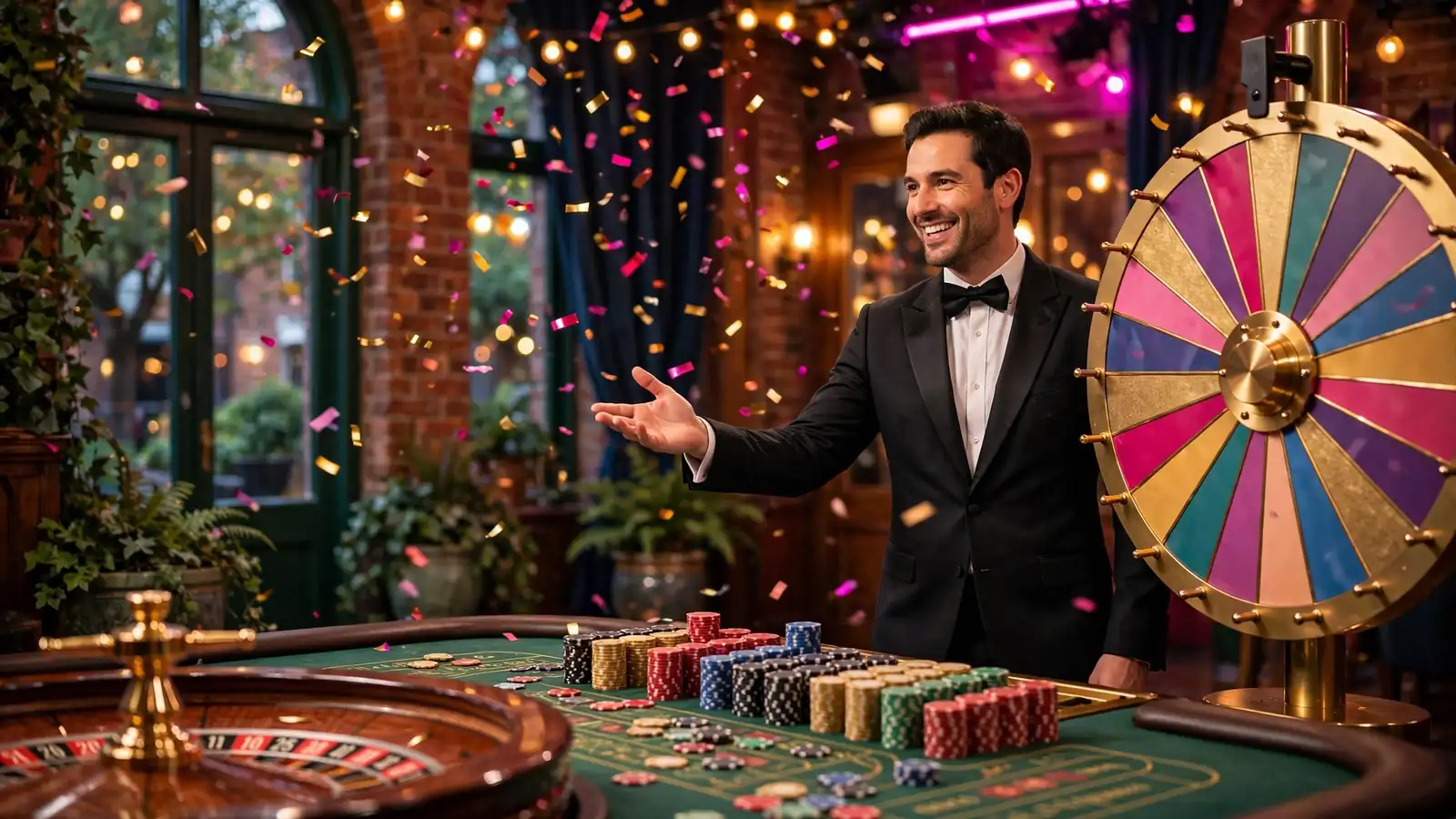
The word “live” has a precise meaning in a casino: the game is shown as it happens, rather than being generated entirely by software. A studio camera carries the action to the screen, where a human dealer conducts the game. Bets are entered through an on-screen interface. The result is a meeting of two kinds of activity: a person working in a physical setting, and players making choices through a digital one.
That arrangement gives a live casino its particular character. The dealer is not an animation or a voice laid over a computer game. The streamed footage comes from a studio, and the human presence is part of the event being watched. At the same time, the player does not reach across a table or hand over a stake. The betting interface is the point of contact between the screen-side participant and the studio-side game.
It is an unusual little theatre. The room exists somewhere beyond the device, but the player encounters it through a camera’s view and a set of buttons or controls. The interface translates an action into a bet; the stream makes the surrounding game visible. Neither half quite replaces the other. A conventional digital casino game can present a simulated scene, while a live table depends on footage of an actual studio and the person dealing there.
Choosing a casino for Crazy Time involves more than the game itself: payout speed is one practical detail to consider. This list provides a quick reference for UK players.
Zombillion
Zombillion lists a payout speed of 1–3 business days, a useful detail to check when choosing where to play.
Amunbet
Amunbet lists a payout speed of 1–3 business days. This gives players a stated timeframe to consider.
Britsino
Britsino’s stated payout speed is 1–3 business days, offering a clear practical point for players to note.
Chanze
Chanze lists payouts as taking 1–3 business days. Players can use this information when considering their options.
SpinFormula
SpinFormula states a payout speed of 1–3 business days, a relevant detail for players weighing where to play.
Dieselwin
Dieselwin lists a payout speed of 1–3 business days, giving players a stated timeframe to keep in mind.
NightLuck
NightLuck’s listed payout speed is 1–3 business days. This is a straightforward practical detail for players to consider.
Jetsetspins
Jetsetspins lists payouts as taking 1–3 business days, which may help players assess whether its stated timing suits them.
x3bet
x3bet states a payout speed of 1–3 business days, providing a useful timeframe to consider.
WinBeast
WinBeast lists a payout speed of 1–3 business days, giving players a clear detail to factor into their choice.
The distinction matters when a title is described as a live casino game show. “Show” may bring to mind bright scenery, contestants and a host addressing an audience. The live-casino meaning is narrower: the central evidence is the real-time studio stream and the human dealer. The label does not, by itself, explain every feature of a particular game or establish what appears on screen. It identifies the format, not a complete inventory of the production.
For someone looking at Crazy Time casino options in the UK, that is the useful starting point. The phrase “Crazy Time live casino” points towards a streamed experience, but the words alone do not tell the whole story of how a particular interface is arranged. What defines the live format is the connection between studio footage and remote betting: the game is conducted in view, while the player’s wager is placed digitally.
The camera changes the ordinary idea of a casino table. In a physical room, the dealer, the table and the participants share a space. In a live online game, the dealer’s studio and the player’s surroundings remain separate. The stream creates a visible link, while the interface carries the act of betting. It is not simply a window onto a room; it is a window paired with a mechanism for taking part.
That pairing also explains why “live” should not be mistaken for “in person”. A real dealer is present in the studio, but the player participates through the screen. The distinction is plain, though online language tends to blur it. A casino game can look social without placing everyone in the same room. The camera supplies presence; the interface supplies participation.
Crazy Time live casino searches often gather together several ideas: a recognisable game title, a show-like presentation and the possibility of playing remotely. The general live-dealer format accounts for the last of these, but it is not a promise about the precise look or mechanics of any named game. A stream and a human dealer describe how live play is delivered. Details beyond that belong to the individual game and its presentation.
There is something revealing in this arrangement. The old casino relied on a shared room, with its visible table and attendant rituals. The online version preserves a human dealer and a studio, then detaches the audience from the room itself. Participation becomes a sequence of interface choices, while the camera keeps the human setting in view. Technology does not abolish the dealer; it changes the distance at which the dealer can be watched.
So the essential picture is simple: studio footage transmitted in real time, a human dealer conducting the game, and bets placed through controls on the screen. The format is neither wholly mechanical nor physically shared. It is a mediated encounter, carefully divided between the visible work of the studio and the digital act of placing a bet. The room stays elsewhere. The game arrives on screen.
The appeal of a live casino game is partly its refusal to behave like a button-operated digital version. The action unfolds at the pace of a real-time session, rather than appearing instantly after each command. That distinction matters when considering a live show such as Crazy Time: online access does not turn a broadcast table into a faster, more private kind of game. It brings the table to a screen, with the rhythms and practical demands that come with it.
A digital game can move directly from one decision to the next. Live play has a more deliberate cadence. The action is presented as it happens, and the sequence cannot be compressed simply because someone is watching on a phone or computer. A pause between decisions may feel like part of the occasion to one player and unnecessary waiting to another. Neither reaction changes the pace. The format asks for attention over time, rather than offering the brisk succession of outcomes associated with many digital games.
That slower rhythm has a financial side. Live games have higher minimum bets than their digital counterparts, so the threshold for taking part can be less forgiving. A minimum is not a suggestion about what a player ought to stake; it is a condition of the table. Still, the distinction between a minimum and a comfortable amount can disappear in the atmosphere of a continuously running game. A table that looks lively on screen may have little to do with the sums a person intended to risk. The pace is measured; the spending decision remains immediate.
For that reason, the table’s rules and minimum should be understood before play begins, not discovered mid-session. The social staging of a live game can make a stake feel like an entrance fee to the action, even though it remains money placed at risk. Familiarity with the screen does not make the minimum less real. Nor does a steady succession of rounds make it sensible to keep participating automatically. A budget set in advance gives the session a boundary; once that boundary is reached, the game’s momentum is not a reason to move it.
A reliable internet connection is another basic condition, not a decorative technical preference. Live play depends on a stable stream and a responsive connection between the game and the player’s device. If the connection is unreliable, the experience can become difficult to follow precisely when attention matters. The screen may be open, but that alone does not mean the session is being received smoothly. Connection quality belongs among the practical considerations, alongside the table minimum and the slower rhythm.
This dependence also changes the setting in which the game is played. A live table may be available through a screen, but the experience still competes with whatever else is happening around that screen: movement, conversation, interruptions, or a weak connection. A session that demands sustained attention is poorly suited to being treated as background noise. The streamed format can make the casino feel close at hand; it cannot make a distracted or unstable viewing environment dependable.
The phrase “Crazy Time online casino” can suggest that the essential difference lies in finding the right website. Yet for the player, the immediate contrast is often between the conditions of live play and those of a digital game: a slower sequence, a higher entry stake, and a need for reliable connectivity. These are not small details attached to the experience after the fact. They shape whether the format feels absorbing or cumbersome, and whether its costs fit a person’s intended limits.
A live session is therefore not simply a faster route to the same experience available in software. Its tempo is set by real-time play, its minimums are higher than those of digital versions, and its stream depends on a stable connection. Those features can give the game a sense of shared occasion, but they also make casual, half-attentive participation less straightforward. The screen brings the table closer. It does not make the table weightless.
For a live-dealer casino serving customers in Great Britain, legality begins with a UK Gambling Commission operating licence. The rule applies whether the operator is based in Britain or elsewhere: selling remote gambling to the British market brings the operator within the local licensing system. A studio’s location, a polished website or the presence of familiar games does not replace that requirement.
This is the regulatory baseline, not a verdict on an operator’s quality. A licence means the business is authorised to provide the relevant gambling service under UK rules; it is not a promise that every game suits every player, that a site is generous, or that an individual will have a good experience. Regulation draws a boundary around lawful provision. It does not turn gambling into a risk-free activity.
The Gambling Act 2005 governs gambling in England, Wales and Scotland, while Northern Ireland has a different legal framework. Within the British system, the UK Gambling Commission is the regulator responsible for licensing remote operators. In practical terms, a casino site accepting customers in Great Britain must hold the appropriate current operating licence. The operator’s country of incorporation does not create an exemption from that condition.
That distinction matters because a site can look thoroughly British while operating beyond the British regulatory system. Offshore companies may hold permission from another jurisdiction, but such permission is not a substitute for a UK Gambling Commission licence when the service is offered to British customers. The relevant question is not simply whether a business has some licence somewhere; it is whether it holds the licence required for this market.
A responsible assessment therefore starts with the operator’s identity and licensing status, rather than with presentation or promotional language. The licence should be attributable to the business actually providing the gambling service, not merely to a studio, software supplier or payment provider mentioned elsewhere on the site. A named game or live table cannot establish the operator’s legal status either. The legal responsibility rests with the gambling business serving the customer.
This is particularly important where live games are presented as entertainment first and gambling second. The studio may have the look of a television set, and the interface may resemble a familiar online service, but the legal character of the activity does not change with the décor. Where customers stake money on casino games, the operator must meet the licensing condition applicable to the British market. A lively set is still a gambling service.
The word “best” also needs separating from “legal”. A comparison of Crazy Time casino sites, or of live casino scores attached to them, cannot sensibly begin with a ranking that ignores licensing. Yet a licence alone cannot settle every practical comparison: it does not rank operators, establish which has the clearest interface, or determine which offer provides better value. Those are separate questions, and promotional claims deserve no special authority simply because they sit beside a licence reference.
The same distinction applies to bonuses and strategies. Their wording cannot change the operator’s regulatory status, and a bonus is not evidence of authorisation. Nor do scores, streaks or other descriptions of game outcomes confer any legal standing on a site. The threshold remains plain: a live-dealer casino serving Great Britain must hold a current UK Gambling Commission operating licence.
That is the floor. Not the whole building.
For someone looking to play Crazy Time live, the natural starting point is an online casino’s live-games area. That is where streamed tables and other live formats are grouped, rather than among the conventional digital games that run without a dealer on screen. A casino’s own catalogue determines what is available there; the label “live casino” describes a format, not a promise that every game will appear at every venue.
This distinction matters because “live” can suggest more than one thing. In live dealer roulette, a dealer spins a physical wheel and the ball settles into one of its numbered pockets. The event being shown is the movement of the ball around an actual wheel. By contrast, computerized roulette uses a Random Number Generator to determine the result. Both may present familiar roulette choices, but the result comes about differently: one through a physical spin, the other through software.
A game-show title with a wheel in its name should not automatically be read as roulette. The shared visual idea of a wheel does not make two games the same, any more than a studio set turns a quiz into a casino table. The useful distinction is between the game being sought and the format in which it is delivered. A live listing points to a streamed experience; it does not, by itself, explain the rules or establish that the game is roulette.
That is why the catalogue is more than a doorway. Its labels help separate live dealer games from other streamed entertainment, while the game’s own information identifies what is actually being played. A roulette table has a wheel, a ball and bets on numbered outcomes. A title built around a wheel may have a different structure altogether. Appearance is a poor rules manual.
The casino setting also changes the way people encounter these games. Online, a live section collects formats that once required a visit to a physical venue and places them alongside software-led games. The arrangement is efficient, but it compresses distinct traditions into neat tabs and tiles. A physical roulette wheel retains the visible suspense of a ball slowing against its pockets; computerized roulette replaces that visible mechanism with a generated result. Neither presentation should be mistaken for the other.
The same care applies when looking for Crazy Time online in the UK. The relevant question is not simply whether a site calls itself a live casino, but whether its catalogue includes the particular game and explains its format. Naming a category is easy. Describing the game accurately takes more care. A wheel is only a shape.
A “best” casino is a slippery idea when the deciding detail is the table itself. A live game may carry a higher minimum stake than its digital counterpart, so a venue’s general reputation says little about whether a particular table suits a particular budget. The more useful comparison is between the conditions attached to the games on offer.
A specialist review has reported live roulette and baccarat tables starting at around 20p, with blackjack tables often opening at higher limits. That is a snapshot from one type of source, not a fixed UK market standard: table limits can vary between operators and games, and may change. The displayed minimum is therefore more informative than a broad claim about what casinos offer.
For anyone considering a Crazy Time casino in the UK, the same distinction matters. A list of supposed winners cannot establish whether a game’s entry stake is manageable, or whether the table remains within the intended budget. The name of a casino is only part of the decision; the conditions shown beside the game determine what playing there actually entails.
There is also a difference between a headline minimum and the practical experience of a session. Live play moves more slowly than digital play, and a stable internet connection is necessary to follow it. A lower entry point does not alter the pace or remove the need to keep spending within a planned limit. Nor does a string of recorded results turn a table into a more predictable prospect. Results describe what has happened, not a dependable guide to what comes next.
That matters when searches for Crazy Time results or a Crazy Time slot lead towards claims about strategies or recent outcomes. Past results are not a basis for predicting future ones, and a results tracker cannot make a future outcome more favourable. The useful comparison remains concrete: what the table asks for, what its rules say, and whether the conditions are acceptable before play begins. A slot label, meanwhile, is not enough to establish that a game follows the same format or conditions as other casino games.
A sensible choice does not require a podium. It requires a clear view of the minimum stake and the table rules, alongside a budget set before play starts. If those terms are difficult to find, that uncertainty is itself relevant. A casino may advertise its live selection in bright colours; the small-print table limit is less theatrical, and more consequential.
The word “strategy” lends a casino game the reassuring air of a contest that can be studied into submission. At a live table, that impression is sharpened by the visible dealer, the pause before a decision and the sense that a player’s choices are part of the event. Yet familiarity with a game’s rules is not the same thing as control over its outcome.
Blackjack makes the distinction plain. The aim is to finish with a hand closer to 21 than the dealer’s, without going over. Decisions matter to how a hand unfolds, but the game still retains a house edge. A sound choice may improve the shape of play; it does not turn the table into a source of predictable income. The dealer’s presence makes the encounter feel human. The arithmetic remains indifferent.
That difference matters when a review uses the language of a “winning system”. A staking method can dictate how much is placed after a win or a loss, but it cannot change what the cards do. Martingale, for instance, calls for increasing a stake after a loss in an effort to recover it with a later win. A losing run can make that escalation costly, and a subsequent win does not guarantee that the accumulated losses have been recovered. The method organises risk. It does not remove it.
The same caution applies to claims of strategy attached to Crazy Time. The name may be used in searches alongside words such as tracker, history or system, as if a record of earlier results could disclose the next one. A record can describe what has already happened. It cannot, by itself, make future outcomes obedient. Past results and statistics do not affect future spins or Lightning Numbers.
There is a social history in the appeal of these systems, even without turning it into a fabricated origin story. Games invite people to find patterns; money makes those patterns feel urgent. The table offers a sequence of visible events, while a tracker turns that sequence into a personal archive. The archive may look orderly. Chance has no obligation to follow its columns.
A useful review therefore separates what can be assessed from what cannot be promised. Rules, available choices and the terms of a game can be described. No staking progression can be presented honestly as a guarantee of profit, and a run of results cannot certify the next one. Calling a method a system does not make it a system of control.
Before play, a budget belongs outside the drama of the table: set in advance and kept intact, rather than expanded to pursue losses or winnings. The discipline is modest, and not especially cinematic. That is its virtue.
Entertainment, not gambling advice.
A free-play version of a casino game can resemble its real-money counterpart closely enough to make the distinction feel cosmetic. The screen may look familiar; the decisions may appear to carry the same weight. But a practice round and a wager are different arrangements. One offers a way to become acquainted with a game’s presentation. The other puts money at risk and can produce a monetary result.
That difference matters when looking for a Crazy Time demo. A free version may be described as a way to try the game, but its availability should not be assumed. Nor does the label alone establish what the version contains: access, controls and presentation can depend on the particular offering. A page promising a demonstration is not itself proof that a playable demo is available.
Where free play is available, its value is limited but real. It can help show how the interface is arranged, how a round progresses and where choices are made. That is useful orientation, especially in a live-format game where the screen is part of the experience. It can reduce the small confusion of unfamiliar controls. It cannot, however, turn practice into a forecast.
A run of free outcomes says nothing reliable about what will happen in a later session involving money. Past results do not improve the odds of future results, and a sequence that seems to suggest a pattern is still only a sequence. A demo can make the rules and rhythm more legible; it cannot reveal a dependable method for choosing when to play or how much to stake. The distinction is plain. The attraction of a pattern is not.
Free-play outcomes do not pay real winnings. A simulated balance, if one is shown, is part of the practice environment rather than money waiting to be withdrawn. That can be easy to overlook because casino interfaces often use familiar visual cues for both modes. The display may suggest a balance, a stake or a result, but the resemblance does not give virtual credits a cash value.
This is also why free play should not be treated as a promise of a no-cost route to a payout. It can offer practice without financial exposure, but that is precisely what makes it different from real-money gambling. A practice environment cannot demonstrate what it feels like to risk money, and it cannot settle whether a game is suitable for someone’s circumstances. Those are separate questions, and neither is answered by a run of virtual rounds.
The phrase “free spins” introduces another possible source of confusion. Spins attached to a welcome offer are not necessarily a free version of a live game. A specialist review describes most UK welcome offers as slot free spins, which cannot be used at live tables. The offer’s wording and conditions matter; the word “free” does not mean that every game is included or that the promotion gives access to a live table without restrictions.
There is a wider history behind this small vocabulary problem. Casinos have long borrowed the language of play to describe very different exchanges: an invitation, a demonstration, a promotion, a stake. The same word can soften the boundary between entertainment and commerce. Yet a free demonstration is not a bonus balance, and neither is a cash prize. Clear terms are more useful than a generous-sounding label.
For anyone considering real-money play after practising, the sensible transition is not to assume that familiarity equals protection. A demo may make the interface less unfamiliar, but it does not remove the possibility of losing money. A budget set before play is more meaningful than a strategy built from practice outcomes; it should remain a limit, not a target to recover or exceed. This is entertainment, not gambling advice.
The same restraint applies to tips. Interface guidance can help with navigation, and game rules can explain what a choice means. Neither should be confused with a system that guarantees a result. Advice based on supposed “hot” or “due” outcomes gives coincidence the appearance of expertise. Practice can teach where a button is. It cannot teach the future.
A free mode, when genuinely offered, is therefore best understood as a viewing and learning tool. It may clarify the format and give a sense of how interaction works, while leaving the financial question untouched. No virtual result can be cashed out, and no sequence of virtual results should be carried forward as evidence that a real-money session will behave the same way.
The boundary is easy to state and worth keeping visible: practice can familiarise; only real-money play risks real money. A demo does not pay.
A casino described as “not on GamStop” is being defined by its relationship to a self-exclusion scheme, not by a separate category of UK gambling licence. The distinction matters. GamStop is a self-exclusion programme; the legal test for a live-dealer casino serving the British market is whether its operator holds the relevant licence from the UK Gambling Commission.
That applies whether a site advertises Crazy Time, another live game, or a broader casino catalogue. A game’s name, studio branding or live presentation does not change the operator’s licensing obligation. Remote gambling businesses that sell into Great Britain need the appropriate UKGC licence, wherever the business itself is based. A site outside that system is not made lawful for the British market simply by describing itself as an alternative to GamStop.
The phrase “not on GamStop” can therefore blur two different questions: whether an operator is connected to a self-exclusion scheme, and whether it is authorised to offer gambling to customers in Great Britain. One answer cannot stand in for the other. In particular, a claim about GamStop status should not be treated as proof of a UK licence—or as evidence that a casino is suitable for someone who has chosen to self-exclude.
That boundary is especially important where a search for a Crazy Time casino outside GamStop is driven by an existing exclusion. Self-exclusion is intended to create distance from gambling, not to prompt a tour of alternative platforms. Trying to get around that distance can turn a regulatory distinction into a personal risk.
The UK system draws its line at the operator’s authorisation. For live-dealer play to be legal in the British market, the casino must hold a UK Gambling Commission licence. A different label does not redraw the line. Not a loophole.
A Crazy Time casino bonus can look like an invitation to bring a promotional balance to the live table. The terms may tell a different story. Bonus value and game access are separate questions: an offer can be available to a customer while live games contribute little towards the wagering needed to release it.
A specialist review of casino bonus terms describes live games as receiving only a small share of wagering credit, giving 10% weighting as an example. That is a reported illustration, not a universal rate. The relevant figure, if any, depends on the offer’s own rules. A live wager may therefore count for much less than its face value, leaving a bonus balance slower to clear than the headline suggests.
The same specialist-review source reports that most UK welcome offers are slot free spins, which cannot be used at live tables. That does not establish what any particular operator is offering at a given moment. A Crazy Time welcome bonus, deposit bonus or no-deposit offer should not be assumed to exist—or to apply to the game—without terms that say so. The label is not the permission.
This distinction matters when a promotion is described around a bonus game or a named live title. Eligibility, contribution to wagering, excluded games and any maximum-bet conditions can determine whether play counts towards the offer at all. They can also separate bonus funds from cash balance, so a displayed balance is not necessarily an amount available to withdraw.
“Payouts” can mean the game’s result or the release of promotional funds. These are not the same calculation. A win at Crazy Time does not by itself show that bonus wagering has been completed; the offer’s terms govern that process. No deposit wording changes that principle.
The sensible reading is contractual rather than hopeful: check game weighting, wagering requirements and maximum bet rules before opting in. A bonus is a set of conditions attached to play, not extra certainty about its outcome. This material is for entertainment only, not gambling advice.
Place your bet through the on-screen interface, then watch the live dealer spin a physical wheel. You win if the ball lands on a number you selected.
Live roulette includes European, American and French variants. European roulette has one green pocket, American roulette has 0 and 00, and French roulette has a rule that can reduce losses on even-money bets when the ball lands on zero.
In roulette, the stated house edge is 2.9% for straight-up bets and 2.7% for other bets. In French Roulette, an even-money bet loses only half when the ball lands on zero.
The dealer does not always win: players can beat the dealer by finishing closer to 21 without going over. Blackjack retains a house edge, but that does not mean the dealer wins every hand.