French roulette pairs a single-zero wheel with rules that soften zero’s effect on certain wagers, alongside live and RNG formats.
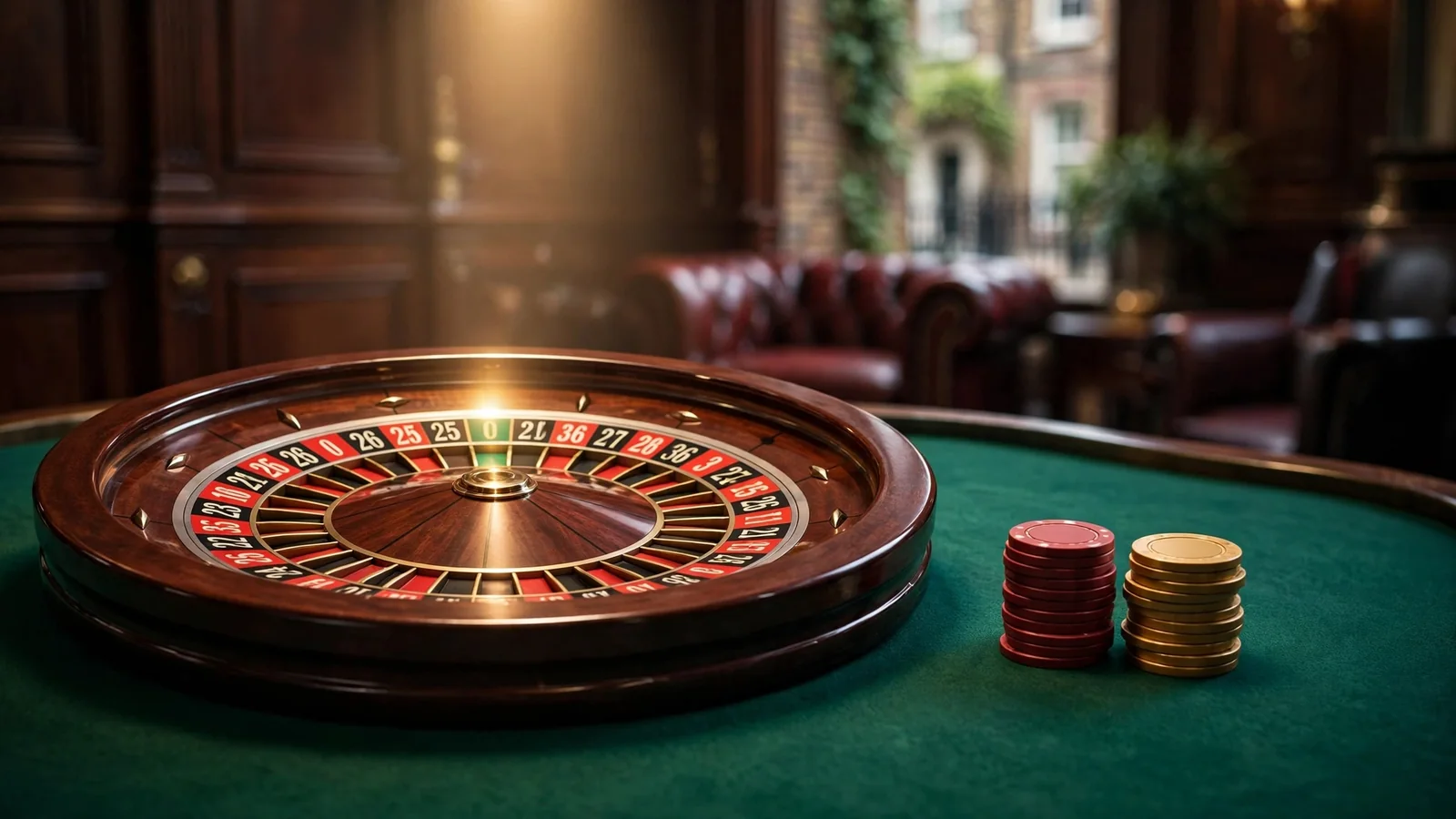
Roulette’s history is often told through its machinery: a wheel, a ball, a ring of numbered pockets. But the important difference between tables is not always visible in the spinning apparatus. European and American roulette announce their arithmetic plainly; French roulette adds a rule that changes what happens to certain bets when the ball finds zero.
A European wheel has pockets numbered from 1 to 36, alongside a single zero: 37 pockets altogether. The American version adds a double zero, making 38. That extra green pocket matters. With more ways for the house to win and no corresponding improvement to the player’s chances, the standard house edge rises from 2.70% on a European table to 5.26% on an American one. The wheel looks much the same at a glance. The arithmetic does not.
French roulette uses the same single-zero arrangement as European roulette, but its reputation rests on more than pocket count. The French rules include La Partage and En Prison, which make the zero less punishing for particular wagers. This is why French roulette is described as having the lowest house edge among standard variants. The distinction is not a charm or a clever betting pattern; it is built into the rules of the table.
Choosing a French roulette casino in the UK calls for checking practical details alongside the game itself. This list provides a concise reference, with payout speed as the available point of comparison.
Zombillion
Zombillion lists a payout speed of 1–3 business days, a useful detail to consider when choosing a French roulette casino.
Amunbet
Amunbet lists a payout speed of 1–3 business days. This gives players one practical detail to consider for French roulette play.
Britsino
Britsino lists a payout speed of 1–3 business days, giving readers a clear reference point for withdrawals.
Chanze
Chanze lists a payout speed of 1–3 business days. That withdrawal detail may help inform a choice for French roulette.
SpinFormula
SpinFormula lists a payout speed of 1–3 business days, offering a practical detail for readers to weigh.
Dieselwin
Dieselwin lists a payout speed of 1–3 business days. This is the available practical detail for players considering it.
NightLuck
NightLuck lists a payout speed of 1–3 business days, a useful point to check when considering a casino for French roulette.
Jetsetspins
Jetsetspins lists a payout speed of 1–3 business days, giving readers a straightforward withdrawal reference.
x3bet
x3bet lists a payout speed of 1–3 business days. This is the available detail to consider when assessing it for French roulette.
WinBeast
WinBeast lists a payout speed of 1–3 business days, providing a practical point of reference for players.
La Partage is the clearest example. It applies to even-money bets: those that pay the same amount as the stake when successful, such as red or black. If the ball lands on zero, half of the wager is returned rather than the entire stake being lost. The remaining half is lost. That small-looking concession changes the long-run house edge on those bets to 1.35%, half the European figure.
The zero has not disappeared, and the bet has not become safe. The player still loses money on a zero, but not all of it. Over repeated spins, that distinction matters because the house edge measures the mathematical cost built into play over time, not the fate of any particular spin. A favourable result can arrive immediately; the rule concerns the balance of probabilities, not a promise about what happens next.
En Prison is the other name associated with French roulette’s treatment of zero. Alongside La Partage, it forms part of the explanation for the variant’s lower edge. The rules are not merely decoration imported with French labels. They alter how the table handles an outcome that otherwise gives the house a clean win on an even-money wager. The wheel supplies the uncertainty; the rule determines how much of that uncertainty is charged to the player.
That distinction helps explain why French roulette online casino tables attract attention even when the wheel itself resembles a European one. A single zero is useful, but the rules attached to it are what give French roulette its particular advantage. A table that displays French styling without applying La Partage or En Prison would not offer the same terms. The name alone is not the arithmetic.
There is a quiet social history in the rule, too. Casino games present themselves as neutral contests of chance, yet every table is designed with a margin for the house. French roulette softens that margin in a specific circumstance, without abolishing it. The concession is narrow, disciplined and easy to overlook: half a stake returned when zero appears on an even-money bet. No grand rebellion against the casino’s advantage; just a less expensive answer to one green pocket.
The comparison with American roulette makes the point sharper. Its double zero increases the house edge to 5.26%, while European roulette’s single zero leaves it at 2.70%. French rules lower the edge on eligible even-money bets to 1.35%. These figures describe different structures, not interchangeable promises. In particular, the French figure applies to even-money bets under La Partage; it should not be mistaken for a blanket rate covering every choice on the table.
For anyone comparing a French roulette casino with a European or American table, the useful first question is therefore not whether the wheel looks elegant or the interface carries a tricolour flourish. It is whether the zero is treated under the French rules. A lower house edge cannot remove chance, and it cannot tell the ball where to land. It changes the price of a particular outcome.
The advantage is real, but modest in character: a rule, a refund, a thinner margin. French roulette does not defeat the house. It makes the house’s claim on certain losses smaller.
“French” describes a set of rules, not a wheel with extra pockets or a different set of numbers. The distinction lies in what happens to certain bets when the ball lands on zero. La Partage and En Prison change the consequences of that result, giving French roulette the lowest house edge among standard variants.
La Partage is especially relevant to even-money bets: red or black, odd or even, and high or low. These wagers normally return an equal amount when they win. If zero appears under La Partage, half the stake is returned rather than the whole stake being lost. That adjustment brings the house edge on those bets down to 1.35%.
The arithmetic of the wheel remains separate from this rule. A single-zero layout has 37 pockets; the French advantage does not come from removing zero or adding a pocket. It comes from treating a zero result differently for eligible wagers. That distinction is easy to miss when a casino game is labelled by its variant alone: the layout tells where the ball can land, while the rules determine what that landing means for a bet.
En Prison is the other rule associated with French roulette. Its presence matters to the game’s overall advantage, but a table’s label is not enough to establish exactly which rules apply to every wager. The displayed table rules are the practical definition of that particular online French roulette game. A French title without La Partage or En Prison would not offer the same basis for the variant’s reduced house edge.
This makes the French format less a new arrangement of numbers than a different settlement of risk. The wheel supplies the same basic uncertainty; the rules soften the cost of one outcome for certain bets. Even-money wagers receive the clearest benefit, while the broader claim about French roulette rests on the combined effect of La Partage and En Prison. A small clause, with a large mathematical consequence.
The cost of a roulette session is shaped by two settings that are easy to overlook: the table minimum and the time between bets. A low minimum makes it possible to place smaller wagers, but it does not make a session slow. A quick format can turn a modest stake into a steady stream of decisions. The two settings belong together.
At UK tables, live roulette minimums can begin at 10p; auto-roulette and speed formats sometimes begin at 5p, according to a specialist review. These are starting points, not promises that every table will offer them. The minimum is displayed with the table details, and it sets the smallest permitted wager on each spin. A table described as low-limit is useful only if its actual minimum suits the scale of play intended.
Limits also have an upper end. Standard tables tend to offer a more moderate betting range, while high-limit or VIP tables are designed for larger wagers. The labels are not a reliable guide to the exact boundaries: those are set out in the individual table information. A larger maximum changes the range available, not the odds of any spin. The velvet-rope vocabulary is mostly about scale.
Pace changes the arithmetic of attention. A specialist review puts speed roulette at more than 150 spins an hour, compared with 80–100 at a standard table. That is a substantial difference in how often a player can make a decision, and therefore in how quickly a session can move through a bankroll. A smaller minimum does not offset a faster rhythm. It simply permits smaller individual bets.
RNG American roulette has a different tempo again: it typically runs at 150 to 200 or more spins per hour, while live-dealer play runs at 50 to 60. These figures describe formats, not a guarantee for every game. A session may feel very different depending on whether it is built around a streamed dealer, an automated wheel or software-generated spins. The distinction matters even when the table layout looks familiar.
For low-stakes play, the practical choice is not simply the table with the smallest number beside its name. A low minimum can suit a cautious pace, but a rapid game may create more opportunities to wager in the same stretch of time. Conversely, a slower table may allow more time between decisions without changing the minimum. The total amount placed depends on both variables and on the player’s choices; the label alone cannot settle it.
A French roulette table may be listed at a low, standard or VIP limit, but those descriptions concern the permitted stakes, not a different scale of chance. Comparing tables therefore means checking the displayed minimum and maximum, then considering how quickly the format moves. The smallest entry point and the fastest spin rate are not automatically the best pairing. Often, they are the ones requiring the clearest sense of pace.
A live French roulette table is not simply a digital board dressed up with a dealer’s voice. Its wheel is in a studio, its dealer is present, and the ball travels around the physical wheel before settling into a pocket. A camera carries that small sequence of motion into the online game. The result is a table with a visible setting and human pace, rather than a simulation that produces its outcome entirely through software.
The studio matters because it gives the spin a beginning and an end that can be watched. The dealer prepares the round, announces the betting phase, launches the ball and confirms where it lands. There is no need to imagine a wheel behind the interface: it is there, turning in the frame. The ritual is modest, but it changes the texture of play. A result arrives through a sequence of observable actions, not as a number appearing after a brief animation.
That does not make the online experience identical to sitting beside a physical table. The camera determines what can be seen, and the screen keeps the player at a remove from the room. Still, the dealer’s presence gives the game a social surface. There is a voice, a shared table and the steady etiquette of rounds beginning and ending. The other people at the table may be represented by on-screen activity rather than conversation; the dealer remains the human anchor.
The pace is part of that character. Live play includes the dealer’s actions and the time allowed for a round to unfold, so it moves more slowly than a software-led game. A comparison cited for roulette formats puts live dealer play at 50 to 60 spins per hour, against 150 to 200 or more for RNG American roulette. Those figures describe different formats, not a promise that every table keeps the same rhythm. A live French table asks for a little more waiting. That is the point.
Waiting is often treated as a flaw in online games, where speed can be mistaken for efficiency. At a live table, the pauses give each round a human outline: bets close, the wheel turns, the ball drops, the dealer calls the result. The interval is not merely dead time. It is the space in which the game becomes a performance, however restrained. A studio need not be grand to make the physical act legible.
A live table and an automated table should not be confused merely because both are streamed or displayed online. In live dealer roulette, the defining event is the ball’s movement on a real wheel, handled in a studio by a human dealer. An automated physical wheel may preserve the object and the ball while removing the dealer’s role; an RNG table instead simulates the spin. The screen can make these formats look like neighbours, but their sources of motion differ.
For French roulette, the live format adds atmosphere without changing what makes the game French. It presents the table through a real wheel and a dealer, while the pace remains measured by the practical demands of running a round on camera. No elaborate spectacle is required. The wheel turns; the ball falls; the room, briefly, becomes part of the game.
A French roulette table can look much like another French roulette table: the same layout, familiar bets and a wheel whose appearance tells only part of the story. The useful distinctions are less theatrical. They sit in the rules attached to the game, the information available before play, and the small print governing any bonus funds. A premium label is not evidence of a more favourable table.
The first check is whether the game actually applies La Partage or En Prison, and to which bets. A title or decorative French styling does not settle that question. The table’s rules should say what happens when the ball lands on zero and make clear whether those rules apply to the selected game. If they are absent or difficult to find, the label “French” does not provide enough information to judge the offer.
That matters because a table’s appearance is not its mathematics. The European wheel’s house edge is 2.70%, while French rules can reduce the edge on eligible even-money bets. A comparison that mentions only a game’s name, or only its wheel, leaves out the detail that changes the calculation. For a fair comparison, the rules need to be read alongside the game itself.
The published return information deserves the same attention. UKGC-licensed operators should make RTP information accessible, rather than leaving it buried behind a promotional description. RTP and house edge describe related aspects of a game from different directions: one expresses the theoretical return, the other the casino’s advantage. Neither is a promise about a particular session. A displayed figure is useful for comparing games only when it is clearly attached to the specific roulette version being considered.
There is a practical reason to look for that specificity. A casino may offer several roulette formats under similar names, while their rules and features differ. Information attached to one version should not be assumed to describe another. The game rules, payout details and RTP disclosure together form a more dependable description than a banner calling a table “premium”.
That word does very little work. It may describe presentation, a branded room or a particular product tier; it does not, by itself, establish lower house edge, better RTP or more generous rules. A polished studio can still present a standard game, and a plain interface can still provide clear information. Quality of presentation and mathematical terms belong in separate columns.
Bonuses introduce another column, and often a less legible one. Roulette wagers do not necessarily count in full towards wagering requirements. Operator terms and specialist reviews describe game weighting that varies: roulette may count at 10% to 20%, while RNG roulette can count at 100%. Those are not universal rates, so the terms for the particular offer and game matter more than a general description of casino bonuses.
A percentage contribution determines how much of a qualifying wager is credited towards the requirement; it does not change the roulette outcome or improve the game’s return. At a low contribution rate, a large amount of play may add relatively little progress. At a higher rate, progress may be quicker, but other conditions still govern whether bonus funds can be used and when any resulting balance can be withdrawn. The headline offer is only one part of the arrangement.
Live roulette needs particular scrutiny in bonus terms. Some UK operators exclude live roulette from no-deposit bonus wagering; where it is included, specialist reviews report contribution rates ranging from 0% to 10%. These descriptions concern specific operator terms, not a rule shared across the market. The bonus page and the full terms should agree on whether live games qualify, and whether the game weighting differs from that for RNG roulette.
The distinction can matter even when the table itself is attractive. A live game may be the preferred format, but a bonus that excludes it is not a live-roulette offer in any useful sense. Conversely, a listed contribution rate does not establish that every table or variant qualifies. Terms can name exclusions, game categories and restrictions that a short promotion cannot comfortably carry. The short version is rarely the whole version.
The wagering cap is another part of the 2026 picture. Regulatory guidance states that, since January 2026, licensed operators are subject to a maximum wagering requirement of 10x. That cap limits the multiplier; it does not make every bonus equally valuable, nor does it remove game weighting or other conditions. The contribution assigned to roulette still affects how much a roulette wager counts towards the requirement.
A sensible comparison therefore starts with the table, not the badge beside it: confirm the French rules, find the RTP information for that exact game, then read how any bonus treats the format and its wagers. These checks do not produce a universal winner. They do make the differences visible, which is a less glamorous service and a more useful one.
French roulette can appear in an online casino catalogue, but the name of the game does not determine whether the service is lawful. For British residents, an operator taking real-money live roulette bets must hold a valid UK Gambling Commission (UKGC) operating licence. The Commission regulates online casino activity in Great Britain; a platform without the required licence cannot legally offer real-money live roulette to British residents.
That distinction is practical, not decorative. A site’s own claims about being “regulated” are not a substitute for checking its status. The UKGC public register is the place to verify the operator and its licence before depositing. A familiar-looking brand or a polished roulette studio proves neither. The regulator’s reach follows the market being served, rather than the location from which the casino happens to operate.
Age checks come before money goes in. Operators must verify a customer’s age before allowing a deposit into a gambling account; online gambling at a UKGC-licensed casino is for adults aged 18 and over. Account checks may also establish identity and other details needed to manage the relationship. They are part of the regulated service, not an optional courtesy.
Financial controls are built into that relationship as well. Remote operators must prompt new customers to set a financial limit before their first deposit and make account-level limit controls accessible. UKGC-licensed live casino operators must offer deposit limits, loss limits and session time reminders, alongside reality checks and cool-off periods. The point is not to make a roulette session feel like an administrative appointment. It is to make the boundary between entertainment and expenditure visible while the account is open.
Self-exclusion is another required protection. UKGC-licensed casinos must provide responsible-gambling tools, including self-exclusion through GamStop. A person who chooses that route is asking for access to participating gambling services to be blocked, not merely for a reminder to take a break. The option matters because regulation cannot make chance predictable, but it can make withdrawal from play more enforceable.
There are safeguards around disputes and payment, too. A UKGC licensee must provide an internal complaints process and access to an approved Alternative Dispute Resolution service if a complaint remains unresolved. Casinos cannot accept credit cards for gambling, including credit-card funds routed through a money service business; a wallet cannot be used where it permits credit-card funds to finance gambling. Operators are also required to contribute to the Research, Education and Treatment levy.
These protections do not certify that every table is identical, or that every French roulette game applies the same rules. Those are questions about the game itself. Here the threshold is simpler: a British-facing real-money service needs the proper UKGC licence, and the account must sit within a framework of checks, limits and routes for seeking help. Regulation is the floor, not a promise about the spin.
In RNG roulette, the wheel is represented by software rather than a physical wheel in a streamed studio. A random number generator produces the result of each spin; the screen then presents the familiar sequence of bets closing, a ball appearing to travel around the wheel and a winning number being revealed. The theatre is digital. The result is generated by the game.
That change affects the pace. There is no dealer handling a ball, waiting for bets to close at a table, or managing the pauses that belong to a live broadcast. The game can move from one spin to the next as soon as the software is ready. For anyone comparing online French roulette with a live table, the distinction is not just visual: RNG play removes the human and physical steps that set the rhythm of a live game.
The word “French” still describes the rules and layout offered by a particular game, not the presence of a real French wheel. A software version may reproduce a French table on screen, but the ball is an animation and the outcome comes from the generator. The game’s information panel is the place to establish which rules apply; a French label alone does not tell the whole story.
The lighter pace can make a session feel less like a visit to a casino and more like a succession of decisions. There is little waiting between spins, and the interface keeps the betting area in view. That efficiency is also a change in atmosphere. A live dealer gives pauses a social shape; software has no need to fill silence. The screen simply moves on.
RNG roulette can also be accessible at a small stake: minimum bets are often as low as 10p. That is a possible entry point, not a promise that every game or operator will offer it. The stated minimum should be checked on the individual table, since the practical cost of a session depends on the choices available there as well as on the speed of play.
This combination—quick results and a low possible minimum—can make the format seem modest. Yet speed changes the scale of a session. More decisions can fit into the same stretch of time, even when each individual stake is small. The software does not make the game more predictable; it only removes some of the pauses between outcomes. A brisk interface is not an advantage over chance.
There is a quiet social difference, too. At a live table, the dealer’s movements and the shared wait give each spin a public moment. RNG play makes the result private and immediate: the wheel exists as an image, while the software does the work behind it. For some, that is the appeal; for others, it strips roulette of the very ritual that made it recognisable.
So the online French roulette experience depends on two separate things: the rules displayed by the game and the format generating its spins. An RNG table offers the faster, software-led version, with a minimum stake that may be low. The wheel is there on screen. The room is not.
The layout of a French roulette table is a small map of risk, with each marked position carrying its own return. A straight-up bet covers one number. If it wins, it pays 35:1: the stake is returned, with winnings at thirty-five times that amount. The same payout applies to a single-number bet on European and American wheels.
A split bet sits across the line between two adjacent numbers. It pays 17:1 if either number comes up. The return is lower because the bet covers more of the wheel.
A street covers a horizontal row of three numbers and pays 11:1. On the outer edge of the layout, even-money bets cover broad groups instead: red or black, odd or even, and low or high numbers. These pay 1:1, so a winning bet returns the stake plus an equal amount in winnings.
| Bet | Numbers covered | Payout |
|---|---|---|
| Straight-up | One | 35:1 |
| Split | Two adjacent | 17:1 |
| Street | Three in a row | 11:1 |
| Red/black, odd/even, low/high | A broad group | 1:1 |
These are the table’s stated payouts, not a promise that any selection is favoured. A higher return accompanies a narrower target; the broad outside bets pay less because they cover more possibilities. The felt makes that exchange visible. A neat little arithmetic of hope.
The Martingale is an old attempt to make uncertainty look orderly. After each loss, the stake is doubled, on the premise that a later win will recover the earlier losses and leave a gain equal to the first stake. The arithmetic is neat; the table is not obliged to cooperate.
A losing run makes every next step more expensive. The bankroll has to absorb the accumulated losses and still fund the larger wager, while a table limit can prevent the sequence from continuing. In online French roulette, the method changes neither the wheel nor the rules governing a spin. It changes only the size of the money exposed to the next result.
That distinction matters because a betting system can organise decisions without controlling outcomes. The Martingale may give a session a repeated pattern — loss, larger stake, another loss — but no pattern in the bets can make a particular number, colour or side more likely to arrive. A run of losses can strain a bankroll precisely because the system responds to each one by demanding more.
There is also a human appeal in the method. Doubling after a loss turns the previous setback into a problem that seems solvable by persistence. Roulette offers no such accounting service. Each result remains a matter of chance, and no staking sequence can predict the final outcome.
The system manages exposure. It does not manage fate.
Players place bets on where the ball will land as a wheel spins. The result is determined by chance, and the payout depends on the bet and the table’s rules.
European roulette has a 2.70% house edge, compared with 5.26% on American roulette. The difference comes from American roulette’s additional double-zero pocket.
Since January 2026, UK-licensed operators can set bonus wagering requirements no higher than 10 times the bonus. Roulette’s contribution toward that requirement still varies: live roulette commonly counts at 10–20%, while RNG roulette often counts at 100%.