The American format adds a marked 00 beside the single zero, changing the set of destinations represented on the wheel and table.
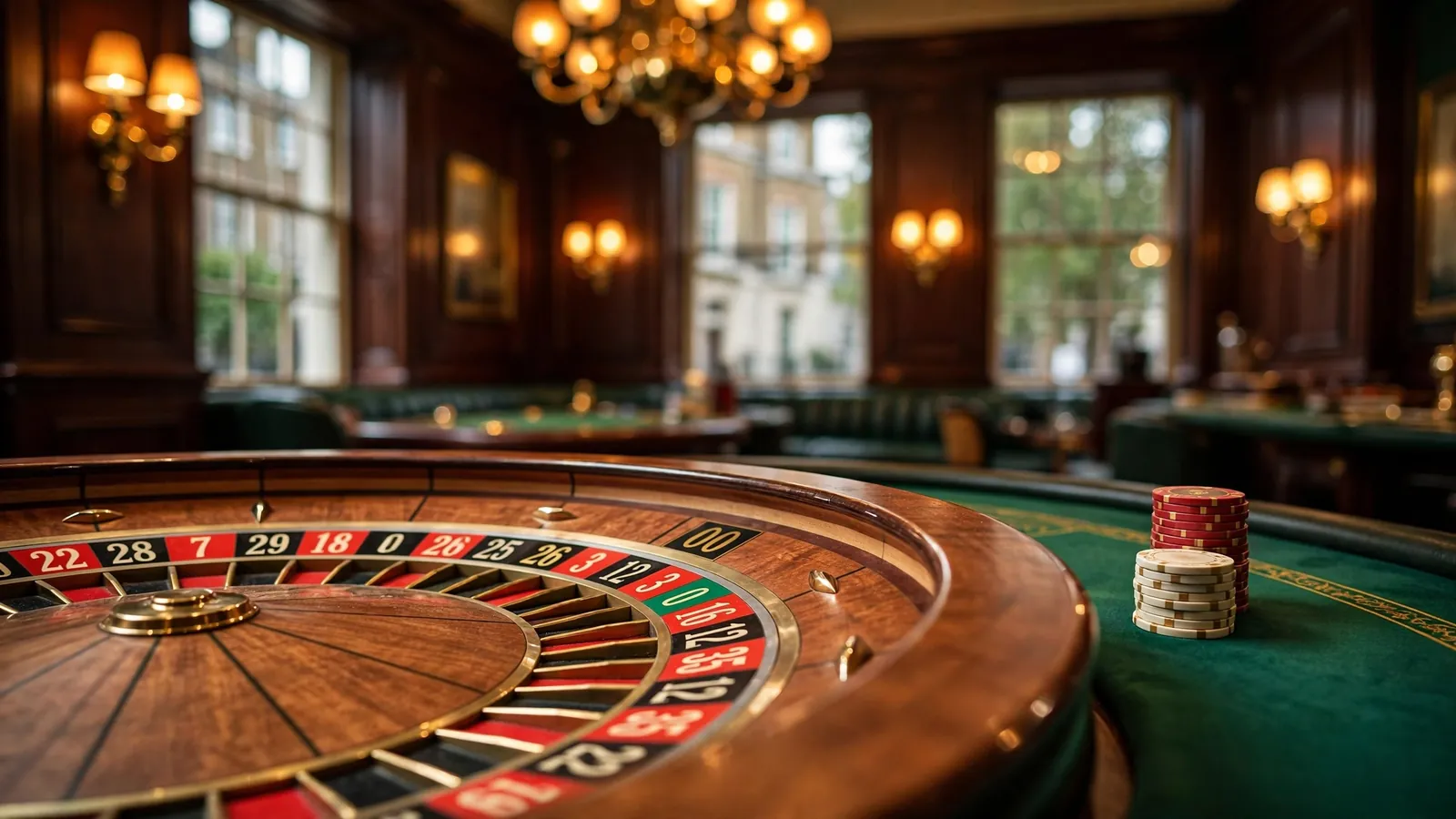
American roulette has a small but consequential distinction: alongside the single zero, it includes a double-zero marked 00. That extra mark is the feature that gives the American version its identity. The wheel has not acquired a new philosophy or a more elaborate ceremony; it has acquired another numbered destination. In a game organised around the possibility that a moving ball may settle in one place rather than another, an additional destination changes the terms of the arrangement.
The difference is easy to miss when the name is doing most of the work. “American” sounds like a broad label, but here it points to something quite precise. A player comparing versions online is not merely choosing between different graphics or styles of presentation. The 00 belongs to the game itself. It appears in the wheel’s set of marked positions and is also represented on the associated table. The single zero remains; the double-zero is added beside it.
That is the extra complication. Not a flourish, not an optional feature, and not a dealer’s invention for one particular game. The double-zero is part of what defines American roulette. A familiar green zero may make a version look recognisable, but recognition is not the same as sameness. The additional 00 is a quiet reminder that games can share a name and still be built around different arrangements.
Choosing an online American roulette casino in the UK can involve checking practical details as well as the game itself. This list provides a concise reference to the payout-speed information available for each operator.
Zombillion
Zombillion's listed payout speed is 1–3 business days.
Amunbet
Amunbet's listed payout speed is 1–3 business days.
Britsino
Britsino's listed payout speed is 1–3 business days.
Chanze
Chanze's listed payout speed is 1–3 business days.
SpinFormula
SpinFormula's listed payout speed is 1–3 business days.
Dieselwin
Dieselwin's listed payout speed is 1–3 business days.
NightLuck
NightLuck's listed payout speed is 1–3 business days.
Jetsetspins
Jetsetspins' listed payout speed is 1–3 business days.
x3bet
x3bet's listed payout speed is 1–3 business days.
WinBeast
WinBeast's listed payout speed is 1–3 business days.
A casino game often presents its rules as if they were simply waiting to be discovered: positions are marked, choices are displayed, and a result arrives. Yet every such arrangement reflects decisions made by people. Someone decided which places the wheel should contain and how the game should name them. Once established, those choices acquire the appearance of inevitability. The double-zero is a useful interruption to that impression. It is visibly an addition, a sign that the familiar structure could have been organised differently.
That does not make American roulette mysterious. Its defining feature can be stated plainly: there is a 0 and a 00. Still, the distinction matters before a game begins, because a name alone may not tell enough. A screen can place several roulette versions within easy reach, each dressed in the same polished colours and offered through a similar interface. The difference may occupy little visual space, but it is not merely decorative. American roulette is the version with the extra zero position.
This is especially worth noticing when a game is encountered through an online casino. The digital setting can make unlike versions appear almost interchangeable. The same kind of wheel animation, the same broad visual language, and the same familiar word—roulette—can smooth over the point at which the rules diverge. The label “American” is therefore more than a regional flourish in a menu. It identifies the version whose wheel and table include 00 alongside 0.
No grand explanation is needed to make the distinction useful. It is enough to know what the name signifies and to recognise the double-zero marking when it appears. That is a modest form of clarity, but gambling interfaces have a habit of making small distinctions feel smaller than they are. A game title can be read in passing; a marked position cannot be wished away once the wheel is in view. Details matter.
The double-zero also gives the American version a slightly different visual character. The word “zero” usually suggests a single point of absence, a pause in an otherwise continuous sequence. Roulette turns that idea into a marked place on the wheel; American roulette gives it a companion. The pair is not a metaphor the game requires, but it is an apt reminder that a seemingly simple pastime depends on a carefully bounded set of possibilities. One extra label changes the set.
There is no need to mistake that observation for a promise of novelty. The American wheel does not become a different kind of entertainment simply because it has 00. Its distinction is narrower, and clearer, than that. For anyone considering American roulette online, the practical first step is recognising which version is on screen: the one with the single zero alone, or the one with both 0 and 00. The names may sit close together in a casino’s catalogue. The wheels do not have the same markings.
That extra pocket is the whole point.
A suitable place to play American roulette is not necessarily the one with the loudest welcome offer or the most polished promotional language. The useful comparison is quieter: whether the game is available in the format sought, whether its rules and paytable are clear, and whether the site’s terms make sense beyond the headline. A casino page can make an offer look generous while leaving the important conditions several clicks away.
The first distinction is between a game being advertised and being accessible on the terms expected. A search result or promotional banner may feature American roulette, but the game itself should be identifiable in the casino’s catalogue, with its rules available before play. That is a modest test, but a revealing one. Clear information suggests that the operator expects its terms to be read; vague descriptions leave the player to discover details after choosing a table.
Licensing is part of the setting, not decorative fine print. In Great Britain, remote operators offering gambling to customers must hold the relevant UK Gambling Commission licence. A licensed site operates within the local regulatory system; an offshore licence alone is not a substitute for that requirement. The distinction matters because a casino’s appearance, payment options or promotional tone cannot establish its regulatory status. The licence is a concrete feature to verify, not a mark of style.
Offers deserve their own small print. A specialist review has reported that many UK welcome offers take the form of free spins for slot games, which cannot be used at live tables. That is not a promise that every promotion follows the same pattern, nor a reliable description of every offer currently available. It is a reason to inspect the specific terms attached to the offer rather than assuming that a bonus applies to every game in the casino.
The same caution applies to wagering requirements and game weighting. A specialist review has described live games as contributing only a small share towards such requirements, giving 10% weighting as an example. Where a game contributes only partly, the bonus conditions may take longer to satisfy than the headline suggests. The practical question is not whether the offer sounds substantial, but whether roulette is eligible, how its contribution is calculated and what other restrictions apply. Terms can differ between promotions, so the offer attached to one account or game should not be treated as a general rule.
A welcome offer may have little value to someone interested chiefly in roulette. Free spins that cannot be used at a live table are not a roulette benefit, however prominently they appear beside the casino’s name. Conversely, an offer that does include the intended game can still have conditions that make it unsuitable. The promotional figure is only the opening sentence.
The game’s own information should be just as easy to locate. Rules and the paytable need to be reviewed before play, rather than inferred from a casino’s general description of roulette. This is especially useful when comparing versions with similar names: familiarity with one game does not prove that another has identical conditions. A well-presented page separates the game’s rules from its marketing and makes the relevant details legible without turning them into a scavenger hunt.
The word “best” is too blunt for a decision that depends on different priorities. One player may value straightforward access to the game; another may care more about transparent terms or whether an offer can be used at all. Neither preference can be resolved by a ranking alone. A list of casinos can indicate where a game is promoted, but it cannot settle whether the rules, bonus conditions and regulatory status fit a particular purpose.
There is also a difference between a casino’s overall reputation and the details of a particular roulette game. General claims about a large catalogue or generous promotions do not answer whether American roulette is available, whether the relevant rules are shown, or whether a bonus excludes it. Those are separate questions, and each deserves a direct answer on the operator’s own pages.
The most useful comparison therefore begins with plain checks: confirm the UK licence, find the game’s rules, read the paytable and inspect any promotion’s eligibility and weighting. If the offer’s language is unclear, its apparent value is difficult to judge. If the game information is difficult to find, the promotional material should not be allowed to stand in for it.
A casino can make roulette visible without making its terms equally visible. That is the distinction worth noticing. The best setting is not a universal title awarded by a banner, but one where the game and its conditions can be understood before a decision is made. No confetti required.
Live American roulette places a studio between the player and the game. A human dealer spins a physical wheel while cameras stream the action in real time; bets are entered through an on-screen interface. The arrangement borrows the visible rituals of a casino and delivers them through a screen, with the dealer’s presence doing much of the work that a graphic animation cannot.
That presence changes the atmosphere, not the underlying uncertainty. The dealer performs the same sequence for everyone watching, while the interface carries each player’s choices to the table. A camera may show the wheel and the dealer together, or move closer to the action as the round unfolds. The result is a shared event at a distance: several people can follow the same table without standing in the same room.
For some, that visible process is the point. A physical wheel and a person operating it make the game feel less like a private exchange with software. The studio supplies gestures, pauses and a human face, though it does not make the outcome more predictable. A live dealer is a host of the procedure, not an interpreter of the ball.
The trade-off is time. Digital roulette can move from one round to the next without waiting for a person to complete the sequence. Live dealer roulette has to leave room for the dealer’s actions and for players to use the betting interface before the round proceeds. That gives the game a slower rhythm. It may feel more sociable or more deliberate; it is not the quickest way to watch outcomes arrive.
The table also tends to ask for higher minimum bets than a digital version. That distinction matters before the first round, because the studio format can make a game feel casual even when its entry point is less forgiving. The camera gives the table a welcoming polish. The minimum does not share the sentiment.
The stream depends on a stable internet connection. If the picture freezes or the connection falters, the central attraction—the ability to follow the live action as it happens—becomes harder to use. A digital game may be less dependent on a continuous video feed, while a studio game puts that feed at the heart of the experience. The technology is not scenery; it is the room.
In the UK, a live dealer casino must hold a UK Gambling Commission licence to operate legally. The studio format itself is not a separate guarantee of quality or a promise of better results; it is simply a different way to present the game. Any welcome offer attached to a casino also needs careful reading, since live games may count only partly towards bonus wagering requirements, and some offers exclude live tables altogether.
The contrast is plain: a person, a wheel, a broadcast and a slower pace, set against the immediacy of a digital version. Live American roulette can make the game feel more tangible, but tangibility is not an advantage at the wheel. This is entertainment, not gambling advice.
A roulette wager is a choice made before the ball settles. If it lands on a number selected by the player, the wager wins; otherwise, it loses. That simple divide between a winning selection and the rest of the result is the point from which the financial side of the game begins.
A return is not the same thing as a profit. In ordinary use, “return” can mean the money paid back after a winning bet, including the original stake. The profit is what remains after that stake is accounted for. The distinction matters because a displayed payout can look larger than the amount actually gained. The terms attached to a bet explain what a winning result pays, but the longer-term measure is the house edge: the built-in mathematical advantage held by the casino across play.
For roulette, the stated house edge is 2.9% on a straight-up bet and 2.7% on other bets. A straight-up wager is a selection of one number; other wagers cover different possible outcomes. The percentages describe the game’s expected advantage over repeated play, not a deduction taken from each individual stake. A single result may produce a win or a loss. The edge does not tell anyone what the next spin will do.
That distinction is easy to lose in the language of gambling. A run of wins can feel like evidence that a method has found its footing; a run of losses can invite the same search for a pattern in reverse. Neither changes the arithmetic built into the game. A roulette result is resolved by where the ball lands, and the house edge concerns the balance of outcomes over time, not a forecast for an individual turn.
The difference between the two stated edges is modest, but it is meaningful in a game where the wager is repeated. The straight-up bet has the higher house edge of the two categories described here. That does not make every other bet a sound way to play, nor does a lower edge promise a winning session. It marks a mathematical distinction, not a recommendation or a system.
In American roulette, a straight-up bet has a house edge of 2.9%, while other types of bets have a house edge of 2.7%.
For someone considering whether to play American roulette online in the UK, the useful question is therefore not simply which bet appears to offer the most dramatic return. It is what the bet covers, what a win pays under the game’s terms, and how the house edge shapes the wager over time. Those details belong together: the outcome determines whether the bet wins, the payout determines what is returned, and the edge describes the casino’s advantage across repeated play.
The numbers can be stated plainly. They cannot make chance obedient. Content about roulette is for entertainment purposes only, not gambling advice.
The American roulette table is a map of possible selections, arranged so that a player can place a wager on a particular number or on a broader group. Its surface is more than decoration: the numbered area and the surrounding betting spaces divide the game into choices that are easy to scan, even when the names of those choices are unfamiliar.
The numbered section is the visual centre. Individual numbers sit in a grid, while separate spaces around it represent selections that cover groups rather than single numbers. The exact appearance can vary between digital interfaces and physical tables, but the basic purpose is stable: to make each selection visible and give wagers a defined place. A casino table may add labels, colours or small interface cues; those details help with navigation, not with predicting what will happen.
American roulette has a feature that must be visible on that surface: alongside the space marked 0 is a separate space marked 00. The double-zero is not merely a label tucked into the margin. It is an additional number in the table’s betting arrangement, so the American layout cannot be mistaken for one that shows only a single zero. A screen that crops the edge of the grid can make this distinction less obvious; a complete view restores it.
Around the numbered grid, the table generally groups wider selections into clearly marked areas. These give the surface its second visual layer: close attention can settle on one square, while a broader choice occupies a larger labelled space. No special skill is required to read the arrangement, though its compactness can make unfamiliar terminology look more formidable than the actual task. The table is a catalogue, not a cipher.
On a digital table, the same map is reproduced as a touch or click interface. Selecting an area places a marker there; the layout then serves as a record of where the wager has been assigned. That is a practical distinction from a printed felt surface, not a different set of table spaces. Live interfaces may place controls around the board, but the betting surface remains the central reference.
Before play, the rules and paytable deserve a look. Labels can differ, and a familiar-looking grid is not a substitute for knowing what a selected area means under that table’s rules. This is especially relevant when moving between versions: the double-zero space is a visible sign that the American arrangement has its own structure. The small detail matters.
Roulette tables turn abstract choices into geography. A number occupies a square; a wider selection occupies its own marked territory; the zero and double-zero have their own places. The arrangement makes the game legible without making it predictable. That distinction is useful.
The American roulette wheel announces its difference in green. Alongside the pocket marked 0 sits another, marked 00. European roulette has the single green 0, without that double-zero neighbour. The distinction is small enough to fit on the rim and large enough to give the American version its own visual signature.
On a physical wheel, the pockets are part of the object rather than marks on a diagram: a ball travels around the rim before settling into one of them. In a digital game, the wheel is represented on screen, but the same contrast remains visible. The American version shows both green spaces; the European version shows one. A familiar colour, used sparingly, carries a lot of the game’s identity.
Green is not merely decoration here. It identifies the zero positions against the numbered pockets, making the extra marker legible at a glance. The 00 is particularly easy to overlook if attention is fixed on the wheel’s general shape or on the movement of the ball. Yet it is not a second label for the same pocket. It is a separate place on the American wheel, and the European wheel does not have it.
That difference can be described without turning the wheel into a lesson in wagering. The pockets are the physical framework of the game; the table is where selections are recorded. The two are related, but they are not the same surface. A screen may show both the wheel and the betting area at once, which can make them seem like parts of one interface. The wheel itself still has its own structure, and its green markings tell the essential version apart.
There is a quiet design logic to the contrast. The European wheel’s green marker is singular; the American wheel’s green markers are paired, one bearing 0 and the other 00. No elaborate ornament is needed to make the distinction. The second green pocket is enough. It changes the wheel’s visual grammar before a ball has moved, and remains apparent whether the game is represented by polished wood and a physical ball or by a digital image.
A close look at the rim, then, settles the basic identification. One green pocket belongs to the European design. Two belong to the American one. The markings are simple, but they are not interchangeable: 0 and 00 each name their own pocket. On the American roulette wheel, that extra green space is not an accessory or a quirk of the screen. It is built into the version itself.
Playing American roulette for real money changes the atmosphere around a spin, not the mathematics behind it. A stake becomes money that can be lost, while the house edge remains part of the game whether the wager is small or large. The stated edge is 2.9% for a straight-up bet and 2.7% for other bets. Those figures describe the game’s long-run advantage for the house; they do not predict what will happen in a particular session.
That distinction matters. A short run can produce wins, losses or an uneven mixture, but no staking pattern removes the edge. Increasing a wager after a loss does not make the next result more favourable, and a recent win does not make a later one more likely. The wheel has no memory. Systems that promise to recover losses by changing stake size merely expose more money to the same uncertainty.
A budget set before play gives the session a boundary that the excitement of betting cannot redraw. It can be treated as entertainment spending: an amount that is affordable to lose, not money earmarked for bills or future needs. Once that amount is spent, play ends. The same principle applies to time. A stopping point chosen in advance helps prevent a session from expanding simply because the result feels unfinished.
American roulette betting options can make a session feel more varied, but variety should not be mistaken for control. Choosing a different kind of wager changes the relevant house edge, not the basic fact that the casino holds an advantage. The figures offer context for a decision about whether to play; they are not a reason to raise the stake or stay longer.
Real-money play also benefits from keeping deposits and bets within the plan rather than treating the balance on screen as separate from ordinary finances. Chasing losses can turn a bounded expense into an open-ended one. Chasing winnings can do much the same, as each new wager puts money at risk again. Neither impulse improves the underlying terms.
The practical discipline is plain: decide the budget, decide when to stop, and keep both decisions intact. Roulette offers uncertainty dressed in ceremony; a limit is less theatrical, and more useful. This is entertainment, not gambling advice.
An American roulette game can appear in an online casino without being a live-dealer game. The distinction is about how the game is presented, not merely where it is found: a digital version is played through software, while a live-dealer version brings a studio game to the screen. The same broad label can therefore cover different experiences, and the word “online” alone says little about which one is on offer.
That difference also matters at the boundary between entertainment and regulation. In the UK, a live-dealer casino may operate legally only if it holds a licence from the UK Gambling Commission. More broadly, online casinos serving British players must be licensed by the Commission. A studio stream does not sit outside the rules simply because the game takes place somewhere else; the operator’s relationship with the British market is what matters.
This is one of the quieter features of regulated gambling. The wheel may be physically distant, and the screen may make the transaction feel like a private arrangement between player and game. Legally, it remains an organised gambling service offered to people in the UK. The licence is not a decorative badge attached to a camera feed.
Finding American roulette online, then, involves recognising two separate questions: whether the casino is authorised to serve the market, and whether the particular version is digital or live-dealer. Neither answer can be inferred from the game’s name alone. The interface may make the options look adjacent; their formats are not interchangeable.
The distinction is modest, but useful. A game catalogue describes what can be played; the licensing status describes whether the operator may lawfully provide it in the UK. Those are different facts, and one does not prove the other. Gambling is for entertainment only, not financial advice.
At its simplest, an American roulette casino game is a small contest between a chosen number and a moving ball. The ball travels around the wheel, settles into a numbered pocket, and a player wins if the number selected matches the one where it comes to rest. Everything else is decoration around that brief comparison.
The simplicity is part of the game’s durability. Its central event needs little explanation: a choice is made, the wheel turns, and the result becomes visible. The player does not control the ball or alter its landing place. Participation consists of choosing before the outcome, then watching chance settle the matter.
An online American roulette casino game preserves that structure on a screen. The setting may be digital, but the essential sequence remains recognisable: select a number, wait for the spin to finish, and compare the selection with the result. The screen gives the event a tidy boundary. Before the spin, there is possibility; afterwards, there is an answer.
That order matters. Roulette turns uncertainty into a public little ritual, with the same pause before the result whether the game is followed alone or among others. The ball’s movement supplies suspense, while the numbered outcome supplies a clear end to it. No interpretation is needed once the ball has stopped.
The simplicity should not be mistaken for predictability. A previous result does not tell the ball where to land next, and watching a sequence does not change the basic condition for a win: the selected number must be the one that appears. The game offers a decision, not a way to command the result. Chance remains in charge.
This section is for entertainment purposes only and is not gambling advice. Roulette’s plain structure can make it feel almost self-explanatory, but the financial meaning of a wager is a separate matter from the game’s basic sequence. Here, the whole event can be reduced to a selection and a landing. A neat little drama.
An American roulette wheel has thirty-eight pockets: the numbered spaces from 1 to 36, plus 0 and 00. European roulette has thirty-seven, with a single zero. That extra space is not decorative. It changes the chance attached to a selection, even though the difference between the two wheels may look small at a glance.
The stated odds of winning in American roulette are 1 in 38; in European roulette, they are 1 in 37. The comparison is easiest to understand as a matter of scale: a chosen number has one possible winning pocket, but the American wheel offers one more pocket in total. The chance is therefore spread across a larger set of outcomes.
The green spaces explain the difference in the totals. On the American wheel, both 0 and 00 sit alongside the numbered pockets; the European wheel has 0 alone. Those pockets count as outcomes just as surely as any numbered space does. A wheel does not become more favourable because its extra pocket is printed in a different colour.
This is a small numerical gap with a clear direction. The American version gives a selected number a lower chance of landing than the European version, because there are more pockets to contain the ball. The figures describe the wheel’s structure, not a promise about what will happen in any particular spin. A run of outcomes cannot make the next spin owe a result.
The distinction can be easy to miss when both games are presented under the same broad name. Yet the pocket count is a useful first check: thirty-eight means the American wheel, while thirty-seven means the European one. It is the simplest way to see why the versions do not carry identical odds.
A single extra pocket, then, is enough to alter the arithmetic. Roulette remains a game of chance, but its versions are not interchangeable in that respect. This discussion is for entertainment purposes only, not gambling advice.
The extra double-zero pocket is the key difference in American roulette: its odds of winning are 1 in 38, compared with 1 in 37 on a European wheel.
Watch a dealer spin a physical wheel, then place bets through the on-screen interface. You win when the ball lands on a number you selected.
American roulette has two green pockets, 0 and 00, while European roulette has only 0. The odds of winning are 1 in 38 on the American wheel and 1 in 37 on the European wheel.
You win when the ball lands on a number you selected. The game’s outcome cannot be guaranteed.
Check that the operator holds a UK Gambling Commission licence, and confirm that the game, rules and paytable are clear before you play. Read the offer terms too, since live games may contribute only a small share towards wagering requirements.