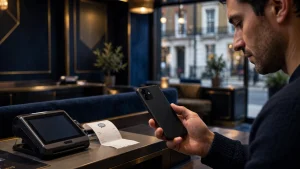
Payforit routes a casino deposit through a mobile account, with the charge added to a bill or deducted from prepaid credit.

Payforit turns a mobile casino deposit into a charge against the phone account rather than a payment made with a bank card. The basic sequence is straightforward: select Payforit in the casino cashier, enter a mobile number, receive a confirmation code by SMS and submit that code to approve the deposit. Once confirmed, the amount is charged through the phone account and credited to the casino balance.
The route is designed around a phone number and its associated billing arrangement. On a monthly contract, the deposit is added to a future phone bill. On Pay as You Go, it is taken from the balance of prepaid credit. The player may see the same Payforit option in the cashier in either case, but the source of the money differs: one charge appears later on a bill, while the other reduces credit already held on the phone.
That distinction gives the payment its particular character. It does not ask the player to enter card details into the casino cashier; instead, the phone account becomes the channel through which the payment is collected. The bill or prepaid balance carries the charge. A mobile phone, in this arrangement, serves as both the point of access to the cashier and the means of confirming the transaction.
The process begins at the casino’s deposit screen. After Payforit is selected, the player enters a mobile number. An SMS then arrives with a code, which must be entered and submitted to confirm the payment. The code is not a decorative extra: submitting it is the step that authorises the charge.
That makes the transaction a short exchange between the casino payment flow and the phone in the player’s hand. The cashier requests a number; the number receives a message; the code returns to the cashier. After confirmation, the deposit is made through the phone account. Payforit deposits are described as instant, so the balance is intended to be available without the slower sequence associated with a bill being issued and paid. The billing itself still follows the phone plan: a contract customer sees the charge on a later bill, while a Pay as You Go customer sees prepaid credit used.
The difference between when a deposit reaches the casino balance and when the phone customer sees its final accounting is worth keeping clear. A contract charge can be attached to a future bill even though the casino deposit has been processed at the time of confirmation. A prepaid charge reduces existing credit rather than waiting for a bill. One is deferred billing; the other draws on money already placed on the phone account.
The SMS step gives the phone account holder a chance to approve the specific transaction through the number entered in the cashier. The code must be submitted before the process is complete. Merely choosing Payforit or typing a number does not, by itself, amount to the confirmation step described for a deposit.
It also explains why the payment can feel different from entering a card number. The relevant action happens across two screens: the casino cashier and the SMS inbox. The player moves between them, then returns to submit the code. This is a small ritual, but it makes the phone an active part of the payment rather than simply a device used to browse the casino.
If a code is not received, or the entered number is wrong, the described confirmation sequence cannot be completed as intended. The practical point is to use the number associated with the phone account that is to carry the charge and to enter the SMS code in the cashier. A deposit should not be treated as confirmed until the code has been submitted and the cashier reflects the transaction.
Paying this way does not create a separate casino fund held by the mobile provider. Payforit is the payment route: the amount is charged to a contract bill or deducted from prepaid credit, and the casino balance receives the deposit. The phone account records the charge according to its own billing arrangement; the casino account records the resulting deposit.
That split is easy to overlook because the whole action starts on a mobile screen. Yet the phone bill and casino balance are distinct records. On a contract, the charge becomes part of the bill to come; on Pay as You Go, it comes out of the available prepaid balance. In both cases, the player has used Payforit to fund casino play, but the way the cost appears on the phone account depends on the plan.
Pay by phone therefore describes a payment path, not a promise that every casino cashier will offer the same route or that every phone account will display the charge in the same way. The working sequence remains compact: choose Payforit, enter the mobile number, receive the SMS code, submit it. Then the phone account carries the cost, and the casino balance reflects the deposit. A modest piece of billing infrastructure, doing exactly what billing infrastructure tends to do.
“Pay by phone credit” can sound like a way of borrowing to gamble. With Payforit, the phrase points instead to the account held with a mobile network: a charge is added to a monthly phone bill or deducted from prepaid credit. That makes it different from paying with a credit card, even though both can leave money to be accounted for later. The distinction is about the payment route, not a special exemption from gambling rules.
The UK Gambling Commission bars remote gambling operators from taking credit-card payments for gambling. The restriction also covers payments routed through a money service business, so sending card funds through an intermediary does not turn the transaction into an acceptable deposit method. The rule is intended to prevent gambling with borrowed card money; changing the route does not change the source of the funds.
Payforit is not a credit card in disguise. A monthly contract customer may see the gambling charge on a later phone bill, while a pay-as-you-go customer spends existing prepaid credit. The bill may still have to be paid, but the payment has been made through the mobile account rather than by presenting a credit-card payment to the casino. Similar timing can obscure a meaningful difference in the financial arrangement.
That difference matters because “phone credit” is an imprecise phrase. It may refer to prepaid balance, which has already been bought, or to a charge placed on a contract account and collected later. Neither description makes Payforit a universal substitute for a card deposit: the method must be offered for the account in question, and a mobile billing route does not establish that other payment options are available there.
Debit cards are a separate case. They draw on money in a bank account rather than a credit facility, and are not caught by the credit-card gambling prohibition. A specialist review describes debit-card deposits at UK casinos as free and more widely accepted than Payforit. That is a reported comparison, not a guarantee for every operator: payment choices and any charges should be checked in the current cashier.
The practical contrast is therefore not “phone payment versus cards” as if the two sides were equal alternatives everywhere. It is a narrow mobile-billing route alongside payment methods whose availability depends on the operator. Someone looking for a casino pay-by-phone-credit option may find Payforit in one cashier and not another; the existence of a phone number or mobile account alone does not create acceptance. Nor does the word “credit” make phone billing a lawful way around the credit-card ban.
There is a small social history in that distinction. A telephone account began as a means of paying for calls and services, then became a channel for other purchases. The charge can feel less immediate than a card debit, especially when it arrives with an ordinary bill, but familiarity is not the same as harmlessness. A phone account is still a spending channel, and prepaid credit still represents money already committed.
The rules draw a firm line around credit cards, while the everyday language of payment remains less tidy. “Phone credit” may sound like borrowing; “phone bill” may sound like an ordinary household expense. Neither label is enough to identify the method. What matters is whether the payment is made through Payforit, a debit card, or a prohibited credit-card route—and whether the casino’s own cashier actually offers the first two.
For new customers, a financial limit must be considered before the first deposit, and account-level limit controls must remain available afterwards. That requirement applies regardless of whether the money reaches the gambling account from a bank card or a mobile account. Different route. Still money.
A phone-funded slot session can look much like any other: the payment method gets money into the casino account, and the games are chosen afterwards. Promotions are where that apparent simplicity tends to fail. A specialist review of UK casino payment terms reports that Payforit deposits are commonly left out of welcome offers and other promotions. That is a pattern to check, not a promise that every operator applies the same rule.
The distinction matters because a bonus is not simply a gift attached to a deposit. It is an offer with its own terms, and the payment method can determine whether a deposit qualifies at all. A welcome promotion may be visible on the casino site while a Payforit-funded deposit remains ineligible. Seeing the offer and seeing Payforit in the cashier are separate things; neither confirms the other.
The terms should therefore be read before a deposit, with particular attention to which deposit methods qualify. If Payforit is excluded, the deposit does not become eligible because it is being used for slots, because the account is new, or because the offer is prominent. Promotional wording can sit beside the cashier without changing the conditions attached to it. Fine print is not decorative.
This also changes how “bonus value” should be understood. A larger-looking offer is of no practical use when the chosen deposit route does not qualify. Equally, a deposit made without a bonus is not necessarily a worse choice: it simply avoids attaching the play to an offer whose conditions may not suit the account or the payment method. The useful comparison is between the terms that actually apply, not the headline that attracts the eye.
Searches for pay-by-phone slots with no wagering can blur two separate matters. Payforit is a way to fund an account; it does not, by itself, establish whether a promotion has wagering conditions or whether a deposit qualifies for that promotion. Any claim of “no wagering” belongs to the offer’s terms, not to the phone-bill payment route. The label needs to be read in context, rather than treated as a property of the payment method.
The same applies to mobile slot play more broadly. Playing on a phone does not make a Payforit deposit promotional, and a mobile-friendly offer does not necessarily include every way of paying. Device, deposit method and promotion are distinct parts of the transaction. Their proximity on a small screen does not make them one thing.
There is a modest but useful habit in separating the cashier from the promotions page. The cashier establishes which payment option can be selected; the promotion’s terms establish whether that option counts. When the two do not line up, the terms decide the bonus question. A player can still choose to deposit, but should not assume that the offer will attach afterwards.
That is the catch: phone-bill funding may suit the deposit, while the promotion may require something else. The offer can be real and the exclusion real at the same time. Check before committing.
When considering pay-by-phone casinos in the UK, check the available payment details and how long withdrawals may take. This list gives a brief reference point for the operators covered here.
Zombillion
Zombillion lists a payout speed of 1–3 business days. This gives you a stated timeframe to consider when reviewing its payment options.
Amunbet
Amunbet lists a payout speed of 1–3 business days. This provides a stated timeframe to keep in mind when reviewing its payment options.
Britsino
Britsino lists a payout speed of 1–3 business days. This gives you a stated timeframe to consider when reviewing its payment options.
Chanze
Chanze lists a payout speed of 1–3 business days. This provides a stated timeframe to keep in mind when reviewing its payment options.
SpinFormula
SpinFormula lists a payout speed of 1–3 business days. This gives you a stated timeframe to consider when reviewing its payment options.
Dieselwin
Dieselwin lists a payout speed of 1–3 business days. This provides a stated timeframe to keep in mind when reviewing its payment options.
NightLuck
NightLuck lists a payout speed of 1–3 business days. This gives you a stated timeframe to consider when reviewing its payment options.
Jetsetspins
Jetsetspins lists a payout speed of 1–3 business days. This provides a stated timeframe to keep in mind when reviewing its payment options.
x3bet
x3bet lists a payout speed of 1–3 business days. This gives you a stated timeframe to consider when reviewing its payment options.
WinBeast
WinBeast lists a payout speed of 1–3 business days. This provides a stated timeframe to keep in mind when reviewing its payment options.
“Best” is a slippery word in payment comparisons. A casino may suit one player because Payforit appears in its cashier; another may find the same option absent when signing in from a different network or account. The practical distinction is not a grand ranking but whether the payment route is offered at the point of deposit.
A specialist review reports Payforit in the cashiers of operators including Kwiff, NetBet, JackpotJoy and Virgin Games. That is a snapshot of named services, not a promise that every account, device or network will see the same choice. Payment menus can change, and the cashier is where the current options are displayed. A casino’s general description of its payment methods is less useful if the method does not appear for the account being used.
Network compatibility matters because Payforit is designed for mobile players. Yet “mobile” does not mean every mobile connection is interchangeable. A phone may access a casino site perfectly well while its network is not supported for that particular payment route. The distinction is easily lost in broad claims about pay-by-phone casinos: access to the site and access to Payforit are not the same thing.
That is why a search for a BT Mobile casino that takes payment by phone cannot be answered by naming a casino simply because it offers Payforit to some customers. The relevant test is whether Payforit appears in the live cashier when the account is accessed on the intended connection. A brand name alone does not settle network support. Nor does the fact that a payment option is visible to another player.
Comparisons should therefore be read narrowly. A service described as accepting Payforit may be a candidate, but the claim needs to be checked against the actual deposit screen. If the method is absent, the label has little practical value. If it is present, the operator’s terms and account controls still matter; the presence of a button is not a substitute for reading what the cashier says before confirming a deposit.
This makes “best pay by phone casino” less like a league table and more like a compatibility question. A ranked list can imply that one operator is universally superior, when the deciding feature may be a network-specific cashier option that can vary. Names such as Kwiff, NetBet, JackpotJoy and Virgin Games are useful as examples reported in a specialist review, not as a guarantee of access or a recommendation.
One of the operators reported in specialist reviews to have Payforit in its cashier.
A service where Payforit has been listed as a payment option for deposits.
An operator identified as accepting phone-bill deposits via Payforit.
A casino where Payforit has been listed as available at the point of deposit.
For a casino serving customers in Great Britain, the relevant operating permission is a UKGC licence. That legal standard is separate from whether Payforit appears in the cashier: a payment method cannot establish a site’s regulatory status, and a licence cannot establish that a particular network will be accepted for a deposit.
The quiet test is the useful one: check the cashier on the connection that will be used. No ranking can do that job on someone else’s behalf.
Payforit is not a standard option across every UK casino. A site may accept phone-bill deposits while another, with a similar-looking cashier, may not offer them at all. The practical answer lies in the payment options available to the account, not in a general claim that a casino “takes pay by phone”.
Availability can also change. Specialist reviews have reported Payforit in the cashiers of operators including Kwiff, NetBet, JackpotJoy and Virgin Games, but those reports are snapshots rather than a standing guarantee. Payment arrangements can be revised, and an option described elsewhere may no longer appear when an account is opened. The cashier is the place to confirm what is currently offered.
There is a further distinction between a casino’s general payment list and the options shown to a particular player. Payforit is generally intended for mobile players, so access may depend on using a mobile device and a supported mobile connection. A payment method mentioned in an operator’s information is not necessarily available in every circumstance. If Payforit is absent from the live cashier, it should not be treated as an available route simply because a review or comparison page names it.
The UK market’s licensing rules matter alongside the payment check. Remote operators serving customers in Great Britain must hold a UK Gambling Commission licence, wherever the operator is based. A phone-bill option does not itself establish that a casino is authorised to serve UK players. The relevant licence status and the live cashier are separate checks: one concerns the operator’s permission to serve the market, the other whether this deposit method is currently offered.
That makes broad lists of “casinos that accept pay by phone” less durable than they appear. A list can mix old reports with current ones, or fail to show whether a payment option is available to mobile users only. It may also leave out the distinction between a method being mentioned in promotional material and appearing as a selectable option at the point of deposit. The detail matters more than the label.
For a useful check, the cashier should be opened while signed in, with the account and device that would be used to deposit. The payment menu should show Payforit as an active choice before any transaction is started. The same screen can clarify whether the operator has made other deposit options available to that account; their presence should not be inferred from another casino’s arrangements.
A missing option is a clear answer, not a puzzle to solve by relying on an old list. Payforit is a mobile-oriented payment route, but its availability remains operator- and cashier-specific. The unglamorous part is the reliable part.
Payforit has a firm upper boundary: a deposit cannot exceed £30 in a single transaction. A specialist payment-method review attributes that ceiling to the Phone-paid Services Authority. It is a limit on each payment, not a promise that every casino will accept a deposit at the full amount. The cashier sets out what that particular account can do.
The lower end is less uniform. A specialist review gives a Payforit minimum range of £3 to £5, rather than one figure that can be applied to every operator. A new pay-by-phone casino may set its own minimum within the payment method’s constraints, or make the option unavailable for a particular account. The number displayed at the point of deposit matters more than a general guide written for a different cashier.
That distinction is useful because “limits” can refer to several separate controls. The payment method has a transaction ceiling; the operator’s cashier may impose a lower maximum or a higher minimum; and the account may also have financial-limit settings chosen by the customer. These are not interchangeable. A deposit being below the Payforit cap does not establish that it meets the casino’s minimum, or that it fits within an account-level limit.
Before funding an account, the current cashier should be checked for the minimum deposit, maximum transaction value and any fee. Those details can vary with the operator and the payment option selected, so an old review or a figure seen elsewhere cannot settle what applies now. If a fee is shown, it changes the amount leaving the phone balance or appearing on the bill; the displayed total deserves attention before confirmation.
Financial limits have a different purpose from payment limits. New remote customers must be invited to consider setting one before their first deposit, and the account controls for managing limits must remain available afterwards. A payment cap restricts what can pass through Payforit in one transaction. An account limit is a separate safeguard on spending. One does not replace the other.
The £30 boundary should not be treated as a puzzle to solve by splitting a larger intended payment into smaller ones. It is the stated ceiling for a Payforit transaction, not an invitation to route around it. If the amount required exceeds what the cashier permits, another deposit method may be listed there, but availability should be confirmed in that live account rather than assumed.
The cashier is therefore the practical record of the amounts that apply at the moment of deposit: the operator’s minimum, its transaction maximum, any fee, and the account’s financial controls. For phone-bill deposits, the headline ceiling is clear; the usable range is narrower wherever the operator’s own settings make it so. Small print, in this case, has a number attached.
A no-deposit offer and a pay-by-phone deposit belong to different parts of the transaction. One describes a promotion that does not begin with a deposit; the other describes a way to fund an account. Putting both together can sound like a single product, but the terms may treat them separately.
Specialist casino reviews report that Payforit deposits are commonly left out of welcome deals and other promotions at UK casinos. That matters when an offer requires a qualifying deposit: paying through Payforit may not make the account eligible, even if the payment itself is accepted. The cashier and the promotion’s terms answer different questions.
A no-deposit promotion does not require an initial payment to begin, whereas Payforit is specifically a method used to fund an account with a deposit. Consequently, using Payforit does not unlock no-deposit offers, and these promotions may not require any phone-bill payment at all.
A genuinely no-deposit promotion, if an operator is offering one, may not require a phone-bill payment at all. Payforit therefore cannot be assumed to unlock it, qualify an account for it, or form part of its conditions. The word “no deposit” describes the offer’s entry point, not a special Payforit version of it.
This is where searches for a pay-by-phone casino with no deposit can blur two separate expectations. Someone may be looking for a real-money casino that accepts phone billing and also has a promotion requiring no initial payment. Those features do not automatically travel together. The operator’s current offer terms determine whether a promotion exists and who can claim it; the payment options in the cashier show how an account may be funded.
The same caution applies to a small phone-bill deposit. A £5 deposit is still a deposit, not a no-deposit offer, and paying that amount through Payforit does not by itself establish promotional eligibility. If the terms exclude that method, the amount does not change the exclusion. A small figure, after all, is still a figure.
Promotional wording can also distinguish between new-customer deals and other offers, or impose conditions that are easy to miss in a headline. The practical point is to read the terms attached to the specific promotion rather than infer eligibility from a payment logo or a general description of the casino. A site may accept Payforit for deposits while treating those deposits differently for bonus purposes.
There is no reliable promise in the phrase “no deposit” itself. It does not guarantee that an offer is currently available, that it applies to every account, or that Payforit is relevant to claiming it. The offer terms, not the search wording, set the boundary.
A casino accepting Payforit is not, by that fact alone, outside GamStop. Payment availability and self-exclusion status are separate questions; one cannot be read from the other. Searches for pay-by-phone casinos not on GamStop may join the two ideas, but the connection is not automatic.
The more important distinction in Britain is between a payment feature and the operator’s legal position. A business offering remote gambling to people in Great Britain must hold a UKGC licence, wherever the business itself is based. A site’s claim to be “not on GamStop” does not replace that requirement, nor does Payforit availability establish that the site is licensed. Online gambling for British players belongs within the UK regulatory system only when the operator has the appropriate current licence.
That is a less glamorous answer than a list of bill-payment casinos supposedly beyond the scheme. Pay-by-mobile is a way to fund an account; it is not a certificate of regulatory status, and it does not show whether a particular operator participates in a self-exclusion arrangement. No inference should be drawn from the cashier alone.
There is another piece of the British framework that can disappear beneath the payment question. New remote customers must be asked to consider setting a financial limit before making a first deposit, and account-level limit tools must remain available afterwards. These controls are part of the regulated relationship between operator and customer, not an optional feature attached to a particular payment method.
The credit-card rule offers a useful contrast, but not a shortcut: UK Gambling Commission rules bar remote gambling licensees from accepting credit-card payments for gambling, including when a money service business routes the payment. That restriction concerns how gambling is funded. It does not identify which sites are or are not connected to GamStop.
So a pay-by-phone casino’s cashier cannot settle the question of GamStop status. The licence and the operator’s stated self-exclusion arrangements need to be considered separately. A phone bill is not a regulatory map.
Paying by phone can make a deposit feel separate from the rest of an online account: the charge appears on a phone bill or comes out of prepaid credit, rather than passing through a bank card. That difference is about funding, not identity. It does not turn a casino account into an anonymous one.
In Great Britain, a remote operator must hold a UKGC licence, and operators must verify a customer’s age before allowing a deposit. A phone number linked to a payment does not, by itself, settle every question about who owns the account or whether its details meet the operator’s requirements. Claims of a “no verification” pay-by-phone casino should therefore be read with care: the payment route is not a promise that checks disappear.
The more consequential moment may come when money is requested back. Payforit cannot be used to withdraw casino funds, so a player relying on it to deposit needs to understand what payout route the account can use instead. That route must be available to the account and consistent with its details. A deposit succeeding says nothing conclusive about whether a later withdrawal can be completed.
A specialist review advises checking the account’s available payout route, any outstanding identity checks and the operator’s current terms before depositing. Those details are not decorative fine print. They determine whether the account is ready to receive a payout and what information may still be required. Withdrawal methods and conditions can change, so an old description of a cashier is no substitute for its live terms.
The distinction matters for anyone drawn to pay-by-phone casinos on the assumption that a small, phone-linked payment means fewer formalities. It does not. The operator still has account obligations, and the player still needs a workable route for receiving funds. Convenience at the point of deposit is only one part of the transaction.
A quiet distinction.
Payforit is intended for mobile players, but that does not make every mobile network interchangeable at the cashier. A casino may display the payment option while its availability depends on the network attached to the account. The practical test is the live deposit page: it shows whether Payforit can be selected for that account, rather than merely describing the method in general terms.
Virgin Games is among the operators where Payforit has been listed as available at the cashier. That is a useful indication that the method exists in the UK market, not a standing promise that it will appear for every player or remain available in every session. Payment menus can change, and network eligibility is a detail best settled at the point of deposit.
Sky Mobile calls for the same careful distinction. The fact that Payforit is designed for mobile use does not, by itself, establish Sky Mobile support at a particular casino. A provider name in a search phrase is not a payment guarantee. The cashier is the evidence that matters.
The same applies to searches involving Virgin Mobile: Virgin Games is an operator name, while Virgin Mobile refers to a network. They are not interchangeable labels. A deposit option associated with one does not automatically establish support for the other. The distinction is small on a screen, but decisive at checkout.
A specialist review has listed Payforit at operators including Virgin Games, alongside other named casinos; availability should still be checked directly with the chosen operator. When the option is absent, another payment route may be needed. Mobile by design, not universal by default.
Payforit is listed at Kwiff, NetBet, JackpotJoy and Virgin Games. Check the casino’s live cashier to confirm it is still available.
The deposit may not complete if the mobile number is incorrect or you do not receive and submit the SMS confirmation code. Use the number linked to the phone account that will carry the charge.
Payforit deposits are capped at £30 per transaction.
Usually not: most UK casinos exclude Payforit deposits from welcome bonuses and other promotions.
Payforit deposits typically have a minimum of £3–5. Check the casino’s live cashier for the minimum that applies to your deposit.
The listed methods include Visa, Mastercard, Skrill, Neteller, PaysafeCard and several major cryptocurrencies. Payforit alternatives also include Boku.