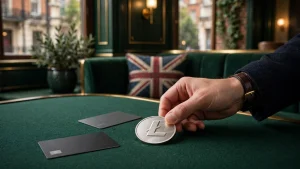
Open Banking connects a casino payment request to a chosen bank, where the customer authenticates and approves the instruction.

A casino cashier is more than a row of logos. It is the point where a deposit leaves the language of games and becomes a payment instruction. With Open Banking, that instruction can be routed through a connection to a bank account rather than entered as a conventional card payment. The distinction is easy to miss on a screen: both options may begin with a button and end with a balance changing. The route between those moments is different.
In practical terms, an Open Banking payment starts when the customer selects the option in the cashier and chooses a bank through the payment service presented there. The customer is then directed to authenticate with that bank and approve the payment. Once approved, the payment provider passes the instruction through the banking system and reports its progress to the casino. The cashier is therefore not simply collecting account details; it is arranging a connection between the payment request and the bank’s own approval process.
That arrangement belongs to a wider change in British banking. For much of modern retail life, banks acted as guarded ledgers: a payment moved only through familiar instruments such as a card, a standing instruction or a transfer arranged in online banking. Open Banking made room for regulated services to work with banking information and payment functions through secure interfaces, subject to the customer’s permission. It did not abolish the bank’s role. It gave the bank a more active part in a transaction initiated elsewhere.
When choosing a casino for direct banking, payment options and withdrawal timing are worth checking before you play. This list provides the payout-speed information available for each operator.
Zombillion
Zombillion lists a payout speed of 1–3 business days.
Amunbet
Amunbet lists a payout speed of 1–3 business days.
Britsino
Britsino lists a payout speed of 1–3 business days.
Chanze
Chanze lists a payout speed of 1–3 business days.
SpinFormula
SpinFormula lists a payout speed of 1–3 business days.
Dieselwin
Dieselwin lists a payout speed of 1–3 business days.
NightLuck
NightLuck lists a payout speed of 1–3 business days.
Jetsetspins
Jetsetspins lists a payout speed of 1–3 business days.
x3bet
x3bet lists a payout speed of 1–3 business days.
WinBeast
WinBeast lists a payout speed of 1–3 business days.
At an online casino, the appeal is plain enough. A card payment asks the cashier to accept a card transaction; an Open Banking payment asks the bank to approve a payment instruction. For people accustomed to managing money through their bank’s own app or online service, that can feel like a more direct passage from account to merchant. There is no need to treat the casino cashier as a separate financial destination in the same way as a card terminal. The bank remains present in the process, and its authentication step marks that presence.
The design can also make the transaction legible. The customer sees a bank selected, an approval requested and a payment returned to the cashier. That sequence is not a guarantee that every payment will succeed: the bank may decline it, the service may not be available for that account, or the cashier may not offer the route at that moment. Open Banking is a payment channel, not a command that overrides the decisions of banks or operators.
Its relevance to UK online casinos is therefore practical rather than mysterious. Remote gambling is a regulated commercial activity, and payment infrastructure has to bridge a digital account at the casino with money held in the banking system. A route that invokes the bank during the transaction can make that bridge visible. The machinery is less like handing over a piece of plastic and more like authorising a message to travel between institutions.
That difference also explains why the words “Open Banking” and “bank transfer” can appear close together without meaning precisely the same thing. Both involve a bank account, but a cashier-led Open Banking payment commonly begins inside the casino’s payment flow and sends the customer to approve the instruction. A bank transfer may instead be arranged through the bank’s own interface, with its own reference or destination details. The cashier’s labels are not always a complete guide to the technical route, so the payment screen matters more than the broad category printed beside it.
Specialist casino reviews have described Open Banking and bank-transfer services as capable of supporting instant deposits and fast withdrawals at many sites. That is a report about services found in a changing market, not a promise attached to every cashier. The particular provider, bank, operator and transaction can affect what happens. A deposit may be credited promptly in one setting and take longer in another; the word “instant” is a description of a possible service experience, not a law of banking.
There is a quiet social shift in this small piece of interface design. Gambling once depended on places where money changed hands in public: a counter, a cashier, a physical token passed across a table. Online, the cashier is a screen, and the bank becomes part of its architecture. Open Banking makes that arrangement more explicit by asking the bank to participate at the moment of payment rather than leaving the customer to infer how funds are moving behind a card symbol.
The route is useful to understand even when its buttons look interchangeable with every other payment choice. The casino displays an option; the bank authenticates and authorises; the payment service carries the instruction back into the cashier’s process. Each institution retains its own role. That is the central idea—not a new kind of money, but a new way of connecting the casino’s request to the bank’s decision.
A useful connection, not a shortcut.
“Direct banking” can sound like a particular button in a casino cashier. In practice, the useful idea is less about the label than about the relationship behind a payment: the account belongs to the customer, and the payment route is associated with that same person. The distinction matters because a cashier can display several ways to move money, while the details attached to each method may not point to the same account holder.
For a UK online casino, a clear link between customer and payment account can reduce avoidable friction caused by basic ownership details. If the casino account is in one person’s name but a deposit comes from an account associated with somebody else, the mismatch is not merely a clerical curiosity. It can make it harder to establish who supplied the funds and whether the transaction belongs to the customer. A route tied to the same person avoids that particular ambiguity.
This is the practical sense in which an Open Banking casino arrangement can feel “direct”: the payment begins from a bank account connected to the customer rather than from an unrelated person’s funds. The term does not, by itself, tell much about the cashier’s wider payment menu. Nor does it mean every method labelled as banking has the same ownership relationship. The decisive question is whose account is involved.
The clearest arrangement is often a named account used consistently for both deposits and withdrawals. That does not mean every casino will handle every payment in exactly the same way; it means the customer identity and the payment identity are not pulling in different directions. A familiar name on both sides gives the transaction a simpler shape.
That consistency is particularly relevant where a payment provider sits between a bank and the casino. A method may move funds through an account or service that has its own registration details. The label on the cashier alone cannot establish whether the account behind it belongs to the casino customer. The relevant connection is the one between the individual and the account used for the transaction, not the general impression created by a method’s name.
There is a small but important difference between “my bank is connected” and “the payment account is mine.” A bank connection describes a technical arrangement; ownership describes who is entitled to use the account. In ordinary life these often coincide, which is why the distinction can disappear from view. When they do not coincide, a shared or third-party account can introduce questions that a straightforward personal account would not.
The aim is not to make a payment method sound more trustworthy because it carries the word “banking”. It is to understand the transaction as a chain of identities. The casino account has a customer name; the bank or payment account has an account holder; the route passes value between them. When those details correspond, the basic ownership picture is easier to follow. When they do not, the transaction may need more explanation.
Casino payment arrangements sit inside a wider system of checks. Remote gambling operators must establish who their customers are, and anti-money-laundering controls help explain why funds are not treated as anonymous simply because they arrive electronically. A direct link does not replace those checks, and it is not a guarantee that a transaction will proceed without review. It simply removes one avoidable source of uncertainty: whether the money came from an account associated with the customer.
The idea resembles a form of housekeeping. Names and account details that line up leave fewer loose ends; a payment from an account belonging to another person creates one. Even when the reason is innocent, the casino may have to distinguish an authorised customer transaction from a deposit made by someone else. The paperwork has no sense of family convenience.
This is why direct banking should be understood as a relationship, not a promise about speed, cost or acceptance. Those are separate questions. A method may be available in a cashier yet be unsuitable for a particular customer’s account arrangement; conversely, a personal bank account may provide a clear ownership link without telling anything by itself about the casino’s processing conditions. The label is only a starting point.
For people comparing online casinos with Open Banking, the useful distinction is therefore between the payment route and the account behind it. The route describes how the instruction reaches the casino. The account relationship describes whose funds are being moved. Keeping those ideas separate makes “direct” less mysterious and more practical: the cleanest route is often the one attached to a single named account, used consistently for deposits and withdrawals. That is clarity, not magic.
The attraction of an instant deposit is not difficult to understand. A payment that reaches a casino account promptly removes the pause between deciding to play and seeing a balance appear. Specialist casino reviews report that Open Banking and bank transfers can deliver instant deposits at many sites, though that is a description of reported availability, not a promise attached to every cashier or transaction. The payment route may be swift; the offer attached to it is a separate matter.
That separation is easy to miss because cashiers and promotions sit beside one another on the same screen. A deposit button records how money enters an account. A bonus has its own conditions, which can determine whether that deposit qualifies at all. A casino may accept a bank-linked payment while its promotion terms exclude that method, restrict eligibility to particular options, or require an offer to be claimed in a particular way. Acceptance is not the same as eligibility.
This distinction matters for Open Banking promotions as much as for other payment routes. Searching for an Open Banking casino no-deposit bonus or free spins can suggest that the payment method and the offer form a package. They need not. A no-deposit offer, by its nature, is not activated by making a deposit through Open Banking; whether one is available depends on the casino’s promotion and its terms. Free spins may also be governed by conditions that have little to do with the speed of a bank-linked payment.
PayPal illustrates the same mismatch. It is valued for speed and convenience, but a specialist casino review notes that it may not qualify for bonus promotions. “May” matters: terms belong to the individual offer, not to the payment brand in the abstract. A promotion can change, and eligibility should be read in the offer’s own wording rather than inferred from the fact that the cashier displays PayPal.
A specialist review also reports that Skrill and Neteller can be excluded from promotions. The point is not that either wallet is invariably barred, but that the method can affect eligibility at some casinos. Promotional rules are not a decorative footnote. They can change the practical value of choosing a payment route that otherwise appears straightforward.
The arithmetic of a bonus often receives more attention than its entry conditions. Yet the first question is simpler: does this deposit method qualify? Terms may identify eligible payment methods, describe how an offer must be activated and set out other conditions for receiving it. If a payment choice is excluded, a fast deposit does not rescue the promotion. It merely makes the non-qualifying deposit arrive sooner.
Nor does a promotion’s presence establish that every customer can claim it. The offer’s own conditions govern, and a cashier’s list of payment options answers a different question from the bonus page. Keeping those two records separate prevents a familiar confusion: treating the visible convenience of a payment method as evidence that it fits the promotional rules.
The quiet lesson is that speed and value are different measures. A quick Open Banking deposit may suit someone who wants funds credited promptly. A player considering a welcome offer, free spins or another promotion has an additional matter to resolve: whether the specific payment route is permitted by that offer. A specialist review can flag potential exclusions, but the casino’s current terms are the operative wording.
Fast money, separate terms.
“Best” is a slippery word at a casino cashier. A direct-banking route that suits one transaction may be a poor fit for another, depending on the account currency, the charges applied along the way and the amount being moved. The useful comparison is not a league table of casinos but a reckoning of the whole payment: what leaves the bank account, what reaches the casino balance and what each intermediary keeps.
The cost can be less visible than a labelled fee. A specialist payment-method review identifies several possible charges: those set by the casino, the payment provider, the bank or card issuer, and, where relevant, the payment network. Currency conversion adds another layer. Its exchange-rate spread is the difference between the rate applied to the transaction and a reference rate; as a specialist payment-method review notes, that margin can outweigh a flat charge printed plainly on a fee schedule. The neatest-looking price is not necessarily the cheapest one.
Currency matters before any button is pressed. If a casino account is held in a currency different from the bank account, conversion may occur somewhere in the route, and the displayed amount may not capture the full cost. A comparison therefore needs the same transaction amount and currency assumptions on both sides. Otherwise, one route appears cheaper partly because it has been measured on different terms. Accounting likes a fair contest.
There is no universal lowest-fee method, according to a specialist payment-method review. The total depends on the casino’s charge, the provider’s fee, any bank or issuer charge, the exchange-rate spread and network costs. Some of these may be absent; others may be difficult to see until the payment is processed. The sensible measure is the combined cost for the transaction in question, rather than a general claim that direct banking is free or cheaper than every alternative.
A direct-banking option can still suit the job even when it is not the lowest-cost route. A person may value a straightforward link to a bank account; another may place more weight on avoiding conversion or a separate provider charge. Those preferences are not competing definitions of “best” so much as different priorities. The payment route should be assessed on its actual terms, not on the reassuring sound of its label.
Promotional language can further blur the comparison. A payment route’s value is not determined by its name alone: a bonus, if one is offered, has separate conditions that can change whether a deposit method is useful. The relevant cost calculation remains the payment itself, while promotional eligibility belongs to the offer’s terms. Combining the two into one headline verdict makes the arithmetic harder to see.
For a casino that accepts direct-banking deposits, the practical test is therefore specific: identify each possible charge, check whether conversion is involved, and compare the total on a like-for-like basis. No method wins by reputation alone. Sometimes the difference is in the small print.
A payment logo on a homepage is not the same thing as an available option at the point of deposit. Methods can change, and a cashier may show a different selection from a general payments page. For anyone checking casinos that accept Open Banking in the UK, the live cashier is therefore more useful than a broad claim on a landing page.
The distinction is practical. A casino may describe bank-based payments without making clear which route it currently supports, or whether that route is available for a particular account. The cashier indicates what can be selected at that moment. If the option is absent, a mention elsewhere is not confirmation that it can be used.
There is a little theatre in the word “accepted”: it can sound like a permanent feature of the venue. In reality, payment menus are operational details, not promises carved into the marble entrance. A site can revise its available methods, and the wording on an information page may not keep pace.
A careful check starts with the casino’s own payment information, then moves to the cashier before any transaction. The method should be identified clearly rather than inferred from a generic reference to bank payments. If the displayed label is unclear, the operator’s support channel can clarify what that particular option means and whether it is available for the account in question. That is more reliable than treating “direct banking” and “Open Banking” as interchangeable labels in every context.
Currency deserves its own glance. A specialist review reports that GBP is supported, but the account currency should still be confirmed before the first transaction. If the account is set to another currency, conversion may enter the process. The cashier or account settings are the places to establish what currency will actually be used; a general statement about GBP does not settle the settings of an individual account.
The legal status of the casino matters too. In Great Britain, remote gambling licensees serving customers must hold the relevant UK Gambling Commission licence. A payment method cannot make an unlicensed casino a lawful one. The licence number can be checked against the Commission’s public register before depositing; payment availability and regulatory status are separate questions, and neither answers the other.
This is why a useful check is less about finding a universal list of casinos with direct banking and more about confirming the exact option at the relevant cashier. An online casino that accepts direct banking should make the method identifiable at the point where the transaction is set up, rather than relying on a vague promise elsewhere on the site. Availability can be real and still be conditional. A small distinction, with consequences.
The amount accepted at a casino cashier is not a single figure attached to the account. A minimum deposit can depend on the payment method selected, while maximums may be set separately for an individual transaction, a day or a month. Those ceilings can also vary with account status. A direct-banking route therefore does not, by itself, tell a player how much can be deposited.
A specialist casino review gives a typical starting range of £10–£20 for minimum deposits, with the payment method affecting where the threshold falls. That is a guide reported by a review, not a universal tariff: the amount displayed in the cashier is the relevant one for a particular account and transaction. Even within one casino, the available methods may not share a minimum.
The upper boundary is less easily summarised. Payment providers can apply their own transaction conditions, and casinos may distinguish between a single deposit and cumulative limits over a day or month. Account status can matter too. The result is a set of conditions rather than one headline maximum for every UK direct-banking casino.
A specialist review describes those maximums as varying by payment method and account status. The practical point is not that one route necessarily permits more than another; it is that a figure found on a general information page may not settle what the cashier will allow. The displayed limit is the one that applies to the payment being made.
There is also a separate boundary around gambling funds themselves. Remote operators serving Great Britain must prompt new customers to set a financial limit before their first deposit and make account-level limit controls accessible. A cashier’s payment ceiling and a player’s chosen financial limit are different things: one governs what a transaction route or account will accept, while the other is a tool for controlling gambling spend. The distinction is easy to miss when both appear as numbers on the same screen.
The cost question needs similar care. A deposit limit is not a fee, and a larger permitted transaction does not establish that a route is cheaper. Conditions can differ between payment options, so the amount entered should not be treated as the whole cost of a transaction. The cashier’s terms are the place to identify charges that apply to that particular route. No universal price tag.
One firm UK boundary concerns credit cards. The regulator’s ban on credit-card gambling took effect on 14 April 2020 and remains in force. UK-licensed casinos cannot accept credit-card payments for gambling; routing credit-card funds through a money service business does not make the payment acceptable. A debit card is a different product, but the card’s status and eligibility still need to match the cashier’s stated conditions.
For a direct-banking casino in the UK, then, the useful figures are the method-specific minimum, the applicable transaction or account maximum, and any financial limit set on the gambling account. They answer different questions. None should be assumed from a general label such as “banking” or “instant” alone.
A payment method is not a complete route simply because it appears beside the deposit button. Its role matters: some options may fund an account without being available for withdrawals, while others may support both directions subject to the casino’s rules. The cashier’s labels are therefore more useful when read as a map of what each method can do, not as a row of interchangeable logos.
Debit cards remain a familiar option at UK casinos, with Visa and Mastercard commonly accepted. They can be suitable for deposits, but the card brand alone does not establish that a particular card product is eligible or that it can receive a withdrawal. Those details depend on the operator’s current cashier and the payment arrangement attached to the account. Credit-card payments for gambling are not permitted at UK-licensed casinos; a debit card is a different product, not a loophole with a familiar logo.
Commonly accepted for deposits and often withdrawals, provided they are not credit cards.
Primarily used for deposits in certain UKGC-licensed casinos; withdrawal compatibility varies.
A prepaid voucher system used strictly for deposits; it cannot be used for payouts.
Apple Pay has a narrower, clearly stated role: some UK Gambling Commission-licensed casinos accept it for deposits. Its presence can make it a convenient way to fund an account, but should not be read as confirmation that it is also a withdrawal route. Deposit access and payout compatibility are separate questions.
Paysafecard illustrates the distinction more sharply. It is a prepaid voucher for deposits only. That can make it useful for placing funds into an account, but it does not provide a matching way to receive a payout. A deposit-only method is a one-way door.
For an Open Banking casino payment method, the same practical distinction applies: the payment option’s name does not, by itself, settle whether it works for both deposits and withdrawals. An instant banking deposit and an instant withdrawal are not equivalent promises. Before choosing a method, the relevant point is whether the casino lists it for the intended transaction, and whether its terms attach any restrictions to that use.
This is why a cashier’s range should be judged by compatibility rather than sheer number of options. A method that funds an account but cannot receive a payout may still serve a purpose; it simply requires a different route for withdrawals. The useful comparison is between what each payment type can actually do, not what its branding suggests.
A deposit can appear in a casino balance almost at once, yet that says little about when money will leave again. The two movements pass through different gates. A payment service may confirm an incoming transaction quickly; a withdrawal still has to be requested, checked and approved by the casino before the payout route can do its work.
That distinction matters when judging claims about a fast withdrawal through Open Banking. A specialist review describes Open Banking services, PayPal and debit cards connected to fast-payout systems as among the quicker withdrawal options. That is a comparison of payment routes, not a promise about the time from pressing “withdraw” to seeing funds in a bank account. The casino’s own processing remains part of the interval.
For a first withdrawal, KYC can add another stage. A specialist review notes that processing may take longer while verification is completed, and that internal approval is included in the overall wait. The checks are not a quirk of banking technology: they sit between a player’s request and the casino’s release of funds. A direct banking casino withdrawal can therefore be quick at the payment-network end and still wait for the operator’s decision.
There is also a reason a payout may not simply follow whichever route looks fastest. UK anti-money-laundering rules generally require winnings to go back to the original payment source. This closed-loop approach connects the incoming funds and the return, limiting the scope for money to move through unrelated accounts. It can make the route less flexible, even when a different withdrawal option appears in the cashier.
The practical question is not merely whether a casino advertises instant banking withdrawals. It is whether the account has cleared verification, whether the casino has approved the request, and whether the payout is returning through an eligible original source. Each stage has its own clock; only one belongs to the bank.
A specialist review also identifies Open Banking among the faster withdrawal methods, but that broad comparison cannot settle an individual casino’s current processing time. The cashier’s stated terms and the account’s status matter more than the speed of the deposit button. Instant in, perhaps. Instant out is another claim entirely.
“Non-GamStop” describes a casino’s relationship to the UK’s self-exclusion scheme; it does not identify how its cashier connects to a bank. Direct or instant banking, meanwhile, describes a payment route. Combining the labels does not establish that a particular casino accepts that route, serves customers lawfully in Britain or has a particular regulatory status.
For customers in Great Britain, remote gambling licensees selling real-money play must hold a UK Gambling Commission licence. A payment button is no substitute for that distinction: an offshore casino outside the UKGC system is not made part of it by offering bank payments. Nor does the phrase “not on GamStop” by itself verify a casino’s licence or the safeguards attached to an account.
There are protections specific to UKGC-licensed services. Before a new customer makes a first deposit, the operator must ask them to set a financial limit; account-level controls must also be accessible. Licensed casinos must provide self-exclusion tools. These are practical controls, not a judgement about an individual’s circumstances. Self-exclusion is meant to create a barrier, and seeking a route around it can weaken the purpose of that barrier.
Claims about a “non-GamStop direct banking casino” therefore need to be separated: one claim concerns payment availability, another concerns licensing, and another concerns exclusion status. None proves the others. The cashier can show whether a bank option is currently offered, but it cannot settle the operator’s regulatory standing. That requires checking the UKGC public register before depositing. A label is not a licence.
A bank transfer does not end at the moment a casino cashier confirms the request. The money still has to travel through the banking system, where the timing can depend on when the transfer is sent. A specialist payment review notes that bank cut-off times and weekends can affect delivery. A request made late in the day may therefore follow a different timetable from one submitted during normal banking hours. The button is only the beginning.
Currency adds another moving part. If the casino account and bank transfer use different currencies, conversion can affect both the amount received and the time needed to complete the transaction. The exchange rate applied may not be the one visible when the transfer is initiated. For anyone comparing direct banking casinos, the account currency and the transfer details belong in the same calculation; a familiar bank route does not make conversion disappear.
There is also the question of where funds can go afterwards. UK anti-money laundering controls commonly require casino payouts to return to the payment source used for the deposit. This is part of a wider anti-fraud practice: money is expected to follow a traceable route rather than acquire a new destination without explanation. If the original account cannot receive the funds, an alternative may be possible, but additional verification can be required.
That makes the cleanest casino banking route less about a single instant confirmation than about continuity: a transfer that arrives, a currency that matches, and an account that can receive any return. Banking is patient by design.
Returning withdrawals to the original payment source is a common anti-fraud and anti-money-laundering control. Using an account in your own name consistently for deposits and withdrawals can also reduce ownership checks and other avoidable delays.
PayPal, Open Banking services and debit cards connected to fast-payout systems are generally among the quickest options. The casino’s approval process and whether your account is verified also affect how soon you receive the money.
No. Withdrawal speed depends on the casino’s approval process and your verification status; bank transfers can also be affected by cut-off times, weekends and currency conversion.
Verification may be needed, and first withdrawals can take longer while checks are completed. A fully verified account can help avoid delays.
Common options include Visa and Mastercard debit cards, PayPal, Open Banking, bank transfers, and e-wallets such as Skrill and Neteller. Some casinos also accept Apple Pay, Jeton or Paysafecard, which is for deposits only; check the cashier for current availability.
Yes, GBP is supported. Confirm that your account is set to pounds before making a payment to avoid currency conversion.
The minimum deposit usually starts at £10–£20, depending on the payment method.