The American label does not establish where an operator is based or whether it is authorised to serve customers in Great Britain.
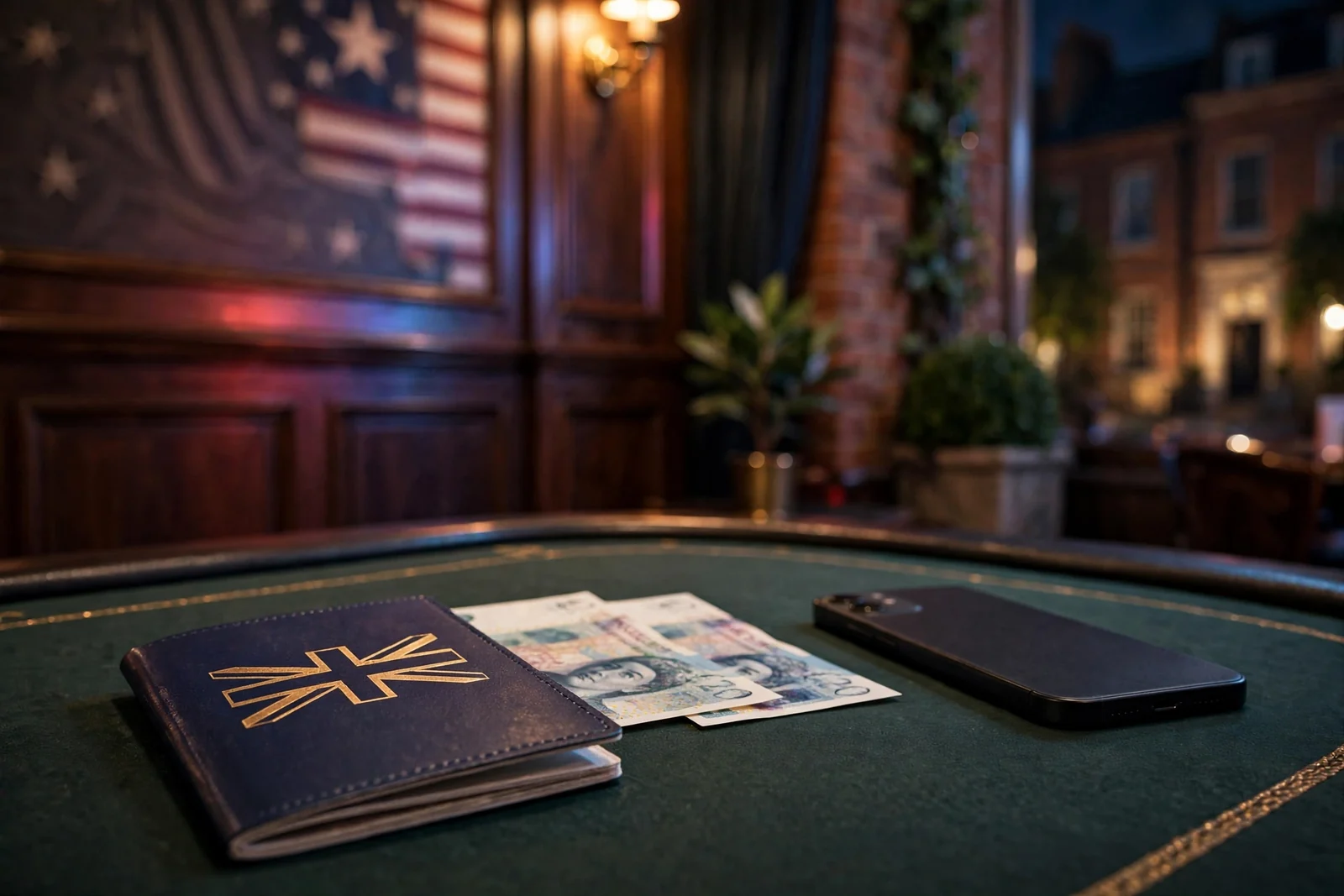
“USA casino” sounds like a statement about geography. In the British market, it is better treated as a label whose meaning needs unpacking. A site described as an American online casino for UK players is not necessarily based in the United States, licensed there, or authorised to serve customers in Great Britain. The phrase alone establishes none of those things.
In practical terms, a foreign casino is an online gambling operator that accepts British customers without a licence from the UK Gambling Commission. That definition turns on the relationship between the operator and the customer, not the flag in a logo, the wording of a welcome page or the country suggested by a brand name. An online USA casino for UK players may therefore be an overseas operator using an American identity as part of its presentation. The label does not prove where the business is incorporated or where its gambling licence comes from.
That distinction matters because the word “USA” carries an appealing sense of place. Casino imagery often borrows from a familiar Atlantic vocabulary: grand rooms, bright signs, a national style of entertainment. But a visual reference is not a corporate address, and a name is not a regulator. A site’s apparent American character cannot tell a British customer whether it holds the licence required to offer gambling services in Great Britain.
For UK players exploring US casino options in 2026, payout details are one practical point to check. This list highlights the payout speed stated for each operator.
Zombillion
Zombillion lists a payout speed of 1–3 business days.
Amunbet
Amunbet lists a payout speed of 1–3 business days.
Britsino
Britsino lists a payout speed of 1–3 business days.
Chanze
Chanze lists a payout speed of 1–3 business days.
SpinFormula
SpinFormula lists a payout speed of 1–3 business days.
Dieselwin
Dieselwin lists a payout speed of 1–3 business days.
NightLuck
NightLuck lists a payout speed of 1–3 business days.
Jetsetspins
Jetsetspins lists a payout speed of 1–3 business days.
x3bet
x3bet lists a payout speed of 1–3 business days.
WinBeast
WinBeast lists a payout speed of 1–3 business days.
The same caution applies to phrases such as “USA-friendly” or “US online casino”. In this context, “friendly” may simply mean that British customers can create accounts or encounter a site presented as available to them. It does not certify UK authorisation. Nor does the word “online” make the operator’s location any easier to establish: a website can be reached across borders while the legal responsibility for offering gambling remains attached to the business behind it.
There are two different legal questions here, and they are often blurred into one. The first concerns the operator: may a gambling site offer its services to customers in England, Scotland and Wales? Without a Gambling Commission licence, it is illegal for an online gambling site to offer those services in those parts of Great Britain. Remote operators selling into the British market are required to hold the relevant UKGC licence, regardless of where they are based. A foreign licence does not become a British one by accepting British customers.
The second question concerns the individual placing a bet. The fact that an operator may be acting unlawfully by offering services without the required licence does not mean that a British player commits an offence merely by betting with an overseas casino. There is no UK law prohibiting an individual from placing bets with an operator licensed outside the country. The player’s activity and the operator’s permission to supply gambling are separate matters.
That separation can feel counterintuitive. In ordinary commerce, people often assume that if a service is available to them, someone has already checked that it is permitted. Gambling regulation does not make that assumption safe. A site may accept British customers while lacking the licence needed to offer gambling in Great Britain. Its apparent availability should not be mistaken for UK approval.
The phrase “best USA online casino for UK players” also contains an ambiguity. “Best” may invite comparison, while “USA” suggests a national category; neither tells whether the operator is authorised in Britain. A list of American-sounding names could conceal different ownership, licensing and operating arrangements. More importantly, a US-facing identity does not establish that the site is a US casino in any meaningful legal sense. The name may tell a story; it does not settle the status.
This is why “USA casino” and “UK-licensed casino” are not interchangeable descriptions. A site can be aimed at British customers, or accessible to them, without being regulated by the UK Gambling Commission. Offshore casinos sit outside the UKGC system. That is a defining difference, not a footnote to the branding.
The British regulatory approach places the duty to obtain permission on the operator that offers gambling services into the market. The individual’s position is distinct: betting with an overseas operator is not, by itself, prohibited. The boundary is therefore not drawn simply between a British player and an American website. It runs between a customer’s act of placing a bet and a company’s act of supplying gambling without the required British licence.
A name can cross borders more easily than a licence.
The year in a casino search can suggest a fresh set of choices: new sites, changed terms, perhaps a different standard of oversight. But a date does not alter an operator’s regulatory status. A casino serving British customers from offshore remains outside the UK Gambling Commission’s system in 2026, just as it was before. The important distinction is not between old and new, but between the rules governing UKGC-licensed operators and the arrangements under which an offshore site operates.
For an operator serving customers in Great Britain, the UK framework turns on the service being offered, not on the location suggested by a brand or website. A UK Gambling Commission licence is required to offer remote gambling to the British market. Offshore casinos that accept British players without that licence are not regulated by the Commission. Their presence in a list of sites described as American, international or new does not place them under UK supervision.
That is the hinge in any assessment of USA casinos for UK players in 2026. The phrase may describe the market a site claims to serve, its branding, or the impression created by its presentation. It does not tell a customer which regulator oversees the operator. A new name can be new to a directory while its legal position remains the same: offshore, and not regulated by the UK Gambling Commission. Newness is a marketing fact, not a licence.
This distinction matters because regulation is not a decorative seal attached to a website. It is the system within which an operator is required to act when serving customers in Britain. A UKGC licence places a site within the British regulatory framework; an offshore licence does not become equivalent merely because the site accepts British customers. The two arrangements should not be collapsed into a single category called “licensed”. The question is licensed by whom, and under which jurisdiction.
The difference is especially visible in affordability checks. UKGC-licensed operators must apply the affordability requirements set by the British regulator. Offshore operators outside the Commission’s remit do not provide those UKGC-mandated checks. That absence is sometimes presented as freedom from friction, as if a shorter process were itself a form of better service. It is more accurately a difference in safeguards. A missing check does not establish that an operator has no internal procedures; it means that the particular requirements imposed by the UK regulator do not govern that site.
The phrase “safe USA casino” therefore carries more weight than it can bear on its own. Safety is not settled by a site’s name, a polished page, or the year attached to a review. Nor does an offshore licence place the operator under UKGC oversight. A customer assessing an offshore option is considering a different regulatory arrangement, not a British casino with a transatlantic accent. The label does not close that gap.
The same caution applies to claims that a site is legitimate. The word can refer to a business operating under some licence abroad, but that is not the same as being authorised by the UK Gambling Commission to serve the British market. In this context, the distinction is practical rather than semantic: offshore operators are not regulated by the UKGC, and they do not offer the Commission’s mandated affordability checks. Those are defining differences, not footnotes.
The year 2026 gives the question a useful frame, but not a new answer. A search for the best or newest American-branded casino for British players may gather together sites with very different presentations. It cannot, by itself, make those sites subject to British oversight. The regulator’s role follows the licence and the market rules, not the date on a page or the country evoked by a brand.
That is why comparisons of overseas casinos need to begin with regulatory status rather than with novelty. A site may be described as new, popular or suitable for British customers; those descriptions do not establish UKGC regulation. Conversely, recognising that an operator is offshore does not explain every feature of its service. It does establish the central limit: the UK Gambling Commission is not the regulator governing it.
For British players, then, “which rules apply?” has a narrower and more useful answer than a catalogue of 2026 options. UKGC rules govern operators licensed by the Commission to serve the British market. Offshore casinos remain outside that system, and the UKGC’s affordability-check requirements do not apply to them. The calendar can change. The jurisdiction does not change with it.
There is no single access rule shared by every site described as a US or American casino. Some non-UK-licensed operators are meant to keep British visitors out; others do not apply that restriction consistently. A site appearing reachable from Britain therefore says little about whether it is entitled to serve customers here. Access and permission are separate matters.
A report by gambling.com says that some offshore casinos are supposed to block visitors from Britain, while many do not enforce the block, and that a basic VPN can bypass it. That is a report about changing operator practices, not a dependable description of every site or a promise that a particular service will remain accessible. A block may be present, absent or applied differently over time. Nor does a technical route around it turn an operator into a licensed one.
That distinction matters because a familiar American name, English-language pages or a registration form that accepts a British address can create the impression that a site has made a considered decision to welcome UK customers. It may only show that a restriction has not stopped the visit. The business’s legal status is not conferred by a page loading successfully. The internet is excellent at making presence look like permission.
A VPN changes how a connection appears to the site. It does not change the operator’s licensing position or the rules on offering gambling to people in Britain. Describing this technical possibility is not a recommendation to use it: bypassing a block can conflict with the site’s own access terms, and it does not add the protections that come with a UK Gambling Commission licence. A visitor should not mistake an open door for an official invitation.
In England, Scotland and Wales, an operator providing gambling facilities to customers must hold a UK Gambling Commission licence. An operator without that licence cannot lawfully offer gambling services to UK customers, and advertising those services in the UK is also prohibited. The relevant question is thus not simply whether a British visitor can open an account, but whether the operator is authorised to supply the service in this market.
The law places the obligation on the operator. It is the supply of gambling facilities and the promotion of an unlicensed service that cross the boundary described here. A site’s willingness to accept a customer does not make that conduct lawful, and a marketing claim about being “available” in Britain cannot substitute for the required UK licence. The distinction between a site’s technical reach and its legal permission is the whole point.
This can make the phrase “accepting UK players” misleading. It may be used to describe a site that allows a British visitor to proceed, but that wording does not establish that the casino is authorised to serve the country. A site could be reachable without being licensed; it could also display a block intended to prevent British access. Neither condition, by itself, tells the whole legal story. The operator’s conduct and its licence status remain decisive.
The geography in the branding can muddy matters further. “USA casino” may suggest an American location or a connection to the United States, but an access page alone cannot establish where a business is based or which regulator, if any, authorises it. For the British market, the practical legal dividing line is whether the operator holds the relevant UK licence—not whether its name, theme or online presentation sounds American.
Access controls are a mechanism, not a regulator. When a site blocks a British visitor, that restriction does not itself make the operator UK-licensed. When a site does not block the visitor, that omission does not grant it permission to offer gambling in Britain. The same applies if the barrier can be circumvented: a change in apparent location is not a change in the law.
This is why lists of American-branded sites said to accept UK customers can be unstable and difficult to interpret. A listing may record that a site was reachable at a particular moment, not that it has legal authority to operate here or that its access policy will remain unchanged. Availability can be a poor proxy for legitimacy. It is a small but consequential confusion.
For readers trying to understand the boundary, the useful distinction is between an operator’s technical accessibility and its lawful ability to serve British customers. The first can vary with the site’s own controls and a visitor’s connection. The second depends on the required UK Gambling Commission licence. A website may invite attention from Britain, whether deliberately or through a lax restriction; that does not erase the rules governing its conduct.
A deposit is the easy half of a casino transaction: money leaves an account and appears as a balance on a screen. The more consequential test comes later, when a balance is supposed to move back. A payment method that accepts funds says little about whether an operator will honour a withdrawal request.
Offshore casinos serving British customers sit outside the UK Gambling Commission’s regulatory system. That distinction matters when a payment dispute becomes more than a technical inconvenience. A UKGC-licensed operator is answerable to the domestic regulator; an offshore operator is not subject to UKGC enforcement. These are not equivalent routes with different branding.
Depositing can involve a choice of payment method, including cryptocurrency. That choice affects how money is sent, but it does not create a guarantee about what happens to winnings. Crypto, in particular, carries a separate uncertainty: the value of the funds can change. A deposit may be recorded in one value and later be worth something different, even before any question of casino conduct arises.
The desire for fast payouts is understandable, and searches for trusted American-branded casinos or low-deposit options often place payment convenience at the centre. Yet a smooth deposit, an attractive welcome offer or a polished cashier page is evidence of a functioning interface, not proof of dependable withdrawals. Nor does a small initial payment make the operator’s obligations clearer. The amount at risk may be limited; the customer’s leverage is not necessarily improved.
There have been reported cases in which offshore gambling sites refused to release winnings, leaving customers without legal recourse. Gambling.com has reported such cases. This does not establish that every offshore operator behaves this way, but it makes the practical distinction plain: a displayed balance is not the same thing as money safely in a customer’s possession. When a site disputes a win or declines to pay, a British customer cannot rely on the UK Gambling Commission to resolve the complaint against an operator it does not regulate.
That is the cost often hidden beneath the language of choice. Offshore casinos may present payment options, bonuses and quick account funding as signs of convenience. But the central protection in a payment relationship is not the number of ways money can enter. It is whether there is an effective authority to turn to if it cannot leave. The interface is not the institution.
The UK system also attaches safeguards to licensed gambling that offshore operators do not provide. In particular, they do not offer UKGC-mandated affordability checks. That absence may look like fewer interruptions during play, but it also means the protections built into the British regulatory framework are absent. Less friction is not the same as greater security.
A search for the best USA casinos for UK players, or for sites promising fast payments, can therefore obscure the more basic question of accountability. Payment methods tell how a deposit is made; they cannot, by themselves, establish that a withdrawal will be paid or that a meaningful remedy exists if it is refused. In offshore gambling, that gap is part of the transaction.
The word “American” can make a casino brand sound like a piece of geography: a business rooted in the United States, carrying its rules and commercial identity across the Atlantic. In practice, the label on a site and the structure behind it are separate questions. The Santeda–SIS relationship offers a more useful way to look at the business: not as a catalogue of American casino sites for UK players, but as a network of licences, brands and revenue agreements.
Santeda held a Curaçao licence. That licence did not authorise the company to operate in either the United Kingdom or the United States. The distinction matters because a place-name in a brand does not enlarge the reach of a gambling licence. Nor does a licence in one jurisdiction become permission to serve customers in another merely because the brand presents itself as American. The corporate paperwork and the public-facing identity are not the same thing.
The more revealing detail lies in Santeda’s contract with SIS. Under that agreement, SIS received a percentage of revenues generated by losing bets placed through Santeda’s brands. The arrangement connects a business partner’s income to losses recorded across those brands. That does not, by itself, establish how either company behaved towards players or whether a particular decision was made to increase losses. It does identify a commercial relationship in which the source of revenue deserves attention.
This is the kind of detail that broad searches for the best American casinos for UK players tend to flatten. A brand may be the visible part of the operation; behind it sit the operator, its licence, commercial partners and agreements governing how money moves between businesses. Those connections are not necessarily apparent from a logo or a welcome page. They are part of the business model, not decoration.
The same distinction applies to USA casino reviews for UK players. A review concerned only with appearance, games or promotions may leave the corporate arrangement out of view. Yet a relationship tied to revenues from losing bets raises a different question from whether a site looks polished: who benefits from the activity, and how are those benefits structured? It is a question about incentives, not proof of misconduct.
That scrutiny also puts claims about USA no-verification casinos or no-wagering bonuses in perspective. Such phrases describe a marketing proposition, not the ownership chain or the scope of a company’s licence. They cannot answer whether a brand is operated by a business authorised to serve a particular market, or what commercial agreements sit behind it. The Santeda example shows why names alone are a poor guide to those matters.
A corporate link is not automatically evidence of wrongdoing. But neither is it irrelevant simply because it appears in a contract rather than on a casino’s front page. In a market where branding can suggest a national identity that the licensing position does not support, the less visible relationships may tell more about the enterprise than its most conspicuous name. A tidy logo; a less tidy structure.
A low opening deposit can make an account feel like a small commitment. It says little, however, about what happens after registration. Before any deposit is allowed, an operator must verify the customer’s age; identity documents may also be requested to establish the account details. That is part of the account process, not a sign that the site is regulated in Britain.
With a non-GamStop casino, the distinction matters. Offshore operators are not regulated by the UK Gambling Commission, and they do not provide the affordability checks required of UKGC-licensed operators. A modest first payment does not replace those checks or create an equivalent safeguard. It only limits the amount initially placed in the account.
Verification can also shape the experience later. A site may ask for identification to confirm who owns the account and to comply with its procedures. The operator’s stated requirements are therefore worth reading before registration: what documents it requests, how it handles them, and whether its terms explain the process clearly. A low deposit is not a shortcut around identification.
Security claims need similar care. Specialist reviews of non-GamStop casinos describe some platforms as using encryption to protect personal and financial data. Encryption can protect information in transit or storage; it does not establish that an operator is licensed in the UK, guarantee fair account handling, or provide UKGC oversight. Different protections, different jobs.
The practical choice is not simply between a smaller or larger opening payment. It is between entering an account process whose safeguards are set by an offshore operator and one governed by UK rules. The latter includes affordability controls; the former does not include UKGC-mandated checks. That gap remains even when registration is brief and the first deposit is low.
A low-deposit offer may reduce the immediate amount at risk, but it cannot settle questions about identity checks, data handling or the operator’s accountability. Those belong to the wider terms of the account. Cheap entry is still entry.
A bonus is a set of conditions attached to money or spins, not money already available to withdraw. Specialist casino reviews describe deposit matches, free-spins packages, no-deposit bonuses and cashback as common formats among foreign casinos serving British players. The formats differ, but the arithmetic deserves more attention than the headline.
Bonus Calculation
Calculate the Requirement
Multiply the bonus amount by the wagering requirement (e.g., £20 bonus × 35x requirement = £700).
Determine Total Bets
Ensure the total amount of qualifying bets reaches the calculated sum (£700) before the bonus funds can be withdrawn.
A deposit match adds bonus funds in relation to a qualifying deposit. Free spins provide turns on selected games; a no-deposit offer does not require an initial deposit, while cashback returns part of specified losses under the offer’s terms. These labels describe how an offer is presented, not what can ultimately be cashed out. The conditions determine that.
Wagering requirements are the central calculation. A specialist review gives the illustration of a £20 bonus with a 35x requirement: £700 in qualifying bets must be placed before the bonus can be withdrawn. The multiplier applies to the bonus amount, not to a promise of winnings. A larger headline can therefore bring a larger obligation with it.
The same review uses a 100% match bonus of £100 with a 35x wagering requirement. That means £3,500 in bets before the bonus funds become withdrawable. It is a useful illustration, not a standard attached to every offer. Each set of terms has to be read on its own.
Free spins can make the promotional value look especially tangible: a stated number of turns is easier to picture than a wagering formula. But the spins are still part of a promotion, and the important question is what conditions apply to any resulting funds. Without those terms, the advertised quantity says little about cash that may leave the account.
Specialist reviews also describe foreign casinos as offering larger welcome packages, linking this to their freedom from UK Gambling Commission restrictions on bonus terms, wagering requirements and promotional language. That is a reported comparison, not a reason to treat the offer as better value. Offshore casinos are not regulated by the UK Gambling Commission and do not provide its mandated affordability checks.
The calculation is plain; the offer is not. A bonus can enlarge the amount that must be wagered before cash-out, while leaving the player to assess terms outside the UKGC system.
“Instant” and “same-day” describe ambitions, not a single stage of a payout. A casino may approve a request quickly while the payment provider or bank still has to complete the transfer. The route matters, as does the operator’s own processing queue.
Skrill and Neteller are the quicker fiat options in many published comparisons: most foreign casinos are reported to clear these withdrawals within 24 hours, with many doing so in under 12 hours. Those timings concern operator processing, not a promise that every transaction will appear in an account at once. A same-day payment is possible, but the label cannot settle how a particular operator handles a request.
Bank transfers take longer. A specialist review reports that they often require five to seven business days, with some casinos adding an internal delay before the banking process begins. Weekends and the point at which a request is approved can therefore matter to the calendar, even when the stated method is unchanged.
Crypto is described as faster still: one specialist review reports that withdrawals often clear in under an hour. That speed comes with a different uncertainty. The value of the cryptocurrency can move between withdrawal and conversion, so a quick transfer does not necessarily preserve the amount’s value.
Reported to clear within 24 hours, often in under 12 hours.
Often require five to seven business days, sometimes with internal delays.
Reported to clear in under an hour, though value may fluctuate during transfer.
There is no common timetable across offshore casinos. Withdrawal limits, pending periods and verification procedures vary by operator; a request may wait for checks before it is sent. UKGC-licensed operators must verify identity before processing withdrawals, but offshore casinos are outside the Commission’s regulatory system and do not provide UKGC-mandated affordability checks. A displayed estimate should therefore be read as an operator’s process, not as a UK regulatory standard.
The route sets the pace; the operator sets the queue. “Instant” is not a guarantee.
A review of a USA casino aimed at British players can describe how an operator handles withdrawals, but it cannot turn that account into a guarantee. The details that matter are often less conspicuous than a welcome offer: withdrawal limits, the time a request can remain pending, and the documents required for verification. A specialist review has reported that these conditions differ considerably between operators, so a general claim about “fast payouts” says little without the terms behind it.
Reviews are evidence of what was observed or reported, not a substitute for the operator’s rules. A pending period may postpone a request before payment processing begins; verification requirements can also affect when a withdrawal is released. Those details should be read together, rather than treating a headline speed as the whole story. Small print has a long career.
There is a more important limit. A review can record a complaint or a favourable experience, but it cannot provide the legal protection of a regulator. Offshore casinos are not regulated by the UK Gambling Commission. Gambling.com has reported cases in which an unlicensed site refused to pay winnings, leaving the customer without legal recourse. That is a reported risk, not proof that every operator behaves this way; equally, positive reviews cannot remove it.
The distinction is between information and remedy. Reviews may help establish what an operator says about its process and what customers report experiencing. They cannot compel payment or supply a route of redress where one is absent. A polished rating is still only a rating.
The legal position has two sides, and they do not cancel each other out. A British resident is not committing an offence merely by placing a bet with a casino licensed overseas. The Gambling Act does not impose a criminal penalty on the player for doing so.
That is different from the operator’s position. A remote gambling business serving customers in Great Britain must hold a UK Gambling Commission licence. An overseas licence does not replace it. Without the required UK licence, an operator cannot lawfully offer gambling services to British customers, even though the customer does not face criminal liability simply for playing. The distinction is easy to flatten in casual discussion; in law, it matters.
For anyone considering a USA-branded casino that accepts real-money play from the UK, the label says little about the player’s legal position. What matters is that the operator is based outside the UKGC system and lacks the licence required to serve the British market. That leaves the customer outside the protections attached to UK-licensed gambling, while not making the act of placing a bet itself a crime.
Tax is a separate question. Gambling winnings are not subject to UK income tax, whether they come from a UKGC-licensed casino or an overseas operator. The tax treatment does not turn an unlicensed service into a lawful one, nor does it confer protection if a dispute arises.
So the player’s position is unusually divided: no criminal penalty for betting abroad, no income tax on winnings, but no UKGC oversight of the operator. A clean tax bill is not a regulatory safeguard.
Yes. UK law does not prohibit an individual from betting with an overseas casino, but an operator without a UK Gambling Commission licence must not offer gambling to customers in Great Britain.
No. Gambling winnings are not subject to UK income tax, whether they come from a UKGC-licensed operator or a foreign casino.
Check which regulator licenses the operator and whether it holds a UK Gambling Commission licence to serve Great Britain. A foreign licence is not UK authorisation, and some unlicensed sites have refused to pay winnings.
It is the amount you must bet on qualifying games before bonus funds can be withdrawn. For example, a 35x requirement on a £20 bonus means £700 in qualifying bets.
No. Gambling winnings are not subject to UK income tax, regardless of whether the casino is UKGC-licensed.
Foreign casinos often advertise larger welcome packages because they are not bound by UKGC restrictions on bonus terms and promotions. A larger offer can still come with substantial wagering requirements: a £100 bonus at 35x requires £3,500 in qualifying bets.
Not necessarily. Foreign casinos are outside UKGC oversight, and some unlicensed sites have refused to pay winnings; a foreign licence does not provide UK authorisation.